White House Chronicle

News Analysis With a Sense of Humor

  • Home
  • King’s Commentaries
  • Random Features
  • Photos
  • Public Speaker
  • WHC Episodes
  • About WHC
  • Carrying Stations
  • ME/CFS Alert
  • Contact Us

The Electricity Future for New England: Uncertainty and High Prices

April 30, 2026 by Llewellyn King Leave a Comment

These days, in terms of resources, New England is poorly positioned to make electricity. As Gregg Cornett, president of Rhode Island Energy, told me in an interview, it doesn’t sit on abundant coal reserves and natural gas — the critical fuel in today’s electricity generating mix — or hide beneath the surface, waiting for the gasman’s drill.

Going forward the prognosis is that New England will make it through without electricity disruption unless there is severe cold, in which case the system will be stretched and blackouts could result.

The North American Electric Reliability Corporation, the industry-supported, not-for-profit authority that studies electricity supply and predicts problems, says New England is at “moderate risk” this summer, but sees changes and stress in consumption patterns as the region shifts from summer peaking to winter peaking. This will put further pressure on the delivery of gas into the region.

Winters are going to be tough for the New England electric grid and the collective transmission organization that distributes power from and between the region’s utilities, the New England Independent System Operator (ISO-NE).

Rhode Island Energy’s Cornett points out that the area has continued to grow, but the infrastructure to support that growth — especially of pipelines bringing in natural gas — has languished.

In part, environmentalists have been responsible because of their desire to restrict all fossil fuels. Times of crisis, though, lead to the burning of oil — a much greater environmental challenge.

Also, because of the lack of pipeline capacity, New England imports liquified natural gas (LNG) from as far away as Norway, adding to the cost of electricity throughout the region. It also imports electricity from Canada.

This means that New England has some of the highest electricity rates in the country. Inaction has consequences.

The bright spots for the future are renewables, wind and solar.

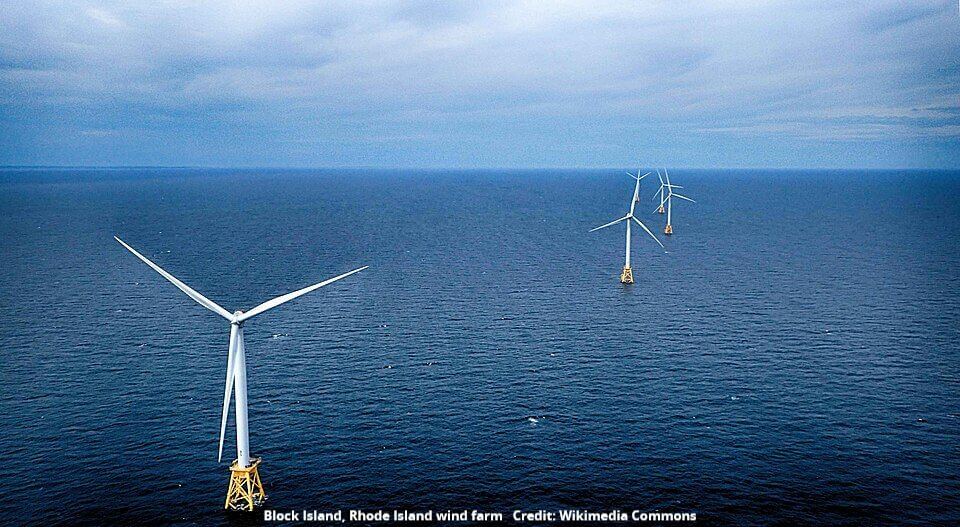
At present they contribute only 12 to 15 percent of the total New England mix, but they represent the one resource that the region has aplenty, especially offshore wind. Currently, this is hamstrung by opposition from President Donald Trump, but the future is hopeful in years to come.

Cornett says Rhode Island Energy is enthusiastic about solar and expects this to grow, although power from rooftop installations now represents a decided challenge for the utility. It is by law obliged to pay top dollar for this electricity, and that is more than the power is worth in the market.

The law guaranteeing the high rate was passed by the Rhode Island General Assembly in 2014 to encourage solar installations, not to hobble Rhode Island Energy with high costs. Cornett says the utility, which is the dominant one in the state, gets no gain from the solar power which it has to buy under this arrangement.

There is irony in the energy shortage in New England because twice in its history, it has led the nation in energy production.

According to the 1840 U.S. census, there were 5,000 water-powered log mills in the region and many other mills, making cloth and grinding corn. New England had dominance in milling of all kinds, thanks to its abundance of rivers on which mills were granted “privileges.”

Rhode Island — with five rivers that had sufficient flow for mills — was a beneficiary of the boom. Most of the mills that survived were converted to steam and those that survived after that, mostly textile mills, turned to electricity.

In the 1990s, there were six operational nuclear power plants with eight reactors. Today there are just two: Millstone in Waterford, Connecticut, with two reactors, and Seabrook in Seabrook, New Hampshire, with one reactor.

All six New England governors have signed a commitment to investigate the deployment of small modular reactors (SMRs), but at present there are no commitments to build. This may reflect a national uncertainty about which of the many competing SMR designs with their various technologies will eventually be market-dominant and lead the way to a nuclear renaissance.

Meantime, power executives across the region are grateful they aren’t feeling pressure from data center developers and are hoping for mild winters ahead.

Electric utility executives used to list cybersecurity as their No. 1 worry. Now they say it is the weather.

You can engineer defenses against cyberattack, but when it comes to the weather, the answer is to hope for the best and respond quickly if there is an outage. The supply future is cloudy.

Filed Under: King's Commentaries Tagged With: Cornett, electricity, energy, New England

A Revolutionary Calls Out the Utility Industry

April 28, 2026 by Llewellyn King Leave a Comment

The demand for electricity continues to rise, and there is a wide recognition that there is going to be pressure on the grid as never before, and that it is time to think about the grid in new ways. 

We need to think about how it operates, how it might operate, and the technologies — including artificial intelligence as a tool in its management as well as a demand stimulator — that could assist in developing a more-reliable, better-balanced grid going forward.

The grid, after all, is the infrastructural backbone of how our society operates; how we live and how we will live. Almost everything, from transportation to manufacturing, from the humblest kitchen appliance to the heating and cooling of homes, will be powered through electricity. Its ubiquity is real today and will be more so tomorrow.

So if we are to have an electricity hegemony, we had better lay down some coordinating philosophy.

Over the last half century, two visionaries have shaped the dimensions of the electricity supply system in America. Initially neither of them was received with enthusiasm, but their impact has been profound.

The first was S. David Freeman, who headed the energy policy staff in the White House Office of Science and Technology during the Johnson and Nixon administrations, and who, in 1974, received funding from the Ford Foundation to examine the energy crisis and suggest future options. His study, “A Time To Choose,” was seminal and started new thinking about growth and conservation.

Freeman would become president of the Tennessee Valley Authority and in turn several other big public utilities, including the Lower Colorado River Authority and the Sacramento Municipal Utility District (SMUD).

The second, and the most influential thinker, was Amory Lovins. In a single article, published in Foreign Affairs in 1976, Lovins introduced the concepts of “soft power” that would lead to today’s renewable energy revolution. His study was called, after Robert Frost’s poem, “The Road Not Taken.”

Both men were criticized for their conclusions: Freeman for introducing the idea of conservation as being a part of the energy mix, and Lovins for wholesale support of conservation, wind and solar, opposition to big central stations, and a small-is-beautiful philosophy. He opposed big, new nuclear power plants.

Lovins, who is chairman emeritus of the Rocky Mountain Institute in Snowmass, Colorado, which he founded, wasn’t criticized so much as vilified. Seldom has a public intellectual been so attacked – or been so effective, leaving an indelible mark that can be seen on rooftops and in the ubiquity of wind turbines.

I knew both men well and frequently debated Lovins on nuclear and other issues before various audiences. While I agreed with his overall idea that there were other ways forward in energy, many of his visions either weren’t viable or he had reached too far in his arguments.

Over the years, I wrote a lot about Lovins and provided platforms for his ideas.

Now the battle for the electric industry’s future is joined by another revolutionary thinker about the future of electricity supply.

He is Chase Weir, whom I think of as a dreamer who is tethered to the ground by experience, an idealist who knows the reality of keeping the lights on, and a doer who will change other people’s thinking by example as much as by proselytizing.

Weir created the Earthshot Foundation in 2008, co-founded Distributed Sun in 2009, and truCurrent, its spin-off, in 2024. He has laid out his ideas in a series of three Forbes articles (he is a member of the Forbes Business Council), published over the last three months. They approach the electric utility challenge differently, philosophically.

He paints a picture of an industry that is misdirected in its responses to market stimuli. He sees a market that is seeking to build generation against its highest demand – a cold day in winter at 6 p.m. — when electricity use is at its peak. 

If this were a financial market, Weir argues, this demand stress would signal market illiquidity and there would be measures to rectify it.

Weir sees a future where the kilowatt-hour becomes, in effect, currency and which has to be managed as such, aiming for flexibility and liquidity. 

Nothing or truly little, he believes, is as important to modern life as dependable, abundant, and environmentally wise electricity.

He has four cardinal rules for achieving this:

  1. Get the intent right. Intent is the driver and needs to be a force in utility planning.
  2. Non-zero thinking. This is the concept, expounded by the author Robert Wright, that one value doesn’t necessarily degrade a competing value. That is distinct from net-zero, which applies quite differently to carbon reduction, but can be confused.
  3. Time is the vital element and must be understood in the mix. All actions, including regulation, market design and flow must be cognizant of time. Weir talks about “return on time” as being similar to return on investment.
  4. The objectives of a liquid KWh market can be achieved with the new tools of energy storage, renewables and traditional generation working in concert through microgrids and similar arrangements managed by AI.

Above all, Weir emphasizes, is item No. 1: intent. Get that right and the rest can fall into place.

Traditionally, Weir believes, profit for utilities has been tied to return on investment not on performance. To achieve a functioning liquid KWh market, a modern grid must be designed to dynamically employ the available resources of technology, capital, capability and time.

He told me, “If we don’t design with intent and seek liquidity, we will lock in decades of systemic failure.”

It seems to me that the price, quantity and reliability of electricity are all open issues and Weir is onto something. More of everything is needed, including a clear understanding of where we are going and how we are going to get there. 

Weir is driving the thinking with his question: “What does a truer, better, smarter, future-proof grid look like?Thinking is good, essential actually, as we careen down the electric highway.

Filed Under: King's Commentaries Tagged With: electricity, intelligence, Lovins, Nixon, stimulator, technologies, utility

Tech Giants Will Boost Nuclear but Won’t Help With Your Bill

March 27, 2026 by Llewellyn King Leave a Comment

There is an abiding faith that if someone is good at one thing, they must be good at many things. At heart, it is a belief that outside the metaphorical box, there is much greater ability than inside it.

This is once again on display with widespread enthusiasm for the idea that the looming shortage of electricity can be solved by companies like Amazon, Google, Microsoft and Meta because they have been so wildly successful at what they do — and have mountains of cash to demonstrate it. Also, it is thought they will somehow do it better than the entrenched utilities.

The argument is that those who use vast new quantities of electricity for data centers will pay for its generation, and somehow the rest of the electricity supply system will be unaffected. It won’t.

The new dedicated generators will still buy steel, connectors (wires), transformers, switches, and the myriad bits that go to generating and transmitting electricity. They will still buy uranium, natural gas, strain the gas pipelines and the transmission system.

They will still buy available solar cells, wind turbines and dominate the competition to site these. They will be exerting four-square price pressure for all supplies, including utility-scale batteries.

The data center-dedicated generator will still compete in the labor marketplace for precious skilled workers, now in perilous short supply as the utility industry, without counting data center generators, spends well over $2 billion yearly on upgrading its systems.

I am not saying it isn’t a good thing to shake up the utility industry. I am saying not to expect magical new electricity developments that won’t affect everyone. The bills will still come, and they will be hefty.

Also, big tech will learn some sharp and costly lessons.

The thing about the internet and the world of computing is that they have been a zero-sum game. There are no rules, there is no legacy drag, and every invention, every step forward, enters the marketplace unencumbered.

There was nothing and no one to hold things back. There still isn’t, except for the availability of power for the data centers.

Not so in the electricity ecosphere. There are rules — local, state and federal. There is political oversight, and issues such as land use, water supply and air pollution must be factored in.

The new generation has to accommodate the rules of yesterday. It will be examined, debated, disputed and delayed.

For big tech and artificial intelligence, its latest frontier, everything is possible. But in their new role of making kilowatt hours, there are entrenched stakeholders and they are vociferous and opinionated, and NIMBY (Not In My Back Yard) is an ever-present reality.

Building a power plant isn’t like designing an algorithm. It isn’t done in secret and then released to the world, as ChatGPT did in November 2022. It must be collaborative and transparent at every step.

The tech giants are betting on nuclear power for their future power needs. Two of them, Microsoft and Google, are supporting restarting mothballed reactors, Three Mile Island in Pennsylvania and Duane Arnold in Iowa. All of them are interested in small modular reactors and have working arrangements with SMR developers.

In this way, the future of nuclear power may rest with the tech giants: They have the money to take the risk. Microsoft has even signed an agreement with Helion, a company planning to bring fusion power to market.

These developments favor a bright future for all electricity as the tech giants assume the challenges and risks of new nuclear technologies. But they won’t contain electric bills in the years ahead. These will continue to rise.

The utilities are doing what they can to contain these bills. The future demands significant expenditures, and, in some way, these will be reflected in consumer electricity costs.

The fact that the tech giants with money aplenty are going to shoulder greater risks doesn’t mean that their presence as ever more demanding electricity consumers won’t affect the commodity’s cost.

The war with Iran will affect global electricity demand. Countries will seek to substitute electricity for oil and gas where they can, thereby straining already-tight supply chains for generation and transmission components.

The essentiality of electricity is growing, as is the household outlay on it. Ouch!

Filed Under: King's Commentaries Tagged With: Amazon, electricity, gas, generators, Google, Internet, Meta, Microsoft, nuclear, tech, transmission

The AI Tsunami Is Approaching Shore; Jobs at Big Risk

October 3, 2025 by Llewellyn King Leave a Comment

The Big One is coming, and it isn’t an earthquake in California or a hurricane in the Atlantic. It is the imminent upending of so many of the world’s norms by artificial intelligence, for good and for ill.

Jobs are being swept away by AI not in the distant future, but right now. A recent Stanford University study found that entry-level jobs for workers between 22 and 25 years old have dropped by 13% since the widespread adoption of AI.

Another negative impact of AI: The data centers that support AI are replacing farmland at a rapid rate. The world is being overrun with huge concrete boxes, Brutalist in their size and visual impact.

Meta Platforms (of which Facebook is part) plans to spend hundreds of billions of dollars to build several massive AI data centers; the first called Prometheus and the second Hyperion.

CEO Mark Zuckerberg said in a post on his Threads social media platform: “We’re building multiple more titan clusters as well. Just one of these covers a significant part of the footprint of Manhattan.”

Data centers are voracious in their consumption of electricity and are blamed for sending power bills soaring across the country.

But AI has had a positive impact on the quality of medicine, improving accuracy, consistency and efficacy, according to the National Institutes of Health.

Predictive medicine is on a roll: Alzheimer’s Disease and some cancers, for example, can be predicted accurately. That raises the question: Do you want to know when you will lose your mind or get cancer?

Where AI is without downside is medical “exaptation.” That happens when a drug or therapy developed for one disease is found to be effective with another, opening up a field of possibilities.

AI also offers the chance of shortening clinical trials for new drugs from years to a few months. Side effects and downsides can be mapped instantly.

Life expectancy is predicted to increase substantially because of AI. Omar Hatamleh, an AI expert and author, told me, “A child born today can expect to live to 120.”

Likewise, predictive maintenance with AI is already useful in forecasting the failure of industrial plants, power station components and bridges.

Oh, and productivity will increase across the board where AI and AI agents — the AI tools developed for special purposes — are at work.

The trouble is AI will be doing the work that heretofore people have done.

Pick a field and speculate on the job losses there. This may be fun to do as a parlor game, but it is deeply distressing when you realize that it could happen in the very near future — like in the next year.

Most are low-skilled white-collar jobs, such as those in call centers, or in medical offices checking insurance claims, or in an accounting firm doing bookkeeping. In short, if you are a paper pusher, you will be pushed out.

Look a little further — maybe 10 years — and Uber, which has invested heavily in autonomous vehicles, will have decided that they are ready for general deployment. Bye-bye Uber driver, hello driverless car.

Taxis and truck drivers might well be the next to get to their career-end destinations quicker than they expected.

By the way, autonomous vehicles ought to have fewer accidents than cars with drivers do, so the insurance industry will take a hit and lots of workers there will get the heave-ho. And collision repairs may be nearly outdated.

These aren’t speculation; they are real possibilities in the near future. Yet the political world has been arguing about other things.

As far as I am aware, when the leadership of the U.S. military gathered at the Marine Corp Base Quantico in Virginia recently to get a pep talk on shaving, losing weight and gender superiority, they didn’t hear about how AI is transforming war and what measures should be taken. Or whether there will be work for those who leave the military.

The Big One is coming, and the politicians are worrying about yesterday’s issues. That is like worrying about your next guest list when an uninvited guest, a tsunami of historic proportions, is coming ashore.

Filed Under: King's Commentaries Tagged With: AI, Data, electricity, health, intelligence, jobs, Meta, military, people, Prometheus, Uber, Zuckerberg

This Isn’t the Time To Politicize Electricity Again

September 19, 2025 by Llewellyn King Leave a Comment

The future of electricity is being discussed in terms of how we make it: whether it should be generated by nuclear, wind and solar or by coal and natural gas.

Nuclear is favored by the utilities and the Trump administration, but it will take decades and untold billions of dollars to build up a sizable nuclear fleet.

The administration has muddied the situation by denouncing wind, halting most offshore wind development, and heavily favoring coal and natural gas.

The utility companies that make and deliver electricity favor what has been described as “all of the above,” weighted by regional resources and state laws.

Twenty-three states and Washington, D.C., have zero-carbon goals. Their laws say that by a certain date, carbon-emitting power plants must be phased out.

The administration says turn right, and the states say turn left. But the nation can ill afford a debate over electricity supply.

America needs more electricity now and will need much more in the near future, reflecting the growth in demand for transportation, manufacturing and, above all, the demands of data centers and artificial intelligence — demands that are growing relentlessly.

Changing how we manufacture electricity isn’t helpful if the nation is to avoid blackouts and brownouts. They could begin any time, depending on that great variable: weather.

It used to be that if you asked utility executives what kept them awake at night, they would say, “Cybersecurity.” Now they say, “Weather.” I know. I ask some of them regularly.

Electricity is fundamental. It is unlikely to be replaced. Its essentiality is uncontested. However, what we use to make it — hydro, wind, solar, natural gas, coal, geothermal and nuclear — is changeable. The methods can be superseded by something else.

It is impossible to conceive of electricity being replaced by another force. Electricity is in nature as well as the wall plug. In short, we may well have different kinds of cars, airplanes and homes in the future, but electricity will be the constant, as vital as water.

In recent years, as summers have gotten hotter and drier, electricity has become more and more important. With some places having temperatures of over 100 degrees for weeks and months, air conditioning has moved from being a source of comfort to being essential for life. In Arizona alone, heat deaths are running over 600 a summer — and it is hard to measure accurately who has died because of heat.

There is some good electricity news that doesn’t seem to have been politicized.

Batteries are getting better, and more of utility scale are being installed. The electricity systems operators in California and Texas — California ISO and ERCOT — have both said that in critical times, their systems have been saved by utility batteries. They are the silent heroes of the moment.

Likewise, another critical change has been the development of better transmission wires, known in the industry as connectors. Traditionally, they have been made with a steel core and the electricity moving in aluminum around the core, which provides strength and stability. The new connectors have light carbon fiber cores, which don’t sag when hot and carry nearly twice as much electricity as the steel-cored variety.

The so-called Big Beautiful Bill savages the renewable power sector by phasing out tax credits, which had become the building blocks of the sector. Now many solar and wind projects will evaporate, and some companies will fail.

Part of the genesis of today’s problem is that another kind of polarization hampered the ordered growth of nuclear power — the logical new frontier of electric generation — in the latter three decades of the 20th century. Fears over nuclear safety were fanned by politicians and the environmental movement.

The environmentalists favored coal over nuclear before wind and solar were perfected. That legacy means nuclear power is now in need of a whole new workforce and supply chain.

President Donald Trump wants to build 10 big nuclear plants of the kind that make up the present nuclear fleet of 95 reactors. He will find that the workers and expertise for that kind of effort are in perilously short supply and will take years to rebuild.

To take any power source off the table today for political reasons is to endanger the nation.

Filed Under: King's Commentaries Tagged With: coal, electricity, future, hydro, natural gas, nuclear, solar, trump, Washington, wind

Trump Hostility To Wind And Solar Has Utilities Treading Softly

August 1, 2025 by Llewellyn King Leave a Comment

This commentary was originally published in Forbes.

President Donald Trump reiterated his hostility to wind generation when he arrived in Scotland for what was ostensibly a private visit. “Stop the windmills,” he said.

But the world isn’t stopping its windmill development and neither is the United States, although it has become more difficult and has put U.S. electric utilities in an awkward position: It is a love that dare not speak its name, one might say.

Utilities love that wind and solar can provide inexpensive electricity, offsetting the high expense of battery storage.

It is believed that Trump’s well-documented animus to wind turbines is rooted in his golf resort in Balmedie, near Aberdeen, Scotland. In 2013, Trump attempted to prevent the construction of a small offshore wind farm — just 11 turbines — located roughly 2.2 miles from his Trump International Golf Links, but was ultimately unsuccessful. He argued that the wind farm would spoil views from his golf course and negatively impact tourism in the area.

Trump seemingly didn’t just take against the local authorities, but against wind in general and offshore wind in particular.

Yet fair winds are blowing in the world for renewables.

Francesco La Camera, director general of the International Renewable Energy Agency, an official United Nations observer, told me that in 2024, an astounding 92 percent of new global generation was from wind and solar, with solar leading wind in new generation. We spoke recently when La Camera was in New York.

My informal survey of U.S. utilities reveals they are pleased with the Trump administration’s efforts to simplify licensing and its push to natural gas, but they are also keen advocates of wind and solar.

Simply, wind is cheap and as battery storage improves, so does its usefulness. Likewise, solar. However, without the tax advantages that were in President Joe Biden’s signature climate bill, the Inflation Reduction Act, the numbers will change, but not enough to rule out renewables, the utilities tell me.

China leads the world in installed wind capacity of 561 gigawatts, followed by the United States with less than half that at 154 GW. The same goes for solar installations: China had 887 GW of solar capacity in 2024 and the United States had 239 GW.

China is also the largest manufacturer of electric vehicles. This gives it market advantage globally and environmental bragging rights, even though it is still building coal-fired plants.

While utilities applaud Trump’s easing of restrictions, which might speed the use of fossil fuels, they aren’t enthusiastic about installing new coal plants or encouraging new coal mines to open. Both, they believe, would become stranded assets.

Utilities and their trade associations have been slow to criticize the administration’s hostility to wind and solar, but they have been publicly cheering gas turbines.

However, gas isn’t an immediate solution to the urgent need for more power: There is a global shortage of gas turbines with waiting lists of five years and longer. So no matter how favorably utilities look on gas, new turbines, unless they are already on hand or have set delivery dates, may not arrive for many years.

Another problem for utilities is those states that have scheduled phasing out fossil fuels in a given number of years. That issue – a clash between federal policy and state law — hasn’t been settled.

In this environment, utilities are either biding their time or cautiously seeking alternatives.

For example, facing a virtual ban on new offshore wind farms, veteran journalist Robert Whitcomb wrote in his New England Diary that the New England utilities are looking to wind power from Canada, delivered by undersea cable. Whitcomb wrote a book, “Cape Wind: Money, Celebrity, Energy, Class, Politics and the Battle for Our Energy Future,” about offshore wind, published in 2007.

New England is starved of gas as there isn’t enough pipeline capacity to bring in more, so even if gas turbines were readily available, they wouldn’t be an option. New pipelines take financing, licensing in many jurisdictions, and face public hostility.

Emily Fisher, a former general counsel for the Edison Electric Institute, told me, “Five years is just a blink of an eye in utility planning.”

On July 7, Trump signed an executive order which states: “For too long the Federal Government has forced American taxpayers to subsidize expensive and unreliable sources like wind and solar.

“The proliferation of these projects displaces affordable, reliable, dispatchable domestic energy resources, compromises our electric grid, and denigrates the beauty of our Nation’s natural landscape.”

The U.S. Energy Information Administration puts electricity consumption growth at 2 percent nationwide. In parts of the nation, as in some Texas cities, it is 3 percent.


Filed Under: King's Commentaries Tagged With: battery, China, electricity, Golf, renewables, Scotland, solar, trump, utilities, wind, windmills

Requiem for America’s Helping Hand in the World

February 7, 2025 by Llewellyn King 2 Comments

I have seen the U.S. Agency for International Development in action — in Bolivia, Botswana, Pakistan and in Eastern Europe — and I can say that it is sometimes ragged and sometimes wasteful, but overall it is a great value for the money.

It is the face of America in 100 countries and its work is independent of the State Department, which has been one of its strengths.

The purpose of State is to represent American policy abroad and all that it entails. The purpose of USAID is to extend a helping hand.

It is the agency which shows the world through its actions our goodness, our decency, our humanity. USAID makes a difference, whether it is fighting AIDS, Ebola and malaria in Africa or helping electrify the Americas.

I have chanced upon — and that is the word — USAID at work in my travels. In Bolivia, I saw a village enjoying the luxury of electricity for the first time. In Pakistan, I saw trucks of American grain going into an Afghan refugee camp — the only source of food for the inhabitants.

I have heard from my family about the work in Southern Africa, about the treatment of AIDS, malaria and other diseases, where it is most needed. My father suffered from malaria, and I have a special feeling for its ravages.

My wife, Linda Gasparello, has a special feeling for Egypt, where she has lived. She has noted the impact of USAID in Egypt, where it has helped build schools and train teachers, helped create jobs in agriculture and tourism, helped provide access to clean water, helped reduce child and maternal mortality, and helped eliminate polio.

USAID has probably convinced more people that the United States is the good guy in the world than most diplomatic efforts or even the reporting of the Voice of America, Radio Free Europe, and Radio Free Asia.

If the work of USAID ceases, as Elon Musk has engineered, or is subsumed into State, people will die and Russia and China will fill the vacuum. They won’t fill it with the same human touch, but they will be there and we will be gone — and our good works and influence with the departure.

I grew up in Zimbabwe and even before President John F. Kennedy created USAID, there was general hostility to the idea of foreign “do-gooders.” In those days, the do-gooders were volunteers and the churches. The white community worried about ideas of democracy and equality that would upset the balance of privilege in colonial society.

Later, in the countries I know best (Zimbabwe, Zambia, Botswana, Malawi and South Africa), that fear and resentment was transferred to the international aid community. The dethroned white ruling class spread the word that foreign aid was corrupt, wasteful, and ineffective. American conservatives signed on.

Did Musk — who is irrational and pathological in his hatred of USAID and wants it abolished, and has  gone a long way to achieving that aim — absorb these prejudices when he was growing up in South Africa?

Musk and President Donald Trump have presented no evidence, sought no information nor commissioned a study on USAID’s efficacy. Based just on hearsay and a paranoia that the world is out to cheat America, take its money and otherwise kick sand in its face, they are dismantling one of our pillars of statecraft.

It is an abiding myth among MAGA conservatives that foreign aid is a sinkhole, corrupt and indefensible. I have seen otherwise. But you can’t see if you don’t look.

Remember the Marshall Plan, the expensive but so worthwhile rebuilding of devastated Europe after World War II? It is cherished here and in Europe as an act of American magnanimity and statecraft that was unique in its scope and its preparedness to use American wealth for the good of others.

The plan paid off as one of the smartest investments we could have made as a country. It is an extreme example of the effectiveness of soft power.

It convinced Europe of the fundamental goodness of the American project and enabled more than 70 years of openness and sharing, convincing generations that America had certain values of human concern that would always prevail even when there were disputes.

In trashing USAID — and what mindless trashing it has taken! — the United States has opened the door to Russia and China to take on the good-guy mantle and to manipulate global opinion in their favor; and to make an always dangerous world into a more hostile one for the United States.

Without food and medicine, staples of the USAID efforts, the poorest and most wretched will suffer unspeakably. In Africa, where Musk and I grew up, people will die.

There is a ghastly irony that they will do so at the hand of the richest man in the world, acting for the richest nation in the world.

Filed Under: King's Commentaries Tagged With: America, Bolivia, Botswana, Ebola, Egypt, electricity, Elon Musk, humanity, malaria, medicine, Pakistan, USAID

‘Missing Link’ Offers Unique Boost to Renewable Energy Generation

December 13, 2024 by Llewellyn King Leave a Comment

In a well-ordered laboratory in Owings Mills, a suburb of Baltimore, an engineer has been perfecting a device that might be called the missing link in renewable energy.

Now, it is ready to begin its transformative role in electric generation, bringing electricity to the remotest places in America and adding it to the grid.

It is an invention that could cut the cost of new wind turbines, make solar more desirable, and turn tens of thousands — yes, thousands — of U.S. streams and non-powered dams into power generators without huge civil engineering outlays.

The company is DDMotion, and its creative force is Key Han, president and chief scientist. Han has spent more than a decade perfecting his patented invention, which converts variable inputs into a constant output.

In a stream, this consists of taking the variables in the water flow and turning them into a constant, reliable shaft output that can generate constant frequency ready to be fed to the grid. Likewise with wind and solar.

Han told me the environmental effect on a stream or river would be negligible, essentially undetected, but a reliable amount of grid-grade electricity could be obtained at all times in all kinds of weather.

He has dreams of a world where every bit of flowing water could be a resource for many power plants, and the same technologies would be essential in harnessing the energy of ocean currents.

A further advantage to Han’s constant-speed device is that it has a rotating shaft, which is a source of what in the more arcane reaches of the electrical world is known as rotational inertia. Arcane, but essential.

This is the slowing down of something that was once moving briskly, like stopping a car. In power generation, this can be a few seconds, but it is necessary to enable an electrical system to keep its output constant — 60 cycles per second in America, 50 cycles per second in Europe and parts of Asia. If that varies, the whole system fails. Blackout. Then, the system must be re-calibrated, and that can take days or several weeks for the entire grid.

Electricity needs rotational inertia. This isn’t a problem with fossil-fueled plants: There is always rotational inertia in their rotating parts.

Wind power loses its inertia, which is there initially as the wind turns a shaft, but is lost as the power generated is groomed for the grid. It passes through a gearbox, then to an inverter, which converts the power from direct current to grid-compatible alternating current.

Han says using his technology, the gearbox and the inverter can be eliminated and inertia provided. Also, most of the remaining hardware could be on the ground rather than up in the air on the tower, making for less installation cost and easier maintenance.

Loss of inertia is becoming a problem for grids in Europe, where wind and solar are approaching half of the generating load. Germany, particularly, must create ancillary services.

Han told me, “DDMotion-developed speed converters can harness all renewable energy with benefits. For example, wind turbines can produce rotating inertia, therefore ancillary services are not required to keep the grid frequency stable, and river turbines without dams can generate baseload, therefore storage systems, such as batteries and pump storage are not required.”

DDMotion has been supported primarily by Alfred Berkeley, chairman of Princeton Capital Management and a legend in the financial community. He served as president of Nasdaq and later as its vice chairman.

Han, who holds patents relating to his work on infinitely variable motion controls, began his career at General Electric before founding DDMotion in 1990. A native of South Korea, Han attended college in Montana to fulfill his dream of becoming a professional cowboy. His resume includes roping and branding calves one summer.

If DDMotion succeeds as Han and his supporters hope, their missing link will vastly enhance the value of renewable energy and bring down its cost to the system and consumers.

Filed Under: King's Commentaries Tagged With: Alfred Berkeley, dams, DDMotion, electricity, environmental, grid, Key Han, Nasdaq, renewable, solar, turbines, water, wind power

Big Tech Needs to Step Up and Take the Risk on New Nuclear Plants

November 15, 2024 by Llewellyn King Leave a Comment

If it gets too hot or too cold for long next year or sometime in the next several years, you may find yourself in the dark, without air conditioning or heat, depending on the nature of the crisis. The electricity system is under stress — more so in some areas than others.

The electricity demand is rising rapidly. Onshoring of manufacturing, EVs (both private and commercial), and, most important, data centers serving the demand for AI are all staking their claim to more electricity.

AI gets most of the attention, and deservedly so. Data centers, essential to AI, are appearing everywhere, with a profusion in Virginia, Texas and California.

There is a critical need for more generation, and there is a general agreement that it should be provided, at least in part, by nuclear power. Seldom does an industry executive or a political figure talk about the electricity shortfall than they mention nuclear power and small modular reactors as a solution.

The big tech companies — think Amazon, Google, Facebook, Microsoft — are aware they may have to play a significant role in the future of the electricity supply, but they are selective.

The electricity-hungry tech giants — those building or have contracted to build data centers — are picky about the electricity they want.

The tech giants are keen to signal virtue. They want to be seen as using only carbon-free power, which means abundant and reliable natural gas isn’t an option for them.

They are buying all the wind and solar generation that is available. But for the great new additions that are going to be needed to support the exploding number of data centers and the nearly insatiable needs of AI, nuclear has to be the answer.

Despite the considerable attention given to Microsoft’s planned restart of Three Mile Island Unit 1, the tech giants have yet to really step up.

James Schaefer, senior managing director of Guggenheim Securities Investment Banking, thinks with their vast wealth and great electricity hunger, they should be leading the deployment of mall modular reactors and providing a path to the future. If not, there will have to be government-guaranteed insurance for the cost overruns that construction will likely face for the early generations of these reactors.

The solution is for the big tech companies to sign agreements with the developers to buy their power at generous and, maybe, flexible rates. In other words, they need to take the risk to bring their wealth to bear; otherwise, the risk will have to be taken by the government, which is unlikely to be favored in a conservative administration.

New nuclear plants face two problems: the risk of building the first-of-a-kind, always high, and the fact that the nuclear construction industry in America has been allowed to run down.

This was apparent with the delays and runaway costs experienced by the Southern Company when it added two old-style, big reactors at its Plant Vogtle near Waynesboro, Georgia. The costs and delays were wildly underestimated for the first unit, and the contractor, Westinghouse, went bankrupt during construction. The costs for the second unit also ran over its estimates, but less so than the first. Lessons had been learned, workers trained.

Schaefer believes the electric utility industry, acting in unison, needs to agree with the tech giants on how to provide a serious path to bring these exciting new reactor designs to market.

If the tech companies don’t shoulder a large part of the risk in new nuclear generation, that risk will fall on the industry and its customers and will be reflected in higher electricity rates when inflation has already taken a toll on household income.

Without a new path forward, the state commissions, which regulate electricity pricing, will be fighting for rates to remain low, well aware that inflation has already eaten into family budgets and a rise in the cost of electricity will have political consequences.

The can-do attitude of the incoming Trump administration will be seriously tested in the electricity field. It won’t want people sweating or shivering, and it may have to nudge tech biggies into doing more than peripheral things — and looking green — to provide for a demand they are creating.

Filed Under: King's Commentaries Tagged With: big tech, crisis, electricity, James Schaefer, nuclear, Onshoring, reactors, trump

Coming Electricity Crisis Will Test Trump and Musk

November 8, 2024 by Llewellyn King Leave a Comment

I would like to lay before you two powerful myths that are very present in the United States in this post-election hiatus.

The first is that business people, because they have had a record of making money, will be good at running the government.

The second is that because one has been a successful inventor, one can fix everything.

No president, including Donald Trump in his first term, has been able to apply the harsh lessons of business to the infinitely complex task of taking care of all of the people.

Equally, inventors can’t invent the nation out of every challenge; they fail more often than they succeed. If Elon Musk had launched his Boring Company before Tesla, he likely wouldn’t be known today.

No one should underestimate the genius of the man. Just think of the engineering feat of Musk’s SpaceX “catching” the first-stage booster of its Starship megarocket as it returned to the launch pad after a test flight.

But that doesn’t mean Musk is qualified to overhaul the government or that he will have a simpatico relationship with Trump for long. Trump has suggested that Musk will be the architect of a new streamlined government. Maybe.

The Trump-Musk entwining  of two myths isn’t likely to endure.

Trump, always used to getting his way, will come into office with the knowledge of where he failed the first time. He will take control as though he had won the nation not at the ballot box, which he assuredly did, but in a takeover battle, and he will do with the company he has bought what he will. He found that hard to do the first time, but he is better-equipped this time with a substantial mandate that he will employ.

Even though he has been designated by Trump as an agent of change, Musk is unlikely to last.

Musk won’t bow to Trump for long. He is like Rudyard Kipling’s cat: He walks by himself, alone and capriciously. He embodies many of the strengths and limitations that marked the late Howard Hughes: vision and willful eccentricity.

Trump has disparaged electric cars and renewable energy, two of the cornerstones of the Musk empire. Musk is a man who dreams of a future that he can invent, with automated cars, space habitation, and solar power dominating electric supply.

Trump’s vision is not soaring. It is a backward look to a time that has passed. It is a vision which recalls the Reader’s Digest view of America in the heyday of that magazine, wholesome, patriotic, simple but fundamentally unreal.

The first crisis that might divide the two men, and challenge the Trump administration, is energy.

An electricity shortage is bearing down on the nation and there are no easy fixes. Trump has laid out an energy policy that would emphasize oil and gas drilling and environmental controls and curbs on the rate of wind generation deployment.

None of that will get us through the impending crisis as the demand for more electricity is surging. It is driven by more electric vehicles, greater use of electricity in manufacturing, and by the huge and seemingly limitless demands of data centers being built across the country to serve the needs of a data-driven, AI economy and its relentless electricity demand.

The fixes for the electricity shortage are all just over the horizon: new nuclear plants, more solar and wind, more transmission, and a more efficient use of the generation we have at hand.

The most immediate fix is a so-called virtual power plant which coordinates energy saving with new sources, like rooftop solar and surplus self-generation at industrial facilities, under the rubric of distributed energy resources. That is already underway and beyond that looms the potential of blackouts.

California and Texas, along with parts of the Midwest, are precariously balanced. Any severe weather interruptions, like extreme heat or extreme cold, and the electricity supply could fail to meet demand.

Trump is likely to react with fury and to lash out at renewable energy (solar and wind) and electric vehicles. In a way, he will be blaming his new best friend, a principal creator of the current electric landscape, Elon Musk.

The myths will unravel, but the underlying truth is that we are going to have five or more years of acute electric shortage without a quick fix, from an inventor or a businessman.

Filed Under: King's Commentaries Tagged With: Donald Trump, electric vehicles, electricity, Elon Musk, renewable, Rudyard Kipling, shortage, SpaceX, Starship, Tesla

  • 1
  • 2
  • 3
  • Next Page »

White House Chronicle on Social

  • Facebook
  • Twitter
  • Vimeo
  • YouTube
The Woman Behind Trump’s Overnight Truth Social Raging

The Woman Behind Trump’s Overnight Truth Social Raging

Llewellyn King

President Trump’s press secretary, Karoline Leavitt, likes to say that his administration is the most transparent in history. Possibly, she is right. That is, if you think letting it all hang out is the kind of transparency Leavitt has in mind. Certainly, it all hangs out in a way we have never seen in Washington. […]

In the Turmoil, Challenges for Graduates in the Class of ’26

In the Turmoil, Challenges for Graduates in the Class of ’26

Llewellyn King

Dear Graduates of 2026, Welcome to the world you will be taking jobs in and where you will begin building careers, and at times shaping history. It isn’t the world of your parents, and it isn’t the world your college has taught you about, because it is changing too fast. It begins anew daily. As […]

Watch Out When the Political Class Forgets Cause and Effect

Watch Out When the Political Class Forgets Cause and Effect

Llewellyn King

Anyone who has spent time in criminal court knows this: One of the characteristics of lawbreakers is a poorly developed sense of cause and effect. At the low end, the folly of the defendants is always on display. The young man who takes a gun with him on a night of drinking. He has increased […]

The Electricity Future for New England: Uncertainty and High Prices

The Electricity Future for New England: Uncertainty and High Prices

Llewellyn King

These days, in terms of resources, New England is poorly positioned to make electricity. As Gregg Cornett, president of Rhode Island Energy, told me in an interview, it doesn’t sit on abundant coal reserves and natural gas — the critical fuel in today’s electricity generating mix — or hide beneath the surface, waiting for the […]

Copyright © 2026 · White House Chronicle Theme on Genesis Framework · WordPress · Log in