White House Chronicle

News Analysis With a Sense of Humor

  • Home
  • King’s Commentaries
  • Random Features
  • Photos
  • Public Speaker
  • WHC Episodes
  • About WHC
  • Carrying Stations
  • ME/CFS Alert
  • Contact Us

Microgrids Offer Community Solution to Electricity Challenge

June 5, 2026 by Llewellyn King Leave a Comment

You may have heard of microgrids in passing, maybe at a town meeting or when the future of your electricity supply is under discussion. Mostly, they aren’t headliners like data centers.

However, microgrids are becoming an important part of the future electric infrastructure. They provide a valve to release some of the pressure building up to supply more electricity to data centers and transportation.

Burns & McDonnell, an architecture, engineering and construction firm, figures that by 2030, 50 percent of in-city deliveries will be made with electric vehicles of all types, and these will have to be charged daily.

There are 700 microgrids operating in the United States, and 7,000 are planned or under construction. While they got off to something of a slow start, they are now going full-speed ahead.

Originally, microgrids were seen as appropriate for military bases, college campuses, and other uses with a defense or social purpose, or for remote locations far from the grid.

Utilities were cool or actively hostile to them, although it can be argued that the first microgrid was established by Thomas Edison in Manhattan.

One utility executive said to me four years ago, “What is it about ‘micro’ that the promoters don’t understand?” Now utilities are beginning to embrace microgrids as part of the solution, not a raid on their customer base.

A microgrid, as explained by the futurist-entrepreneur Chase Weir, CEO of Distributed Sun and its spinoff truCurrent, is a way of bringing “kilowatt-hour liquidity” to the electricity industry, smoothing out the periods when demand meets maximum capacity, often beginning as the sun sets.

It is a self-contained electric generation and localized distribution entity, using storage, renewables, and, at times, traditional generation to create a grid that can operate either independently of the national grid or be connected to it. It is usually separated from but linked to a utility.

Oisin O’Brien, senior director of commercial solutions at truCurrrent, walked me through the dynamics of a microgrid that the company is building for a large food distribution company in Northern California.

Its assignment was to develop a charging station for 30 Daimler electric-tractor trailers used for food distribution. The challenge: To provide 2 megawatts of power for charging the Class 8 trucks during largely off-peak hours. Each truck has a 200-mile range on a single charge and must be charged daily.

On this project, O’Brien explained, truCurrent is working closely with the local utility, PG&E. “We were able to harness the utility’s flexible service program,” he said.

The full power plant — which is awaiting permission to operate from PG&E — will team 800 kilowatts of solar power with battery storage to create a contained system.

Currently, solar collectors are being installed on the facility’s roof, but two dozen of the company’s trucks are already using the charging points in the parking lot. The 180-kilovolt (which equals 1,000 volts) fast chargers can fully recharge a truck in three to four hours.

This first-of-a-kind pilot is remarkable in that it has brought “speed to power,” going from contracting to charging in 13 months. It meets the food distribution company’s need to charge when they need to, provides resilient backup and load flexibility, and provides a price hedge at a time of record-high diesel prices.

“Our solutions are only becoming more valuable as cost, reliability and power availability worsens,” Weir said.

According to O’Brien, truCurrent has plans to deploy microgrids nationwide, using a system of turnkey installations where the infrastructure is owned and operated by the local company or the community, but the planning, procurement and installation is provided by truCurrent.

“This project was driven by regulatory pressures in California, the company’s sustainability targets, and the increasing economic benefits with updated analysis, showing lower operating costs for electric fleets compared to diesel (pre-Iran war calculations),” O’Brien said.

The truCurrent project is for transportation usage, but there is a growing demand for microgrid deployment in suburbs and even in apartment complexes.

It is an example of Weir’s vision for the electrical grid of the future, which, in addition to liquidity and speed, must be designed for abundance and affordability.

The project “turned every challenge into an advantage for the developer, the customer, the utility and capital markets,” Weir said.

Shared prosperity with a microgrid: What’s not to like?

Filed Under: King's Commentaries Tagged With: California, data centers, electric vehicles, electricity, grid, Infrastructure, Manhattan, microgrids, social, truCurrent

The Age of Dichotomy Is Tearing Up America

October 24, 2025 by Llewellyn King Leave a Comment

We live in an age of dichotomy.

The rich are getting richer and the poor are getting poorer.

We have more means of communication, but there is a pandemic of loneliness.

We have unprecedented access to information, but we seem to know less, from civics to the history of the country.

We are beginning to see artificial intelligence displacing white-collar workers in many sectors, but there is a crying shortage of skilled workers, including welders, electricians, pipe fitters and ironworkers.

If your skill involves your hands, you are safe for now.

New data centers, hotels and mixed-use structures, factories and power plants are being delayed because of worker shortages. But the government is expelling undocumented immigrants, hundreds of thousands who have skills.

Thoughts about dichotomy came to me when Adam Clayton Powell III and I were interviewing Hedrick Smith, a journalist in full: a Pulitzer Prize-winning reporter and editor, an Emmy Award-winning producer/correspondent and a bestselling author.

We were talking with Smith on “White House Chronicle,” the weekly news and public affairs program on PBS for which I serve as executive producer and co-host.

The two dichotomies that struck me were Smith’s explanation of the decline of the middle class as the richest few rise, and the way Congress has drifted into operating more like the British Parliament with party-line votes than the body envisaged by the founders.

Echoing Benjamin Disraeli, the great British prime minister who said in 1845 that Britain had become “two nations,” rich and poor, Smith said: “Since 1980, a wedge has been driven. We have become two Americas economically.”

On the chronic dysfunction in Congress, Smith said: “When I came to Washington in 1962, to work for The New York Times, budgets got passed routinely. Congress passed 13 appropriations bills for different parts of the government. It happened every year.”

This routine congressional action happened because there were compromises, he said, noting, “There were 70 Republicans who voted for Medicare along with 170 Democrats. (There was) compromise on the national highway system, sending a man to the moon in competition with the Russians. Compromise on a whole slew of things was absolutely common.”

Smith remembered those days in Washington of order, bipartisanship and division over policy, not party. There were Southern Democrats and Northern Republicans, and Congress divided that way, but not routinely by party line.

He said, “There were gypsy moth Republicans who voted with Democratic presidents and boll weevil Democrats who voted with Republican presidents.”

In fact, Smith said, there wasn’t a single party-line vote on any major issue in Congress from 1945 to 1993.

“The Founding Fathers would never have imagined that we would have what the British call ‘party government.’ Our system is constructed to require compromise, while we now have a political system that is gelled in bipartisanship.”

On the dichotomy between the rich and the poor, Smith said that in the period from World War II up until 1980, the American middle class was experiencing a rise in its standard of living roughly keeping up with what was happening to the rich.

But since 1980, he said, “The upper 1%, and even the top 10%, have been soaring and the rest of the country has fallen off the cliff.”

This dichotomy, according to Smith, has had huge political consequences.

In 2016, he said, Donald Trump ran for president as an advocate of the working class against the establishment Republicans: “He had 15 Republican (contenders) who were pro-business; they were pro-suburban Republicans who were well-educated, well-off. Trump had run on the other side, trying to grab the people who were aggrieved and left out by globalization. But we forget that,” he said.

Smith went on to say that Bernie Sanders, the Democratic presidential candidate in 2016, did the same thing: “He was a 70-year-old, white-haired socialist who came from Vermont, with its three electoral votes, but he ran against the establishment candidate, Hillary Clinton … and he damn near took the nomination away from her.”

Smith said that result showed “there was rebellion against the establishment.”

That rebellion, in my mind, has resulted in a worsening separation between and within the parties. They aren’t making compromises which, as in times past, would offer a way forward.

A final dichotomy: The United States is the richest country the world has ever seen, and the national debt has just reached $38 trillion dollars.

Filed Under: King's Commentaries Tagged With: America, Artificial intelligence, Britain, Congress, data centers, dichotomy, Disraeli, Hedrick Smith, pandemic, Pulitzer

The Dark Clouds on America’s Housing and Electricity Horizon

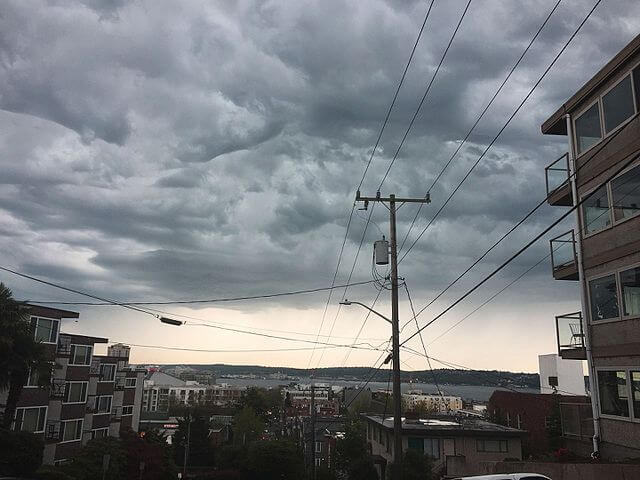
Storm clouds gather on Seattle street horizon.

April 19, 2024 by Llewellyn King Leave a Comment

Not as dark as an eclipse, but two dark clouds, under-mentioned by politicians, are forming on America’s horizon. They are the housing crisis and the growing threat of electricity shortages.

The housing crisis hasn’t caught fire as the issue one would have expected it to be among politicians. Electricity shortages are awkward for President Biden because he has staked his reputation on electrifying the country with alternative energy.

Neither the housing crisis nor the electricity challenge has garnered high recognition in the presidential election. Biden has touched on the housing crisis, and former president Donald Trump has denigrated alternative energy. Both are complex issues and need urgent attention. And both defy simple, declarative political statements, which may be why they are lying there, untouched but with lethality.

Housing hurts in obvious ways, including homelessness, a reduction in the birthrate and a freeze on the mobility of labor, once one of the great economic strengths of the United States. Where there was work, workers went.

Less so during the current housing crunch: When Americans cannot find housing where the work is, they won’t move. The consequence: European-type labor immobility.

Another consequence is that if the free movement of workers and their families stops, it contributes to the splintering of America: The New South goes back to being the Old South, and the rigidity of elitism in the North hardens. The East Coast and the West Coast start to think differently: the East Coast looking to Europe and the West Coast looking to Asia. Those developments aren’t good for the body politic. Intra-nationalism is a challenge to a country of continental dimension.

For those lucky enough to have shelter, nothing delivered to it is more important than electricity. We can do without pizza delivery, mail delivery and telephone service, but we can’t survive without electricity.

If it is extremely hot for months, as it was last summer in some regions, people die. Around Phoenix, according to Arizona data, more than 500 people died of heat-related causes.

In Texas, during Ice Storm Uri in 2021, 246 people froze to death by official count. Try to imagine those people, including children, freezing to death in their homes in America!

The homeless die all the time from exposure.

A chorus of voices, led by the American Public Power Association and the National Rural Electric Cooperative Association, has been sounding the electricity alarm for several years. However, the crisis continues to form because there is no quick fix for electricity generation and transmission any more than for housing development.

Demand is rising because of a national movement to electrify everything, especially transportation, and the growth of data centers. Rudy Garza, president of CPS Energy, the municipally owned natural gas and electric utility in San Antonio, said eight data centers are planned there and “20 more waiting in the wings.”

Utilities don’t say no. They have a history of planning for demand, but the end of that may be in sight if the data center demand, fed by artificial intelligence, continues to grow. While national electricity growth is about 2 percent annually, it is 3 percent in high-growth areas like San Antonio and around Dallas.

David Naylor, president of Rayburn Electric Cooperative, northeast of Dallas, said his area is experiencing explosive growth in demand of 3 percent or more yearly without yet accommodating data-center growth, although that is coming.

Technology will help solve the future of housing with better construction techniques. Also, while national standards would give new housing a boost, the core of the problem remains local ordinances and resistance in the suburbs and other “desirable” areas.

Some of the same not-where-we-live attitude frustrates utilities in moving renewable energy from the sunny and windy areas — mainly in the West — to where it is needed.

The not-where-we-live syndrome is stunting America’s future growth. In housing, the crunch is here. In electricity, it is coming.

Filed Under: King's Commentaries Tagged With: American Public Power Association, CPS Energy, Dallas, data centers, electricity shortages, housing crisis, local ordinances, National Rural Electric Cooperative Association, Rayburn Electric Cooperative, San Antonio

Texas Utility Exemplifies Struggle With Surging Demand

A graphic of the flag of Texas with wind turbines and other methods of electricity generation in the background.

April 13, 2024 by Llewellyn King Leave a Comment

Electric utilities are doing something that is equivalent to a person changing clothes without ever getting naked.

They can’t shut down while they switch out old plants for new; they can’t turn off the lights while they retool. They must try to modernize without the communities they serve being affected by so much as a flicker.

What is called “the world’s largest machine” — the coordinated operation of the nation’s 3,000 electric utilities — must hum 24/7 while replacing old polluting plants with new less-polluting plants and adding tranches of renewable power, primarily wind and solar.

I have been watching this feat of changing in place at CPS Energy, the municipally owned electric and natural gas utility in San Antonio. And, I have been following its president and CEO, Rudy D. Garza.

It is a utility with all the stresses now faced by utilities: growing demand, pressure to retire fossil fuel plants and preparing for the onslaught of demand from data centers, driven by the need for more computing for artificial intelligence and other computing needs.

Underlying all of these challenges in San Antonio, as elsewhere, is the need to control the increase in consumer bills. Garza told me with pride that despite the pressures, CPS Energy still has among the lowest electricity rates in the country.

Some in the environmental community may have balked at the company’s recent announcement that the utility was buying two large gas turbine plants in Corpus Christi and one smaller unit used for peaking in Laredo from Talen Energy, which is emerging from bankruptcy. The deal is worth $785 million and will provide CPS Energy with a whopping 1,710 megawatts of power.

Garza told me that CPS Energy will spend additional money on bringing the purchased plants up to its operating standards and preparing them for continuous use. Talen Energy, a power merchant, used them intermittently.

The purchases will enable the utility to shut down so-called steam gas plants. These older gas-fired units don’t use modern, super-efficient turbines but operate like coal-fired plants with a boiler and a lot of wasted heat. Garza said this would reduce air pollution in San Antonio. CPS Energy is also planning to retire coal generation on an accelerated schedule.

Although CPS Energy may not be able to get off of gas entirely, it is a leader in clean energy. It is, Garza said, the largest solar generator in Texas and the second-largest wind user. It has added 50 MW of battery storage and is seeking up to 500 MW of new storage.

Out with the old and in with the new.

This includes the rising electricity demand, which is growing at a rate of 3 percent, and the looming need of data centers. The demand, fed by artificial intelligence, is incalculable and growing exponentially.

Garza said, “The wild card is how quickly these larger loads that are coming to the area get connected to the system. We’ve got eight of these (data centers) on the ground right now in San Antonio with 20 more waiting in the wings.”

Some data centers, Garza said, will need their own backup generation. Although outages are rare on the CPS Energy system, he said the 24/7 needs of the centers are such that the larger ones will have to have their own emergency backup.

CPS Energy isn’t alone in dealing with data centers. It is a challenge faced by utilities nationwide. Rene Haas, CEO of Arm, the UK chip development company, part of Japan’s SoftBank, has described the need for electricity by AI as “insatiable.” A former U.S. secretary of energy told me it is scary and underestimated.

CPS Energy is looking at ways of accommodating the data centers and is at the forefront of new ways of generating. It is collaborating with Joint Base San Antonio — the giant military installation that sits in the center of the CPS Energy service area — to explore the potential for carbon-free solutions. CPS Energy is also looking into geothermal, particularly efficiencies that can be attained with fracking technology, which has changed the oil and gas outlook.

This creativity, which is part of the electric evolution in San Antonio, is taking place across the country. Like changing clothes without getting naked, it is a challenge.

Filed Under: King's Commentaries Tagged With: AI, battery storage, CPS Energy, data centers, electric vehicles, electricity demand, EVs, natural gas, Rudy D. Garza, San Antonio, solar generation, Talen Energy, Texas, wind generation

The Dark Ahead: Crisis Building in the U.S. Electricity System

March 23, 2024 by Llewellyn King Leave a Comment

There is a gathering storm over the nation’s electric supply.

What has been described as the world’s biggest machine, the U.S. electricity system, is stressed — and that stress will increasingly affect reliability. That means sporadic blackouts, some extensive. While the nation won’t be plunged into total darkness, regional difficulties will occur, according to the industry’s own watchdog group, the North American Electric Reliability Corp.

There are nearly 3,000 electric utilities in the United States, and what is known as the grid is, in fact, three grids: the Eastern, the Western and Texas. The first two interconnect and flow power back and forth where possible, but Texas is separate — and not subject to the regulation by the Federal Energy Regulatory Commission.

There are three classifications of electric utilities: the big investor-owned companies like Pacific Gas & Electric, ConEd and the operating units of the giant Southern Co.; the 2,000 public power companies, usually municipally owned, and a  few, like TVA, federal government-owned; and the rural electric cooperatives, which can be quite large or very small. Together, they operate the grids in surprising harmony and collegial cooperation.

The price of electricity is rising faster than inflation, according to the Energy Information Administration — a sure sign of building pressure on the companies. The causes of this stress are many. First, there is more demand for electricity across the board. That demand is rising about 2 percent a year, and the increase may accelerate after 2026.

Contributing to the demand is the proliferation of data centers and their huge appetite for electricity — an appetite now fed by artificial intelligence and its increasing use everywhere.

Then there is the effect of environmentally driven demand: switching heavy industry from using fossil fuels to using electricity for high-energy uses like steel-making. This is set to grow.

In the same way, the use of electrified transportation is upping its share of electricity demand: It isn’t just Priuses and similar personal vehicles but big fleets, particularly for in-city deliveries. The Postal Service, Amazon and other fleet users are converting to electricity. Burns & McDonnell, the Kansas City-based engineering, architecture, construction, environmental and consulting solutions firm, estimates half of intracity deliveries will be with electric vehicles by the decade’s end.

Increasingly, new homes will be all-electric as the future of natural gas supplies is compromised by public policy.

Exacerbating instability in the electric sector has been the swing from fossil-fuel generation — primarily coal and natural gas — to renewables. Those simply aren’t always available. The race is on for better batteries and storage to smooth the variability of wind and solar, especially wind.

Nonetheless, the pressure is constant to close coal and gas plants, which have always available generation, known in utility parlance as “dispatchable,” and account for 19 percent and 38 percent of generation, respectively. It adds to the difficulties of keeping the lights on.

The dilemma was set out for me by Duane Highley, CEO of Tri-State Generation & Transmission, in Westminster, Colorado. It provides power to 42 rural co-ops in four states.

Highley explained the new instability in the industry this way: “The rapid rate of retirement of dispatchable generators has raised concerns among our membership about the reliability of the greater grid.”

He said the industry can and is achieving rapid rates of emissions reduction but will still need “an appropriate amount of cost-effective dispatchable generation.”  Today, Highley noted, this is provided by coal and natural gas. This power will be needed to ensure a reliable and resilient grid as the demand for electricity increases.

“The traditional metrics utilities have used to model reliability can no longer demonstrate grid resilience as we rely more on intermittent weather-dependent resources.”

Tri-State, Highley said, is “working with its members on new reliability methodology to assure we have sufficient capacity, even with high levels of renewable generation.”

Electricity loss is a lethal matter.

In Texas, 254 people, by official count, died when some of the grid went down during the blackout caused by Ice Storm Uri in 2021. And in last year’s heat dome over Arizona, the state estimates 654 people died of heat-related causes in Maricopa County.

Clearly, job one is to keep the lights on before we retire the tried-and-true generating plant of yesterday. Life depends on it.

Filed Under: King's Commentaries Tagged With: coal, data centers, dispatchable generation, electric vehicles, electricity crisis, natural gas, North American Electric Reliability Corporation, renewable energy, Tri-State Generation & Transmission, U.S. electric grid, U.S. electric utilities, U.S. Energy Information Administration

White House Chronicle on Social

  • Facebook
  • Twitter
  • Vimeo
  • YouTube
Soft Power, the Secret Sauce of the British Empire

Soft Power, the Secret Sauce of the British Empire

Llewellyn King

When President Trump, on the first day of his second term, closed the U.S. Agency for International Development and began dismantling the Voice of America, he also severely curtailed what had been America’s soft power dominance in the world. With those actions, we abandoned something of inestimable value: the ability to project Americanism, our ideals. […]

A British Immigrant’s Defense of Immigration

A British Immigrant’s Defense of Immigration

Llewellyn King

Migration, people moving to new lands, is as old as human history, and as fraught. Today it is a global problem complete with layered hypocrisy, cruelty and, always, hope among those on the move. War and extreme poverty collude in driving people to seek a livable future. There is no simple solution, no slogan that […]

The Birth of a New Reactor: Thorium Past and Present

The Birth of a New Reactor: Thorium Past and Present

Llewellyn King

If you are designing a car from scratch, there are certain essentials to begin with. You need to start with the wheels on the corners, for example. But when it comes to building a nuclear reactor, things are different. There are hundreds and maybe thousands of ways of doing it. The constant is that you […]

Air Conditioning Costs Threaten Summer of Sun Belt Catastrophe

Air Conditioning Costs Threaten Summer of Sun Belt Catastrophe

Llewellyn King

The summer of our discontent is at hand. When I asked a professional weather forecaster what we might expect this season, he said, “Hades.” That was as disturbing as everything else in this disturbing year. America has a summer culture. You could say the whole of the Northern Hemisphere has one, but there is a […]

Copyright © 2026 · White House Chronicle Theme on Genesis Framework · WordPress · Log in