White House Chronicle

News Analysis With a Sense of Humor

  • Home
  • King’s Commentaries
  • Random Features
  • Photos
  • Public Speaker
  • WHC Episodes
  • About WHC
  • Carrying Stations
  • ME/CFS Alert
  • Contact Us

The AI Tsunami Is Approaching Shore; Jobs at Big Risk

October 3, 2025 by Llewellyn King Leave a Comment

The Big One is coming, and it isn’t an earthquake in California or a hurricane in the Atlantic. It is the imminent upending of so many of the world’s norms by artificial intelligence, for good and for ill.

Jobs are being swept away by AI not in the distant future, but right now. A recent Stanford University study found that entry-level jobs for workers between 22 and 25 years old have dropped by 13% since the widespread adoption of AI.

Another negative impact of AI: The data centers that support AI are replacing farmland at a rapid rate. The world is being overrun with huge concrete boxes, Brutalist in their size and visual impact.

Meta Platforms (of which Facebook is part) plans to spend hundreds of billions of dollars to build several massive AI data centers; the first called Prometheus and the second Hyperion.

CEO Mark Zuckerberg said in a post on his Threads social media platform: “We’re building multiple more titan clusters as well. Just one of these covers a significant part of the footprint of Manhattan.”

Data centers are voracious in their consumption of electricity and are blamed for sending power bills soaring across the country.

But AI has had a positive impact on the quality of medicine, improving accuracy, consistency and efficacy, according to the National Institutes of Health.

Predictive medicine is on a roll: Alzheimer’s Disease and some cancers, for example, can be predicted accurately. That raises the question: Do you want to know when you will lose your mind or get cancer?

Where AI is without downside is medical “exaptation.” That happens when a drug or therapy developed for one disease is found to be effective with another, opening up a field of possibilities.

AI also offers the chance of shortening clinical trials for new drugs from years to a few months. Side effects and downsides can be mapped instantly.

Life expectancy is predicted to increase substantially because of AI. Omar Hatamleh, an AI expert and author, told me, “A child born today can expect to live to 120.”

Likewise, predictive maintenance with AI is already useful in forecasting the failure of industrial plants, power station components and bridges.

Oh, and productivity will increase across the board where AI and AI agents — the AI tools developed for special purposes — are at work.

The trouble is AI will be doing the work that heretofore people have done.

Pick a field and speculate on the job losses there. This may be fun to do as a parlor game, but it is deeply distressing when you realize that it could happen in the very near future — like in the next year.

Most are low-skilled white-collar jobs, such as those in call centers, or in medical offices checking insurance claims, or in an accounting firm doing bookkeeping. In short, if you are a paper pusher, you will be pushed out.

Look a little further — maybe 10 years — and Uber, which has invested heavily in autonomous vehicles, will have decided that they are ready for general deployment. Bye-bye Uber driver, hello driverless car.

Taxis and truck drivers might well be the next to get to their career-end destinations quicker than they expected.

By the way, autonomous vehicles ought to have fewer accidents than cars with drivers do, so the insurance industry will take a hit and lots of workers there will get the heave-ho. And collision repairs may be nearly outdated.

These aren’t speculation; they are real possibilities in the near future. Yet the political world has been arguing about other things.

As far as I am aware, when the leadership of the U.S. military gathered at the Marine Corp Base Quantico in Virginia recently to get a pep talk on shaving, losing weight and gender superiority, they didn’t hear about how AI is transforming war and what measures should be taken. Or whether there will be work for those who leave the military.

The Big One is coming, and the politicians are worrying about yesterday’s issues. That is like worrying about your next guest list when an uninvited guest, a tsunami of historic proportions, is coming ashore.

Filed Under: King's Commentaries Tagged With: AI, Data, electricity, health, intelligence, jobs, Meta, military, people, Prometheus, Uber, Zuckerberg

A Disease That Cries Out for Research as Many Suffer Silently

August 17, 2017 by Llewellyn King 5 Comments

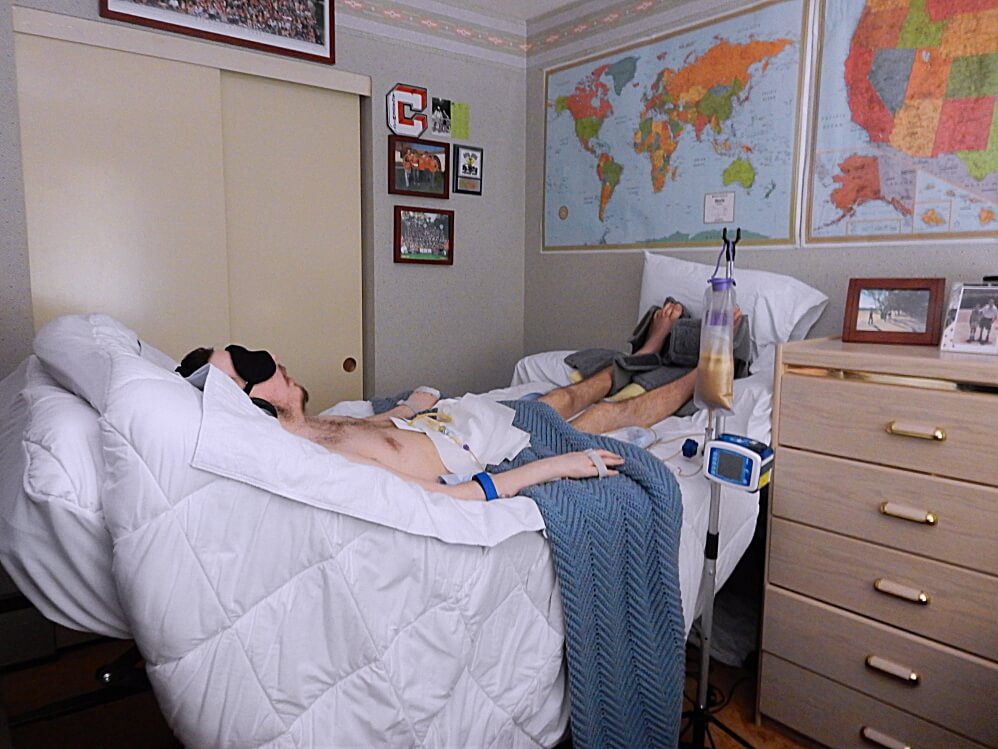
Photo: Tom Camenzind, an ME/CFS patient, photographed at his home in San Ramon, Calif. / Credit: Linda Gasparello

All diseases are cruel, but some have a refined brutality all their own. One such is Myalgic Encephalomyelitis (ME), also known as Chronic Fatigue Syndrome (CFS). It is a monster, often hidden in plain sight; the suffering it inflicts is limitless.

Tom Camenzind is a handsome young man who should be in the joyous throes of youth. A popular and gifted student at Stanford University, Tom was clearing the hurdles of academia with ease and grace. In January of his sophomore year, he caught a cold on campus. ME walked through some door, and stole his promising life.

Today Tom lies conscious but prone in his parents’ home in San Ramon, Calif. He is totally paralyzed and can only communicate with his parents, Mark and Dorothy, by pressure from his fingers on sensors. He cannot tolerate everyday sounds, light or touch.

When the sensor-activated bell sounds, Tom’s parents come rushing to his side. Mark is an engineer and Dorothy is a physician, and the strain of their son’s affliction on them is palpable. Tom cannot do anything, anything whatsoever, for himself. At 23 years old, he is on the threshold of life, but he cannot cross it. He breathes and thinks, but he cannot live his life.

Recently, I filmed the Camenzinds for a special edition of “White House Chronicle,” a weekly program that I produce and host for PBS and other broadcast outlets. It was made in conjunction with the Solve ME/CFS Initiative, a Los Angeles-based charity.

Tom’s agony, and that of 1 million in America and 17 million around the world, predominantly women, cries out in terrible, silent eloquence for a national research effort with international cooperation on ME/CFS – so that those who suffer, like Tom, can dare to hope.

Tom’s paralysis is extreme, but others suffer daily with extreme fatigue, headaches, muscle pain, dysphasia and light and sound intolerance. Normal work is impossible, as is maintaining ordinary family life. Precious few ME/CFS patients make a full recovery. My files contain letters from sufferers who beg for death. Suicide is common.

Yet the United States has never put the effort — read dollars — into ME/CFS that it deserves, that it needs, that one would expect. Previous administrations have spent a paltry $5 million a year on research on the disease. While that amount was due to rise to $15 million, there is no guarantee it will under the Trump administration. The Office of Management and Budget has proposed deep cuts in funding for the National Institutes of Health, the research agency.

Even the diagnosis of the disease is a challenge. There are no conventional biomarkers that can be found in body fluids. One certain but clumsy way of diagnosing it is by asking patients who are ambulatory to walk on a treadmill. If they collapse for one or more days, the diagnosis is positive.

Many suffer for years and cannot find a doctor who knows anything about the disease. The disease is not part of the curriculum in medical schools.

Most patients see many doctors and get many wrong diagnoses before they find a specialist – if they find one at all. Most states have no specialists.

For patients, costs are huge and help is slight. Lovers drift away, spouses give up, children are often thought to be lazy and are criticized by parents, siblings and teachers. Schools are baffled when active kids fall apart from ME.

Over the years, there have been efforts by private charities, like the Solve ME/CFS Initiative, to fund the research gap. But still missing is the government, the big foundations and Big Pharma.

Sadly, ME has no celebrity champions. AIDS had Elizabeth Taylor, Muscular Dystrophy has Jerry Lewis and Parkinson’s Disease has Michael J. Fox.

For Tom to come back to his life one day, money and research are needed now. Oh, so needed.


Llewellyn King is executive producer and host of “White House Chronicle” on PBS. His e-mail is llewellynking1@gmail.com.

Filed Under: King's Commentaries Tagged With: Chronic Fatigue Syndrome, chronic illness, health, myalgic encephalomyelitis, National Institutes of Health

White House Chronicle on Social

  • Facebook
  • Twitter
  • Vimeo
  • YouTube
Can AI Clean Its Own House? There Are Signs It Can

Can AI Clean Its Own House? There Are Signs It Can

Llewellyn King

For me, the big news isn’t the politics of the moment, the deliberations before the Supreme Court or even the news of the battlefront in Ukraine. No, it is a rather modest, careful announcement by Anthropic, the developer of the Claude suite of chatbots. Anthropic, almost sotto voce, announced it had detected introspection in their […]

A Reminder of Kings and Emperors To Rise at the White House

A Reminder of Kings and Emperors To Rise at the White House

Llewellyn King

President Donald Trump is building what will become one of the greatest snow-colored pachyderms in the history of the United States. Some of the nation’s biggest tycoons are going to pay for this ballroom, which will look like the box that the rest of the White House came in — a statement often made about […]

The Age of Dichotomy Is Tearing Up America

The Age of Dichotomy Is Tearing Up America

Llewellyn King

We live in an age of dichotomy. The rich are getting richer and the poor are getting poorer. We have more means of communication, but there is a pandemic of loneliness. We have unprecedented access to information, but we seem to know less, from civics to the history of the country. We are beginning to […]

Old Journalism Is Coming in Shiny New Wrappers

Old Journalism Is Coming in Shiny New Wrappers

Llewellyn King

If you know what is going on in Gaza, it is because a journalist told you. If you know Health and Human Services Secretary Robert F. Kennedy Jr.’s latest comment about autism, it is because a journalist told you. If you know that there was a tsunami off the coast of Indonesia, it is because […]

Copyright © 2025 · White House Chronicle Theme on Genesis Framework · WordPress · Log in