White House Chronicle

News Analysis With a Sense of Humor

  • Home
  • King’s Commentaries
  • Random Features
  • Photos
  • Public Speaker
  • WHC Episodes
  • About WHC
  • Carrying Stations
  • ME/CFS Alert
  • Contact Us

Soft Power, the Secret Sauce of the British Empire

July 17, 2026 by Llewellyn King Leave a Comment

When President Trump, on the first day of his second term, closed the U.S. Agency for International Development and began dismantling the Voice of America, he also severely curtailed what had been America’s soft power dominance in the world.

With those actions, we abandoned something of inestimable value: the ability to project Americanism, our ideals. Trump retired an entire diplomatic system that had served the United States well since we more or less inherited it from the British.

Soft power was codified as a concept by the late Harvard professor Joseph S. Nye, Jr. in four books published between 1990 and 2023.

While Nye made soft power his own — he coined the term in 1990 — and wrote, lectured and testified before Congress about it, he never totally convinced conservatives what a valuable weapon it was in the national armory.

The proof of that is in the current administration’s indifference to diplomatic and social muscle, and its lack of a mechanism to talk to the Iranian people in Farsi, their language.

Nye believed an important part of soft power was our educational system, and U.S.-educated foreign students going home and spreading the good news about America.

I believe, although it was never thought of that way, that soft power was one of the things that kept the British Empire together. I saw it in action in Africa as colonial rule waned.

James R. Schlesinger, who served as chairman of the Atomic Energy Commission, director of the CIA, secretary of defense, and secretary of energy, was a friend of mine throughout his public career and afterward. The one question he asked me constantly was how the British Empire was able to hold together with so few troops spread across so much of the world.

Schlesinger, a former history professor, wondered how those lessons might be applied to America in the late 20th century.

I told him that it was a combination of the hard power of the Royal Navy and British Army but also, importantly, of the then-unnamed soft power.

Take the massacre in Amritsar, in the northwestern Indian state of Punjab. This occurred on April 13, 1919, when a local British commander in the Punjab feared a meeting in a garden might turn violent and opened fire without warning on thousands of unarmed civilians. Official figures reported 379 dead and 1,200 injured; Indian estimates exceed 1,000 deaths.

This massacre hardened Mahatma Gandhi’s attitude to British rule over the subcontinent. His initial reaction, on hearing of the slaughter, was disbelief that the British would do such a thing. He had bought the soft-power assertion of British values, of decency.

Winston Churchill, then serving as the minister of war, told Parliament early the next year that the shooting was “unalterably monstrous.”

I tried to explain to Schlesinger over many evenings, over many years, what I had seen growing up in British Africa as the essence of British soft power.

To me, it boiled down to a kind of moral posture, a determination to project British justice as inviolate, British exceptionalism as a moral force, and a general admirable state of decency. The term soft power hadn’t yet been created, but it was the essential ingredient in British colonial administration.

When American commanders sought the “hearts and minds” of the Vietnamese, they might well have said they were seeking to establish “soft power.” But it was too late.

The concept of soft power and how it blossomed for America has wilted under the Trump administration. The posture now is that economic and military power are how we project influence and authority.

Ironically, while I think Nye did something of great value in identifying and promoting the concept of soft power, he and I didn’t enjoy a warm relationship. He had been President Jimmy Carter’s point man for nuclear disarmament and had favored an end to nuclear reprocessing as well as other aspects of the U.S. nuclear ecosystem.

In 1977, we debated in London, and the argument got so intense that we spilled into the street, shouting at each other.
Filed Under: King's Commentaries Tagged With: America, British, Churchill, educational, foreign, Gandhi, Iranian, national, nuclear, Nye, Punjab, social, trump

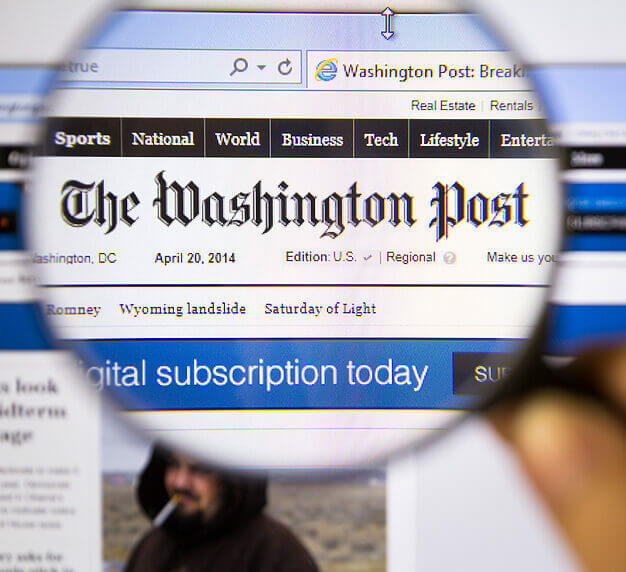
Requiem for The Washington Post

February 6, 2026 by Llewellyn King Leave a Comment

Think of a big-city newspaper as being analogous to a department store. You can get anything you want there, from breaking political news to dinner recipes. When you pick it up, you should be enchanted by the multiplicity of its offerings.

Think of big-city newspapers as you think of the way every city had its own particular and dearly loved emporium like Marshall Fields in Chicago, Bloomingdale’s in New York, and Garfinkel’s in Washington.

For decades, Washington’s great newspaper has been The Washington Post. In recent years, along with The New York Times and The Wall Street Journal, it has also been one of the three newspapers that can claim to be national.

The Post offered everything from history-changing exclusives to the daily horoscope. And great reporting and commentary.

Now it is going from being a great department store to a convenience store, selling bread, milk and cigarettes — actually, politics and business with limited international coverage.

Having once worked at the Post, I feel this personally, as though a part of my life is being taken away.

I am shattered by the folly and the waste. I am also alarmed that now The New York Times will be too powerful with its online dominance. It got the internet right early.

Jeff Bezos, who bought the Post from the Graham family, failed to catch the wave. Instead, he was seen as being more concerned with placating President Trump. Betrayal, said much of the readership, who cancelled their subscriptions or stopped believing in the paper, despite some courageous and insightful journalism.

The seeds of the Post’s commercial success were sown in 1954. At that time, afternoon newspapers were dominant and morning papers were struggling. In the morning, Washington had the Post and the Times Herald. In the afternoon, it had the Washington Evening Star and the Washington Daily News.

Eugene Meyer, a financier, bought the Post in 1933. By all reports, he thought of it as a diversion. I am told he liked to bring bottles of whiskey to the paper and have impromptu parties with the ever-thirsty staff.

In March 1954, Meyer bought the Times Herald and folded it into the Post.

What wasn’t known was that television would soon shift the balance between morning and afternoon papers, and that afternoon papers would go into permanent decline and extinction.

Both the Star and the News in Washington were battling each other for the read-at-home market. Soon, those readers would be watching television.

Under Meyer’s daughter, Katharine Graham, the Post reached unbelievable heights in journalism and in wealth. It appeared invincible.

Just as television had doomed afternoon papers, technology was to threaten all traditional publishing and broadcasting. New media, such as Facebook and Google, delivered personalized advertisements directly to consumers, cheaply and effectively.

As the red ink spread, it was up to Donald Graham, Katharine’s son, to find an angel, someone to stave off bankruptcy, and follow the early example set by the Times of virtual publishing. He persuaded Amazon’s billionaire founder, Bezos, to buy the Post to save it. Ironical?

A word about Graham: I met him when he first came to the Post. I was asked to show him around the composing room. It was the beating heart of the paper, where the newsroom’s creative output was set in hot metal and assembled in steel frames, known as forms, that would become the pages.

I got on well with him, and we became friends. It must have been extraordinarily painful for him to sell the Post, to entrust it to a man with the money to keep it going until a new business plan paid off.

It began well. Bezos kept his distance until he, like other giants of business, felt he had to mollify Trump, ever a media critic.

The extent of Trump’s pressure became clear when Bezos canceled the publication of an editorial endorsing Kamala Harris for president. Emotions were running high, and it was seen by the Post faithful as betrayal: the hand of Trump in the temple of press freedom.

Subsequently, Bezos added insult by changing the direction of the Post’s admired opinion pages, undermining confidence in the readership and the staff.

You can change the product lineup in a retail outlet, but you will burn down the building if you do it in a newspaper.

The Washington Post of old was venerated for fearlessness; now it is despised as craven. It is gone, sunk, a wonderful memory for those who read it, and for those who worked there. R.I.P.

Filed Under: King's Commentaries Tagged With: Bezos, horoscope, international, Katharine Graham, national, New York Times, newspaper, political, recipes, Washington Post

White House Chronicle on Social

  • Facebook
  • Twitter
  • Vimeo
  • YouTube
How U.S. Natural Gas Came Back from the Dead

How U.S. Natural Gas Came Back from the Dead

Llewellyn King

The Trump administration is proud of America’s dominance in natural gas. The nation is the world’s largest producer and a net exporter. We produce a quarter of the world supply of the fuel, which has become fundamental to electricity production. Forty-three percent of our electricity is generated from natural gas. According to the Energy Information […]

Foreign Aid That Works — the Malawi Story

Foreign Aid That Works — the Malawi Story

Llewellyn King

In 2005, Gordon Brown, British chancellor of the exchequer, later prime  minister, was in Washington, seeking to raise $50 billion annually in  additional international aid for Africa. I hosted a press event for Brown at the National Press Club, and I  asked him how all this money would get to the people who needed it? […]

Is Rubio Starting a Nuclear Arms Race in the Middle East?

Is Rubio Starting a Nuclear Arms Race in the Middle East?

Llewellyn King

The Trump administration has announced and appears to be crowing over an agreement with Saudi Arabia to help the kingdom not only to build nuclear power plants but also to enrich the uranium fuel. There is no reason for the Saudis to enrich uranium. There are plenty of willing suppliers of enriched uranium and more […]

Soft Power, the Secret Sauce of the British Empire

Soft Power, the Secret Sauce of the British Empire

Llewellyn King

When President Trump, on the first day of his second term, closed the U.S. Agency for International Development and began dismantling the Voice of America, he also severely curtailed what had been America’s soft power dominance in the world. With those actions, we abandoned something of inestimable value: the ability to project Americanism, our ideals. […]

Copyright © 2026 · White House Chronicle Theme on Genesis Framework · WordPress · Log in