White House Chronicle

News Analysis With a Sense of Humor

  • Home
  • King’s Commentaries
  • Random Features
  • Photos
  • Public Speaker
  • WHC Episodes
  • About WHC
  • Carrying Stations
  • ME/CFS Alert
  • Contact Us

Foreign Aid That Works — the Malawi Story

July 31, 2026 by Llewellyn King Leave a Comment

In 2005, Gordon Brown, British chancellor of the exchequer, later prime  minister, was in Washington, seeking to raise $50 billion annually in  additional international aid for Africa.

I hosted a press event for Brown at the National Press Club, and I  asked him how all this money would get to the people who needed it?

“We’ll give it to the right people,” he said crossly.

I told him I had seen foreign aid stolen, diverted and spent by the agencies that were supposed to deliver it on pet projects and themselves.

But there is another way, and it is working in the small, peaceful and democratic Southern African country of Malawi.

An organization called GiveDirectly has been handing $550 to every  adult — men and women — in villages with no strings attached. It is  estimated that for every $1,000 disbursed, there is an economic impact  of $2,400.

This differs radically from foreign aid that has poured into sub-Saharan Africa since the end of colonial rule. Normally, this is passed on to a local government agency or a non-governmental organization and has been earmarked for a school, a hospital, water supply or famine relief. Often, this has led to bureaucratic delays and high overhead costs.

The aid organizations, mostly from North America and Europe, haven’t  always earned plaudits. I have heard them described as “cheap tourists”  and worse.

Another source of friction has been the tendency of aid workers to  impose their values on recipients — for example, promoting green  technologies or Western dietary preferences.

“We are flipping the traditional aid logic on its head. Rather than  us figuring out what people need and having a kind of one-size-fits-all  approach, we are saying people are the best placed to say what they need and what will be best for their circumstances,” Grace Jackson,  GiveDirectly country director for Malawi, told me and my co-host, Adam  Clayton Powell III, on the television program “White House Chronicle.”

“What we can do is to provide the tools, i.e. cash, so they can go ahead and do what is the most important and most useful to them,” she  added.

Everyone over the age of 18 in a village gets the money delivered via a phone wallet, and if the villager doesn’t have a phone, Jackson said  GiveDirectly provides one.

They also make sure there is a viable local financial entity with enough money on hand to pay out as villagers require it.

I believe this approach works well because of the nature of  subsistence life in rural Africa, typified by village life in Malawi. It is wrong to think of poverty in the African countryside, and it is  extreme, the way we think of urban poverty in America.

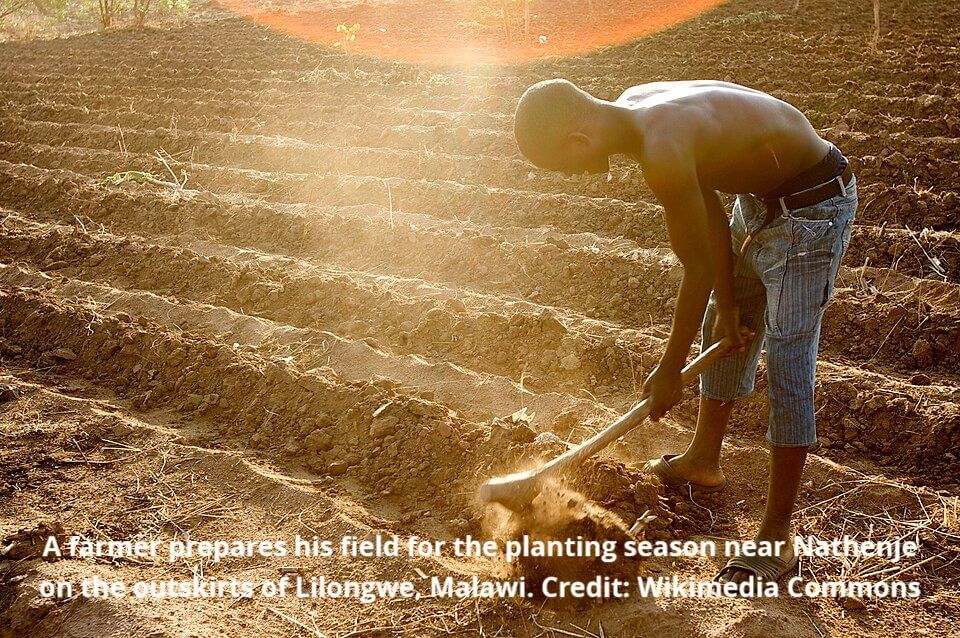
Rural people in Malawi — and a majority of its 22 million people are rural — simply have nothing. I repeat, nothing. They have few clothes, no shoes and no food security.

They survive by subsistence farming, mostly growing corn, which, with an occasional protein, is their diet. They have to eat all year on what they grow.

Yet families hold together as do the villages. Often, grown children live with their parents and help with the farming, generally done with simple hand tools. In the nothingness there is order.

The Malawi experiment is working, lifting whole villages above the international poverty line. Jackson, who is English, said the money was used in various ways. People bought more land, got medical attention, paid school fees or pooled the money for big things like electrification.

Recently, the program has received a $150 million boost from the Canva Foundation, the charity established by billionaires Melanie Perkins and Cliff Obrecht, co-founders of Canva, a popular graphic design tool.

GiveDirectly was created by MIT and Harvard students as a giving circle, based on their studies of the efficacy of charity programs. It was formalized in 2012. The organization hasn’t just helped the needy overseas, it has also handed out aid in the form of debit cards to U.S. disaster survivors.

The idea of letting the recipients of the aid decide how to spend it  may appeal to conservatives and incline them more favorably toward  foreign aid, especially if it is entirely derived from the private  sector.

By the way, Gordon Brown’s grand scheme never got off the ground.

Filed Under: King's Commentaries Tagged With: Africa, aid, America, Europe, foreign, GiveDirectly, Grace Jackson, Malawi, money, Tourists, Washington

Soft Power, the Secret Sauce of the British Empire

July 17, 2026 by Llewellyn King Leave a Comment

When President Trump, on the first day of his second term, closed the U.S. Agency for International Development and began dismantling the Voice of America, he also severely curtailed what had been America’s soft power dominance in the world.

With those actions, we abandoned something of inestimable value: the ability to project Americanism, our ideals. Trump retired an entire diplomatic system that had served the United States well since we more or less inherited it from the British.

Soft power was codified as a concept by the late Harvard professor Joseph S. Nye, Jr. in four books published between 1990 and 2023.

While Nye made soft power his own — he coined the term in 1990 — and wrote, lectured and testified before Congress about it, he never totally convinced conservatives what a valuable weapon it was in the national armory.

The proof of that is in the current administration’s indifference to diplomatic and social muscle, and its lack of a mechanism to talk to the Iranian people in Farsi, their language.

Nye believed an important part of soft power was our educational system, and U.S.-educated foreign students going home and spreading the good news about America.

I believe, although it was never thought of that way, that soft power was one of the things that kept the British Empire together. I saw it in action in Africa as colonial rule waned.

James R. Schlesinger, who served as chairman of the Atomic Energy Commission, director of the CIA, secretary of defense, and secretary of energy, was a friend of mine throughout his public career and afterward. The one question he asked me constantly was how the British Empire was able to hold together with so few troops spread across so much of the world.

Schlesinger, a former history professor, wondered how those lessons might be applied to America in the late 20th century.

I told him that it was a combination of the hard power of the Royal Navy and British Army but also, importantly, of the then-unnamed soft power.

Take the massacre in Amritsar, in the northwestern Indian state of Punjab. This occurred on April 13, 1919, when a local British commander in the Punjab feared a meeting in a garden might turn violent and opened fire without warning on thousands of unarmed civilians. Official figures reported 379 dead and 1,200 injured; Indian estimates exceed 1,000 deaths.

This massacre hardened Mahatma Gandhi’s attitude to British rule over the subcontinent. His initial reaction, on hearing of the slaughter, was disbelief that the British would do such a thing. He had bought the soft-power assertion of British values, of decency.

Winston Churchill, then serving as the minister of war, told Parliament early the next year that the shooting was “unalterably monstrous.”

I tried to explain to Schlesinger over many evenings, over many years, what I had seen growing up in British Africa as the essence of British soft power.

To me, it boiled down to a kind of moral posture, a determination to project British justice as inviolate, British exceptionalism as a moral force, and a general admirable state of decency. The term soft power hadn’t yet been created, but it was the essential ingredient in British colonial administration.

When American commanders sought the “hearts and minds” of the Vietnamese, they might well have said they were seeking to establish “soft power.” But it was too late.

The concept of soft power and how it blossomed for America has wilted under the Trump administration. The posture now is that economic and military power are how we project influence and authority.

Ironically, while I think Nye did something of great value in identifying and promoting the concept of soft power, he and I didn’t enjoy a warm relationship. He had been President Jimmy Carter’s point man for nuclear disarmament and had favored an end to nuclear reprocessing as well as other aspects of the U.S. nuclear ecosystem.

In 1977, we debated in London, and the argument got so intense that we spilled into the street, shouting at each other.

Filed Under: King's Commentaries Tagged With: America, British, Churchill, educational, foreign, Gandhi, Iranian, national, nuclear, Nye, Punjab, social, trump

White House Chronicle on Social

  • Facebook
  • Twitter
  • Vimeo
  • YouTube
How U.S. Natural Gas Came Back from the Dead

How U.S. Natural Gas Came Back from the Dead

Llewellyn King

The Trump administration is proud of America’s dominance in natural gas. The nation is the world’s largest producer and a net exporter. We produce a quarter of the world supply of the fuel, which has become fundamental to electricity production. Forty-three percent of our electricity is generated from natural gas. According to the Energy Information […]

Foreign Aid That Works — the Malawi Story

Foreign Aid That Works — the Malawi Story

Llewellyn King

In 2005, Gordon Brown, British chancellor of the exchequer, later prime  minister, was in Washington, seeking to raise $50 billion annually in  additional international aid for Africa. I hosted a press event for Brown at the National Press Club, and I  asked him how all this money would get to the people who needed it? […]

Is Rubio Starting a Nuclear Arms Race in the Middle East?

Is Rubio Starting a Nuclear Arms Race in the Middle East?

Llewellyn King

The Trump administration has announced and appears to be crowing over an agreement with Saudi Arabia to help the kingdom not only to build nuclear power plants but also to enrich the uranium fuel. There is no reason for the Saudis to enrich uranium. There are plenty of willing suppliers of enriched uranium and more […]

Soft Power, the Secret Sauce of the British Empire

Soft Power, the Secret Sauce of the British Empire

Llewellyn King

When President Trump, on the first day of his second term, closed the U.S. Agency for International Development and began dismantling the Voice of America, he also severely curtailed what had been America’s soft power dominance in the world. With those actions, we abandoned something of inestimable value: the ability to project Americanism, our ideals. […]

Copyright © 2026 · White House Chronicle Theme on Genesis Framework · WordPress · Log in