
White House Chronicle

News Analysis With a Sense of Humor

  • Home
  • King’s Commentaries
  • Random Features
  • Photos
  • Public Speaker
  • WHC Episodes
  • About WHC
  • Carrying Stations
  • ME/CFS Alert
  • Contact Us

Foreign Aid That Works — the Malawi Story

July 31, 2026 by Llewellyn King Leave a Comment

In 2005, Gordon Brown, British chancellor of the exchequer, later prime  minister, was in Washington, seeking to raise $50 billion annually in  additional international aid for Africa.

I hosted a press event for Brown at the National Press Club, and I  asked him how all this money would get to the people who needed it?

“We’ll give it to the right people,” he said crossly.

I told him I had seen foreign aid stolen, diverted and spent by the agencies that were supposed to deliver it on pet projects and themselves.

But there is another way, and it is working in the small, peaceful and democratic Southern African country of Malawi.

An organization called GiveDirectly has been handing $550 to every  adult — men and women — in villages with no strings attached. It is  estimated that for every $1,000 disbursed, there is an economic impact  of $2,400.

This differs radically from foreign aid that has poured into sub-Saharan Africa since the end of colonial rule. Normally, this is passed on to a local government agency or a non-governmental organization and has been earmarked for a school, a hospital, water supply or famine relief. Often, this has led to bureaucratic delays and high overhead costs.

The aid organizations, mostly from North America and Europe, haven’t  always earned plaudits. I have heard them described as “cheap tourists”  and worse.

Another source of friction has been the tendency of aid workers to  impose their values on recipients — for example, promoting green  technologies or Western dietary preferences.

“We are flipping the traditional aid logic on its head. Rather than  us figuring out what people need and having a kind of one-size-fits-all  approach, we are saying people are the best placed to say what they need and what will be best for their circumstances,” Grace Jackson,  GiveDirectly country director for Malawi, told me and my co-host, Adam  Clayton Powell III, on the television program “White House Chronicle.”

“What we can do is to provide the tools, i.e. cash, so they can go ahead and do what is the most important and most useful to them,” she  added.

Everyone over the age of 18 in a village gets the money delivered via a phone wallet, and if the villager doesn’t have a phone, Jackson said  GiveDirectly provides one.

They also make sure there is a viable local financial entity with enough money on hand to pay out as villagers require it.

I believe this approach works well because of the nature of  subsistence life in rural Africa, typified by village life in Malawi. It is wrong to think of poverty in the African countryside, and it is  extreme, the way we think of urban poverty in America.

Rural people in Malawi — and a majority of its 22 million people are rural — simply have nothing. I repeat, nothing. They have few clothes, no shoes and no food security.

They survive by subsistence farming, mostly growing corn, which, with an occasional protein, is their diet. They have to eat all year on what they grow.

Yet families hold together as do the villages. Often, grown children live with their parents and help with the farming, generally done with simple hand tools. In the nothingness there is order.

The Malawi experiment is working, lifting whole villages above the international poverty line. Jackson, who is English, said the money was used in various ways. People bought more land, got medical attention, paid school fees or pooled the money for big things like electrification.

Recently, the program has received a $150 million boost from the Canva Foundation, the charity established by billionaires Melanie Perkins and Cliff Obrecht, co-founders of Canva, a popular graphic design tool.

GiveDirectly was created by MIT and Harvard students as a giving circle, based on their studies of the efficacy of charity programs. It was formalized in 2012. The organization hasn’t just helped the needy overseas, it has also handed out aid in the form of debit cards to U.S. disaster survivors.

The idea of letting the recipients of the aid decide how to spend it  may appeal to conservatives and incline them more favorably toward  foreign aid, especially if it is entirely derived from the private  sector.

By the way, Gordon Brown’s grand scheme never got off the ground.
Filed Under: King's Commentaries Tagged With: Africa, aid, America, Europe, foreign, GiveDirectly, Grace Jackson, Malawi, money, Tourists, Washington

Sorry, Europe Is Full, Tourists Are Told

August 9, 2025 by Llewellyn King Leave a Comment

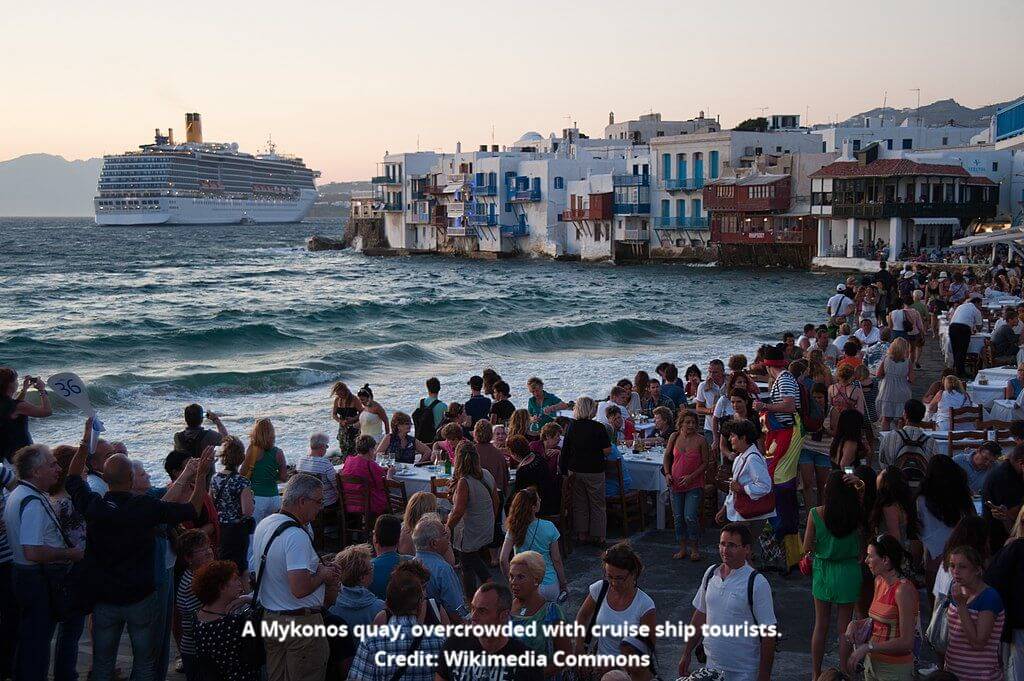
This was the summer when much of Europe said to the ever-increasing flow of tourists, “Sorry, we are full.”
Of course, Europe isn’t full at all. It is just those places that we all want to go, that have been tugging at our imaginations since we began imagining, are hopelessly crowded — and some are brutally hot as well.
The most overcrowded getaways are in southern Europe: Nice, in the legendary South of France; Barcelona, Spain; Italian coastal towns, especially Venice; the best-known Greek islands such as Mykonos, Hydra and Santorini. Along the Croatian coast, Dubrovnik and Split are crowded.
What is ugly outside and delightful inside? Answer: a cruise ship.
The sight of those multitiered behemoths squeezing into a port that was designed for something a lot more gainly reminds me of someone struggling into clothes they have far outgrown. It can be done, but it isn’t pretty.
You can’t blame everything on cruise ships. They aren’t to blame for the summer traffic jams in Britain’s Lake District or around the Cotswolds. They aren’t the reason you can’t get into the great museums of Europe in summer, such as the Louvre in Paris or the Churchill War Rooms in London.
But cruise ships have become a particular problem for much of coastal Europe and aren’t the kind of tourism locals want.
The Greek tourism minister, Olga Kefalogianni, explained it to me when I interviewed her a few years ago. She said that the cruise ships dump a lot of people who don’t spend enough time (i.e., money) ashore. They disembark a veritable army who take tours and are back on board for supper. The ships tend to sail at night to avoid overnight docking fees, and the locals get very little economic gain from the thousands upon thousands who arrive every summer.
She told me Greece was trying to get more of the restocking contracts and to have more of the ships homeport in the country.
For tourists, in general, she said: Avoid the famous sights, such as the Acropolis in Athens, in summer and try to visit in the spring and fall.
She said for Greece, where tourism is especially important, it is a delicate matter, urging tourists to go to the less-visited northern areas of the country.
A couple of summers ago, I was in Santorini when five cruise ships arrived simultaneously. It was ugly. There is a cable railway to get up to the pretty town of Fira, and it meant waiting — and fuming and cursing all of the other cruise ships.
A friend said he had to ride down from the cliffside town on a donkey in order to make his ship’s departure.
There are questions about cruising. Many of them involve a kind of travel snobbery. Some seemingly well-traveled people reject cruising. “I wouldn’t want to be stuck with all those people. Never,” a friend told me.
A large cruise ship with nearly 6,000 passengers and a crew of about 2,000 is, well, just about the size of many of the largest hotels. New York’s Waldorf Astoria had 1,400 rooms from the time of its construction in 1931 until it was gutted and rebuilt recently — and the number of rooms was greatly reduced. The largest hotels in Las Vegas, the Mirage and the Venetian, are the size of the largest ships.
The problem isn’t with the number of your fellow cruisers, but with the destination ports: The cruise ships have worn out their welcome in some places, not others.
My wife and I were hostile to cruising until we did it. That was in the Mediterranean and the Black Sea in the early 1990s and we saw places — such as Yalta, Odessa and Constantia — that we maybe wouldn’t have seen otherwise.
So, we formed a pattern of using cruising for exploration rather than sightseeing. We went through the Panama Canal when it came back into the news because we wanted to see it and know what it was like. We went around Cape Horn, seeing one of the ends-of-the-earth places, where so many mariners have died, from the comfort of a luxury liner.
That is bucket list-stuff, and I want more of it.

Filed Under: King's Commentaries Tagged With: cruise ships, Europe, France, Greece, Greek, hot, Italian, Mediterranean, Mykonos, Santorini, Spain, Tourists

White House Chronicle on Social

  • Facebook
  • Twitter
  • Vimeo
  • YouTube
Foreign Aid That Works — the Malawi Story

Foreign Aid That Works — the Malawi Story

Llewellyn King

In 2005, Gordon Brown, British chancellor of the exchequer, later prime  minister, was in Washington, seeking to raise $50 billion annually in  additional international aid for Africa. I hosted a press event for Brown at the National Press Club, and I  asked him how all this money would get to the people who needed it? […]

Is Rubio Starting a Nuclear Arms Race in the Middle East?

Is Rubio Starting a Nuclear Arms Race in the Middle East?

Llewellyn King

The Trump administration has announced and appears to be crowing over an agreement with Saudi Arabia to help the kingdom not only to build nuclear power plants but also to enrich the uranium fuel. There is no reason for the Saudis to enrich uranium. There are plenty of willing suppliers of enriched uranium and more […]

Soft Power, the Secret Sauce of the British Empire

Soft Power, the Secret Sauce of the British Empire

Llewellyn King

When President Trump, on the first day of his second term, closed the U.S. Agency for International Development and began dismantling the Voice of America, he also severely curtailed what had been America’s soft power dominance in the world. With those actions, we abandoned something of inestimable value: the ability to project Americanism, our ideals. […]

A British Immigrant’s Defense of Immigration

A British Immigrant’s Defense of Immigration

Llewellyn King

Migration, people moving to new lands, is as old as human history, and as fraught. Today it is a global problem complete with layered hypocrisy, cruelty and, always, hope among those on the move. War and extreme poverty collude in driving people to seek a livable future. There is no simple solution, no slogan that […]

Copyright © 2026 · White House Chronicle Theme on Genesis Framework · WordPress · Log in