White House Chronicle

News Analysis With a Sense of Humor

  • Home
  • King’s Commentaries
  • Random Features
  • Photos
  • Public Speaker
  • WHC Episodes
  • About WHC
  • Carrying Stations
  • ME/CFS Alert
  • Contact Us

A British Immigrant’s Defense of Immigration

July 10, 2026 by Llewellyn King Leave a Comment

Migration, people moving to new lands, is as old as human history, and as fraught. Today it is a global problem complete with layered hypocrisy, cruelty and, always, hope among those on the move. War and extreme poverty collude in driving people to seek a livable future.

There is no simple solution, no slogan that encompasses a fair and reasonable course of action for the receiving country.

I moved from a British African colony, Southern Rhodesia, to the homeland, Britain, when that was our birthright, and to America a few years later. I did that because it was the place I wanted to be, the happening place, the place of all possibility and challenge.

I didn’t plan to stay, and now it is more than 60 years later. And, yes, I was elated to become a citizen.

In those days, if you were British, immigration was no harder than filling in some forms and swearing that you weren’t a communist and wouldn’t live in “moral turpitude” when you got to America. That reprehensible state wasn’t described.

To me, America was more than a country; it was, and remains, a state of mind.

At its best, America is generous, caring, open and empathetic to the world and its hurts. Yet, how human a country! It is replete with hideous mistakes from the Palmer Raids, to McCarthyism and the Red Scare, to the Vietnam War. The gash of slavery hasn’t healed, and racism has left its mark.

America’s genius is that it realizes itself as a work in progress. 

Our major weakness, it always seemed to me, was the obverse of our strength: wishing our ways on others; wanting them to see the light we see. 

Like so many others, my attitudes are conflicted, hypocritical and without a simple, elegant defense. About 30 years ago, I first raised the issue of immigration’s effect on the nation. My concern then was that Spanish was becoming a second language. If that were to happen, I feared the country would enter into the same debilitating, two-nation status that has divided Canada and Belgium.

Also, I have argued against the way immigration has left its mark on Europe, especially from North African migrants who have set up enclaves where there is no attempt to integrate and where their religion has maintained them in isolation; angry minorities in their urban strongholds. That undermines the value of the journey both to the migrant and the host country.

I have come to believe that Spanish isn’t the threat it appeared at that time, and that our ability to absorb and prosper as a result of immigration is at a real and present danger of being wasted, denying us the talent flow that has made us a beacon to the world.

Never forget that every deportation is a human disaster: a life and a family sent into an unknown purgatory.

Recently, I had a weeklong stay at a Rhode Island hospital and marveled at doctors who were from distant lands, including Iran and Arab countries. In the late reaches of one night, I had a crisis. My room was flooded with nurses and their assistants, all helping and caring. From their accents, I was certain that at least four of my angels weren’t born here. I was glad of them.

Just as I am glad that we lead the world in high tech and, at the apex of its leadership, sit immigrants. They dominate at the top tech behemoths.

Not every immigrant has added to America’s greatness; some have brought with them creeds that are hard to accommodate, some have brought crime. Overall, each wave of immigrants has lifted America and its people to new heights.

From those early settlers to the German filmmakers, to the Scandinavians who planted the Great Plains, to the Irish who have informed our culture, to the Italian builders, to the German filmmakers, who came in the 1920s and 1930s and created the Hollywood we know and treasure, to the Jewish refugees from Europe who gave us everything from great music to the magic of Broadway, to high science and lifesaving medical research.

When I first arrived in New York, I wrote to a friend, “This is an extraordinary place, less of a mixing bowl and more of a stew, where all of the ingredients remain intact and yet work together in a kind of wondrous unity.” I wouldn’t withdraw or amend a word of that more than 60 years later.

People move because they aspire to a better life for themselves and their families. Grabbing those who slipped in and sending them to all they sought to leave behind is, to this grateful immigrant, un-American.

We are a big country, big-hearted, too, and we have room for these big contributors to our future.
Filed Under: King's Commentaries Tagged With: America, British, Communist, deportation, Europe, history, immigration, Iran, Irish, Italian, Jewish, Spanish

Sorry, Europe Is Full, Tourists Are Told

August 9, 2025 by Llewellyn King Leave a Comment

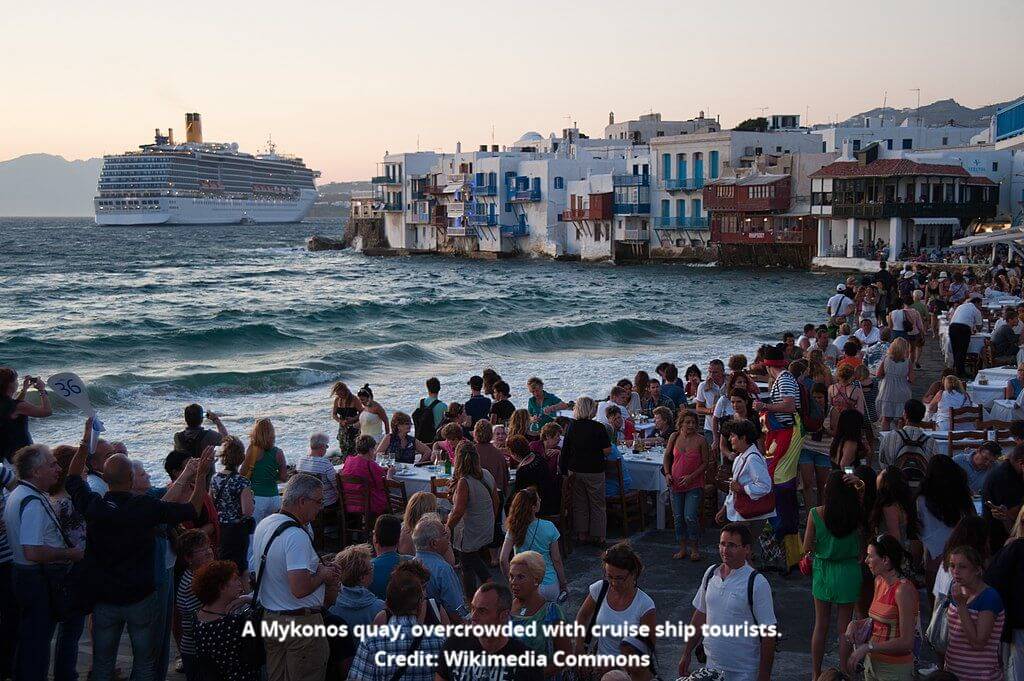
This was the summer when much of Europe said to the ever-increasing flow of tourists, “Sorry, we are full.”
Of course, Europe isn’t full at all. It is just those places that we all want to go, that have been tugging at our imaginations since we began imagining, are hopelessly crowded — and some are brutally hot as well.
The most overcrowded getaways are in southern Europe: Nice, in the legendary South of France; Barcelona, Spain; Italian coastal towns, especially Venice; the best-known Greek islands such as Mykonos, Hydra and Santorini. Along the Croatian coast, Dubrovnik and Split are crowded.
What is ugly outside and delightful inside? Answer: a cruise ship.
The sight of those multitiered behemoths squeezing into a port that was designed for something a lot more gainly reminds me of someone struggling into clothes they have far outgrown. It can be done, but it isn’t pretty.
You can’t blame everything on cruise ships. They aren’t to blame for the summer traffic jams in Britain’s Lake District or around the Cotswolds. They aren’t the reason you can’t get into the great museums of Europe in summer, such as the Louvre in Paris or the Churchill War Rooms in London.
But cruise ships have become a particular problem for much of coastal Europe and aren’t the kind of tourism locals want.
The Greek tourism minister, Olga Kefalogianni, explained it to me when I interviewed her a few years ago. She said that the cruise ships dump a lot of people who don’t spend enough time (i.e., money) ashore. They disembark a veritable army who take tours and are back on board for supper. The ships tend to sail at night to avoid overnight docking fees, and the locals get very little economic gain from the thousands upon thousands who arrive every summer.
She told me Greece was trying to get more of the restocking contracts and to have more of the ships homeport in the country.
For tourists, in general, she said: Avoid the famous sights, such as the Acropolis in Athens, in summer and try to visit in the spring and fall.
She said for Greece, where tourism is especially important, it is a delicate matter, urging tourists to go to the less-visited northern areas of the country.
A couple of summers ago, I was in Santorini when five cruise ships arrived simultaneously. It was ugly. There is a cable railway to get up to the pretty town of Fira, and it meant waiting — and fuming and cursing all of the other cruise ships.
A friend said he had to ride down from the cliffside town on a donkey in order to make his ship’s departure.
There are questions about cruising. Many of them involve a kind of travel snobbery. Some seemingly well-traveled people reject cruising. “I wouldn’t want to be stuck with all those people. Never,” a friend told me.
A large cruise ship with nearly 6,000 passengers and a crew of about 2,000 is, well, just about the size of many of the largest hotels. New York’s Waldorf Astoria had 1,400 rooms from the time of its construction in 1931 until it was gutted and rebuilt recently — and the number of rooms was greatly reduced. The largest hotels in Las Vegas, the Mirage and the Venetian, are the size of the largest ships.
The problem isn’t with the number of your fellow cruisers, but with the destination ports: The cruise ships have worn out their welcome in some places, not others.
My wife and I were hostile to cruising until we did it. That was in the Mediterranean and the Black Sea in the early 1990s and we saw places — such as Yalta, Odessa and Constantia — that we maybe wouldn’t have seen otherwise.
So, we formed a pattern of using cruising for exploration rather than sightseeing. We went through the Panama Canal when it came back into the news because we wanted to see it and know what it was like. We went around Cape Horn, seeing one of the ends-of-the-earth places, where so many mariners have died, from the comfort of a luxury liner.
That is bucket list-stuff, and I want more of it.

Filed Under: King's Commentaries Tagged With: cruise ships, Europe, France, Greece, Greek, hot, Italian, Mediterranean, Mykonos, Santorini, Spain, Tourists

White House Chronicle on Social

  • Facebook
  • Twitter
  • Vimeo
  • YouTube
Foreign Aid That Works — the Malawi Story

Foreign Aid That Works — the Malawi Story

Llewellyn King

In 2005, Gordon Brown, British chancellor of the exchequer, later prime  minister, was in Washington, seeking to raise $50 billion annually in  additional international aid for Africa. I hosted a press event for Brown at the National Press Club, and I  asked him how all this money would get to the people who needed it? […]

Is Rubio Starting a Nuclear Arms Race in the Middle East?

Is Rubio Starting a Nuclear Arms Race in the Middle East?

Llewellyn King

The Trump administration has announced and appears to be crowing over an agreement with Saudi Arabia to help the kingdom not only to build nuclear power plants but also to enrich the uranium fuel. There is no reason for the Saudis to enrich uranium. There are plenty of willing suppliers of enriched uranium and more […]

Soft Power, the Secret Sauce of the British Empire

Soft Power, the Secret Sauce of the British Empire

Llewellyn King

When President Trump, on the first day of his second term, closed the U.S. Agency for International Development and began dismantling the Voice of America, he also severely curtailed what had been America’s soft power dominance in the world. With those actions, we abandoned something of inestimable value: the ability to project Americanism, our ideals. […]

A British Immigrant’s Defense of Immigration

A British Immigrant’s Defense of Immigration

Llewellyn King

Migration, people moving to new lands, is as old as human history, and as fraught. Today it is a global problem complete with layered hypocrisy, cruelty and, always, hope among those on the move. War and extreme poverty collude in driving people to seek a livable future. There is no simple solution, no slogan that […]

Copyright © 2026 · White House Chronicle Theme on Genesis Framework · WordPress · Log in