White House Chronicle

News Analysis With a Sense of Humor

  • Home
  • King’s Commentaries
  • Random Features
  • Photos
  • Public Speaker
  • WHC Episodes
  • About WHC
  • Carrying Stations
  • ME/CFS Alert
  • Contact Us

A British Immigrant’s Defense of Immigration

July 10, 2026 by Llewellyn King Leave a Comment

Migration, people moving to new lands, is as old as human history, and as fraught. Today it is a global problem complete with layered hypocrisy, cruelty and, always, hope among those on the move. War and extreme poverty collude in driving people to seek a livable future.

There is no simple solution, no slogan that encompasses a fair and reasonable course of action for the receiving country.

I moved from a British African colony, Southern Rhodesia, to the homeland, Britain, when that was our birthright, and to America a few years later. I did that because it was the place I wanted to be, the happening place, the place of all possibility and challenge.

I didn’t plan to stay, and now it is more than 60 years later. And, yes, I was elated to become a citizen.

In those days, if you were British, immigration was no harder than filling in some forms and swearing that you weren’t a communist and wouldn’t live in “moral turpitude” when you got to America. That reprehensible state wasn’t described.

To me, America was more than a country; it was, and remains, a state of mind.

At its best, America is generous, caring, open and empathetic to the world and its hurts. Yet, how human a country! It is replete with hideous mistakes from the Palmer Raids, to McCarthyism and the Red Scare, to the Vietnam War. The gash of slavery hasn’t healed, and racism has left its mark.

America’s genius is that it realizes itself as a work in progress. 

Our major weakness, it always seemed to me, was the obverse of our strength: wishing our ways on others; wanting them to see the light we see. 

Like so many others, my attitudes are conflicted, hypocritical and without a simple, elegant defense. About 30 years ago, I first raised the issue of immigration’s effect on the nation. My concern then was that Spanish was becoming a second language. If that were to happen, I feared the country would enter into the same debilitating, two-nation status that has divided Canada and Belgium.

Also, I have argued against the way immigration has left its mark on Europe, especially from North African migrants who have set up enclaves where there is no attempt to integrate and where their religion has maintained them in isolation; angry minorities in their urban strongholds. That undermines the value of the journey both to the migrant and the host country.

I have come to believe that Spanish isn’t the threat it appeared at that time, and that our ability to absorb and prosper as a result of immigration is at a real and present danger of being wasted, denying us the talent flow that has made us a beacon to the world.

Never forget that every deportation is a human disaster: a life and a family sent into an unknown purgatory.

Recently, I had a weeklong stay at a Rhode Island hospital and marveled at doctors who were from distant lands, including Iran and Arab countries. In the late reaches of one night, I had a crisis. My room was flooded with nurses and their assistants, all helping and caring. From their accents, I was certain that at least four of my angels weren’t born here. I was glad of them.

Just as I am glad that we lead the world in high tech and, at the apex of its leadership, sit immigrants. They dominate at the top tech behemoths.

Not every immigrant has added to America’s greatness; some have brought with them creeds that are hard to accommodate, some have brought crime. Overall, each wave of immigrants has lifted America and its people to new heights.

From those early settlers to the German filmmakers, to the Scandinavians who planted the Great Plains, to the Irish who have informed our culture, to the Italian builders, to the German filmmakers, who came in the 1920s and 1930s and created the Hollywood we know and treasure, to the Jewish refugees from Europe who gave us everything from great music to the magic of Broadway, to high science and lifesaving medical research.

When I first arrived in New York, I wrote to a friend, “This is an extraordinary place, less of a mixing bowl and more of a stew, where all of the ingredients remain intact and yet work together in a kind of wondrous unity.” I wouldn’t withdraw or amend a word of that more than 60 years later.

People move because they aspire to a better life for themselves and their families. Grabbing those who slipped in and sending them to all they sought to leave behind is, to this grateful immigrant, un-American.

We are a big country, big-hearted, too, and we have room for these big contributors to our future.


Filed Under: King's Commentaries Tagged With: America, British, Communist, deportation, Europe, history, immigration, Iran, Irish, Italian, Jewish, Spanish

Watch Out When the Political Class Forgets Cause and Effect

May 1, 2026 by Llewellyn King Leave a Comment

Anyone who has spent time in criminal court knows this: One of the characteristics of lawbreakers is a poorly developed sense of cause and effect.

At the low end, the folly of the defendants is always on display. The young man who takes a gun with him on a night of drinking. He has increased his chances that he might use it and spend the rest of the useful years of his life in prison.

The shoplifter who keeps at it despite past convictions faces undetermined years behind bars. The burglar who robs a house and, while there, calls home on a cell phone, which will ping off the nearest cell tower, negating any alibi. The murderer who posts on social media.

This poorly developed sense of cause and effect isn’t confined to the lawless. It is rife in the political class, in both cohorts, but primarily these days in the ruling Republican cohort.

We, as a nation, appear to have forgotten that actions have consequences. Those consequences ricochet down through the decades, even the centuries.

Bomb people, and you will get a massive refugee problem.

Deny medical funding, and you will get overburdened emergency rooms.

Underfund science, and the talent will pop up somewhere else, like the universities of Europe and Asia.

Cut off immigration, and you will have deflation from population decline.

Create stateless people — they are still people, still there — and they will become a burden.

Don’t raise taxes to cover the $39 trillion national debt, and the interest payments on the debt will be so enormous that there will be little left for the business of governance.

Action has consequences, just as inaction has consequences. Winston Churchill said: “A decision not taken is nonetheless a decision.”

Here are just some areas where the effect may linger long after the cause has lost its currency — long after the action, which seemed to be “a good idea” at the time, was taken:

Cause: Traduced allies, vitiated treaties and long-term friends abandoned with abusive disdain while rewarding the deplorable with praise, recognition and encouragement.

Effect: The slights and the negations won’t be forgotten, but the reason for them will have faded with the perpetrators. America diminished as a global power, taking a seat beside Brazil or Argentina, damned by a history of causing damaging effects for passing motives.

Cause: Profligate use of the presidential pardon.

Effect: A further temptation to abuse power and advance corrupt patronage. Friends go free.

Cause: The abandonment of the sacred right to see a judge, to identify the accuser, to be tried by a jury of your peers.

Effect: A lawless state of injustice and cruelty, the state out of control, thugs loosed on the people.

Cause: Undermine the elections by falsely claiming that they were rigged.

Effect: A fundamental weakening of democracy and the supremacy of the ballot. All elections are doubted and more easily overturned. The system is undermined.

Cause: Sustaining a lie in the belief that if you claim it long enough, it will sow doubt.

Effect: Truth becomes what those who have power say it is, whether it is about an election, immigrants, the cost of wind turbines or climate change. Truth becomes a commodity in short supply in the political marketplace.

All governments make mistakes, and most go too far in the service of political ideas, which have legitimacy for a time and then fade. This time it is different. The list of political actions that will have detrimental effects in the future and substantially threaten our world leadership is long.

Since the end of World War II, we have led the world in everything from creativity to moral example, from generosity in foreign aid to genius in medical science, from legal thought to environmental protection.

Now, political exigency is undermining that. Petty, small triumphs in what are often just the culture wars have effects that diminish us worldwide, and harbinger a more troubled future for us and the world.

Any day, in the heat of a political moment, another cause may leave an effect that will damage the decision-making mechanisms of the Senate. If the filibuster goes, both parties would rue the effects, long and often.

If it goes, the cause will be forgotten, but the effect will endure.

Filed Under: King's Commentaries Tagged With: Churchill, consequences, criminal, governments, immigration, Medical, nation, political, Republican, social media

The Rule of Law Is the Foundation of Civilization

January 16, 2026 by Llewellyn King Leave a Comment

The men you see in masks on your television savagely arresting people may not seem like your affair. But they are your affair and mine, and that of every other American.

U.S. Immigration and Customs Enforcement operates outside of the law. It doesn’t disclose charges, and no one arrested sees a court of law.

ICE agents are also the affair of the whole world, for while they are symbols of local terror, they are also symbols of America’s withdrawal from the one critical underpinning of civilization: the rule of law.

Without it, society isn’t much. No one is secure, even those in charge.

At another time, the victim may be the oppressor. When there is no law, there is only fear. One day, the persecutor behind the mask may find himself persecuted by another man behind another mask.

Once power is wielded indiscriminately, it is free to serve many masters.

During the government of Argentina’s campaign to suppress left-wing political opponents, known as the Dirty War, from 1976 to 1983, a new way of settling personal disputes emerged.

The police arrested so many and killed them secretly — between 10,000 and 30,000, and the victims became known as the “disappeared” —  that soon murder became easier. If you didn’t like a rival or even a family member, you “disappeared” them — and that was that. No one would report such disappearances to the police for fear that it was the work of the police.

When I was in Argentina after the Dirty War, I was told about a man who didn’t like his mother-in-law and disappeared her. Lawlessness breeds lawlessness.

Currently, in areas of America where ICE is present, there is a common assumption that if someone suddenly goes missing, it means ICE has detained them, and they are likely being sent to a detention center for deportation.

Mickey Spillane, the American crime writer, once said the only difference between the police and the criminals was that the police were employed by the government. We see that with ICE.

In 1215, at Runnymede, the nobles of England told King John to cut it out. They demanded an end to the arbitrary confiscation of property and his majesty’s habit of handing out sentences without trial.

Habeas corpus (“that you have the body”) dates in English law to before the Magna Carta, but it was codified there. The Napoleonic Code embraces many of the same elements as the Magna Carta, although Napoleon eschewed English common law when he revised French law into the code in 1804.

Now, about half of the world’s legal systems are based on the French code, and half, including 49 U.S. states, are based on English common law. Louisiana has a hybrid of the two.

Nonetheless, it is a tenet of both systems that the individual will face trial and know his or her accusers, that the accused could be tried by his or her peers, and that the accused has rights.

Historically, the British relied heavily on the rule of law. In fact, law and its application became a mainstay of maintaining order in Britain and in the Empire. It was part of the concept of British exceptionalism.

The dignity and openness of trials were an important part of the colonial ethos. In Southern Rhodesia, before the country suffered a civil war and became Zimbabwe, I was a defendant in a minor dispute with a hotel over a bill. Even though I had settled the bill, I was ordered to appear before the native commissioner’s court in the remote area of the country where the hotel was located.

The court was a room with a single table and chair. Everyone else sat on the floor. It was crowded with justice-seekers and defendants, all of them black.

Only the commissioner and I were colonials. I thought the process would be nothing more than a courtesy call, a wink and blink.

Finally, the great man with bushy, unkempt, white hair and a mustache called me to the table. He read the now-moot complaint and dressed me down in terms I have never been dressed down, even by irate readers.

He said I was a disgrace to Britain, to my ancestry, to my family, and to my school. But, he said, I had especially let down the Empire. I was warned that if I ever faced him again for any reason, no matter how minor, I would get strict punishment.

It was really a rough way to treat a teenager, but it was part of the justice of the day that had to be seen as even-handed and blind.

In “Oliver Twist,” Charles Dickens wrote that “the law is an ass.” I think it is a beautiful beast, despite running afoul of it in colonial Africa. We need it back in the U.S. stable.

Filed Under: King's Commentaries Tagged With: civilization, deportation, I.C.E., immigration, Law, Magna Carta, merican, secure, society, terror

How the Special Relationship Became the Odd Couple

September 5, 2025 by Llewellyn King Leave a Comment

Through two world wars, it has been the special relationship: the linkage between the United States and Britain. It is a linkage forged in a common language, a common culture, a common history and a common aspiration to peace and prosperity.

The relationship, always strong, was burnished by President Ronald Reagan and Prime Minister Margaret Thatcher.

Now it looks as though the special relationship has morphed into the odd couple.

Britain, it can be argued, went off the rails in 2016 when, by a narrow majority, it voted to pull out of the European Union.

With a negative growth rate, and few prospects of an economic spurt, Britons can now ponder the high price of chauvinism and the vague comfort of untrammeled sovereignty. Americans could ponder that, too, in the decades ahead.

Will tariffs — which have already driven China, Russia and India into a kind of who-needs-America bloc — be the United States’ equivalent of Brexit? This economic idea doesn’t work but has emotional appeal; it is isolating, confining and antagonizing.

A common thread in the national dialogues is immigration.

Britain is swamped. It is dealing with an invasion of migrants that has changed and continues to change the country.

In 2023, according to the U.K. Office for National Statistics, 1.326 million migrants moved to Britain; last year, the number was 948,000. There has been a steady flow of migrants over the past 50 years, but it has increased dramatically due to wars around the globe.

Among European countries, Britain, to its cost, has had the best record for assimilating new arrivals. It is a migrant heaven, but that is changing with immigrants being blamed for a rash of domestic problems, from housing shortages to vastly increased crime.

In the 1960s, Britain had very little violent crime and street crime was slight. Now crime of all kinds — especially using knives — is rampant, and British cities rival those across America — although crime seems to be declining in America, while it is rising in Britain.

Britain has a would-be Donald Trump: Nigel Farage, leader of the Reform U.K. party, which is immigrant-hostile and seeks to return Britain to the country it was before migrants started crossing the English Channel, often in small boats.

Farage has been feted by conservatives in Congress, where he has been railing against the draconian British hate-speech laws, which he sees as woke in overdrive.

Britain has been averaging 30 arrests a day for hate speech and related hate crimes, few of which result in convictions.

Two recent events highlight the severity of these laws. Lucy Connolly, the 42-year-old wife of a conservative local politician, took issue with the practice of housing immigrants in hotels; she said the hotels should be burned down. Connolly was sentenced to 31 months in jail. She has been released, after serving 40% of her sentence.

A very successful Irish comedy writer for British television, Graham Linehan, posted attacks on transgender women on X. On Sept. 1, after a flight from Arizona, he was met by five armed police officers and arrested at London’s Heathrow Airport.

Britain’s hate laws, which are among the most severe in the world, run counter to a long tradition of free speech, dating back to the Magna Carta in 1215. An attempt to get more social justice has resulted in less justice and abridged the right to speak out. It’s a crisis in a country without a formal constitution.

On Sept. 17, Trump is due to begin a state visit to Britain. Fireworks are expected. Trump’s British supporters, despite Farage and his hard-right party, are still few and public antipathy is strong.

Trump, for his part, will seek to make his visit a kind of triumphal event, gilded with overnight posts on Truth Social on how Britain should emulate him.

The British press will be ready with vituperative rebukes; hate speech be damned.

It is unlikely that the Labor government, whose membership is as diverse and divided as that of the Democratic Party, will find anything to call hate speech about attacks on Trump. A good dust-up will be enjoyed by all.

Isolated, the odd couple have each other.

Filed Under: King's Commentaries Tagged With: Brexit, Britain, crime, European Union, Farage, immigration, Margaret Thatcher, odd, Ronald Reagan, trump, United States

Walking Toward Hope on the Southern Border

October 26, 2018 by Llewellyn King Leave a Comment

If you want to come to the United States illegally, the worst point of entry is along the southern border. If the U.S. Border Patrol doesn’t get you, the gangs that prey on the hapless might; if not, you have a good chance of dying of heat prostration and lack of food and water in the desert.

The smart ones, the conniving illegals, aren’t the destitute walking in blazing heat for a rendezvous with Border Patrol agents and then lord knows what, but those who fly in with student visas, tourist visas and other travel documents and disappear into the shadows.

The people in what is loosely called a “caravan” now walking toward the border have been failed by the societies that bore them. They live in fear of murder, fear of repeated rape and other violence, and fear of starvation. They live in their own circle of hell.

But they aren’t alone. There are many millions more in the failed and failing states, war-ravaged and drought-plagued, in Africa and the Middle East, trying to find a new home. Their exodus is a trickle today but will be a torrent tomorrow and a flood later.

The hopeless are on the march and they threaten to engulf some nations, like tiny Malta, an island in the Mediterranean and a European Union member state.

Europe is struggling with a flood of desperate people who cross the Mediterranean from North Africa in overloaded rafts and boats, risking drowning to reach Malta, Greece or Italy: places where they hope for food, shelter and safety.

Illegal immigration is a global problem. No country has a solution and no country deals well with it.

There are wars and insurgencies in Africa and the Middle East: Consider just the Democratic Republic of the Congo and South Sudan.

Of Africa’s 54 countries, none has anything like enough jobs for its population — its  growing population. Even rich South Africa has a growing population and shrinking economic activity. Add to the failed or under-performing economies drought and climate change and you can imagine new surges in migration — surges so large they could overwhelm the target countries.

In the Middle East, new refugees are created daily. Eleven million are on the brink of famine in war-engulfed Yemen, and Syria continues to generate refugees at a stupendous rate.

Thirty-five years ago, I was at France’s Ministry for Europe and Foreign Affairs, known colloquially as the Quai d’Orsay. My briefer said, “If we don’t solve the problem of poverty, we’ll get three imports we don’t want: drugs, terrorism and people.”

The world hasn’t solved the poverty problem and it’s gotten the three things it doesn’t want.

There is no grand solution at hand, but there are small things that can be done. For us, the first might be to stop worsening conditions in the countries that are generating the flows of people toward the border. Two things would help: Don’t cut off foreign aid, exacerbating economic conditions, and don’t cut off the flow of expatriate earnings, which is so important in those countries. In other words, stop the deportations.

People who are here illegally and hold jobs would hold better jobs if their status was legalized. One solution would be time-limited work permits: not citizenship, work permits.

This is advocated by the Immigrant Tax Inquiry Group, which adds an appealing twist. The Malibu, Calif.-based group recommends that illegals should pay a special tax on their wages with an equivalent tax paid by the employer. The purpose of the tax is to alleviate the local effect of immigrants on schools, policing, courts and health care.

Considering the global problem, we have a small, manageable one. The caravan of people walking through Mexico have a bigger problem: They’re inflaming Americans and endangering their own lives — some deaths have been reported.

But if I were destitute and feared for my life in Central America, I’d likely be headed for the border, feeling I was doing something, even something hopeless.

Filed Under: King's Commentaries Tagged With: immigration, refugees

The Case for the Eight Hundred Thousand Innocents

October 13, 2017 by Llewellyn King Leave a Comment

Pity the “Eight Hundred Thousand.” Pity those who came here as the children of parents who moved illegally to the United States. Pity them for every day they walk in dread: Will they be deported if President Trump loses in his power play with Congress over their future? Them or the Wall.

They, these children, some adults now, live in a place uniquely dreadful as they go through each American day — the only days most of them know or can remember. Pity them as they go about their business of school or work, speaking the only language many of them know: English.

Pity them as they wonder if they will be forced, by brutal deportation, to start life over in country in which they may be truly aliens. Not so bad for those from Ireland or Australia, where they will be accommodated by enlightened governments, but those are the small minority.

Think, instead, of those who must go back to the poverty and war, the deprivation and violence, the sheer horror of a life so harsh we cannot with ease imagine it. That is what awaits them in much of Latin America, Africa and parts of Asia and the Middle East.

The illegals committed what is only a misdemeanor in law and tried to improve their own lives and dared to hope for work, food and shelter in the United States. They hoped for more for their dependent children. They shared the same motive that has always brought people to these shores: the dream of a better life.

Unwanted migration is a huge global problem. The desperate vote with their feet. Ironically, illegals have one of the qualities prized in our culture: enterprise. It is not easy to get here and it is not easy to live in the shadows.

But must the children of illegals also live in the shadows, fearing the knock on the door that ends their hope? Must the iniquity of the fathers, as it says in the Book of Exodus, be visited upon the children?

The administration has worked mightily to demonize all illegals, to brand them as murderers, rapists and job-snatchers despite study after study showing illegals to be more law-abiding than the citizen population. Yet Trump is set on deportations and triggering a season of fear in the migrant community.

The knock on the door is one of the terrifying sounds that echoes down through history, a knell of horror for the oppressed. When the state — whether it was the Roman state, the Inquisition state, the Nazi state, the Soviet state or the apartheid state — comes a-calling, it is a time of unmitigated fear.

To hold the “Eight Hundred Thousand” hostage to Trump’s other immigration demands is callous and supremely cruel. He has claimed sympathy for the children who are here through no fault of their own, but his subsequent actions belie that.

Is the president’s only motivation to undo, with pathological fervor, everything that President Obama did? Is the human cost to have no entry in his ledger?

If the deportations begin to include the Dreamers, then there will be shame aplenty to go around. Shame on the Republicans in Congress, who mutter privately against the Trump excesses but do not act, perhaps out of fear of Twitter ridicule. Shame on the evangelical churches, who preach family values but are silent on the tearing apart of parents and children, husbands and wives, mocking all that they profess to hold dear.

There is an economic case for considering the issue of illegals, who are here and contributing mightily. But the moral and human case for the children — these innocents who have adopted us — is prime. Time to adopt them.

To leave the “Eight Hundred Thousand” in limbo is to tear the cloth of our decency.

I get regular cascades of emails that ask: What is it they do not understand about “illegal”? I ask: What is it they do not understand about “innocent child”?


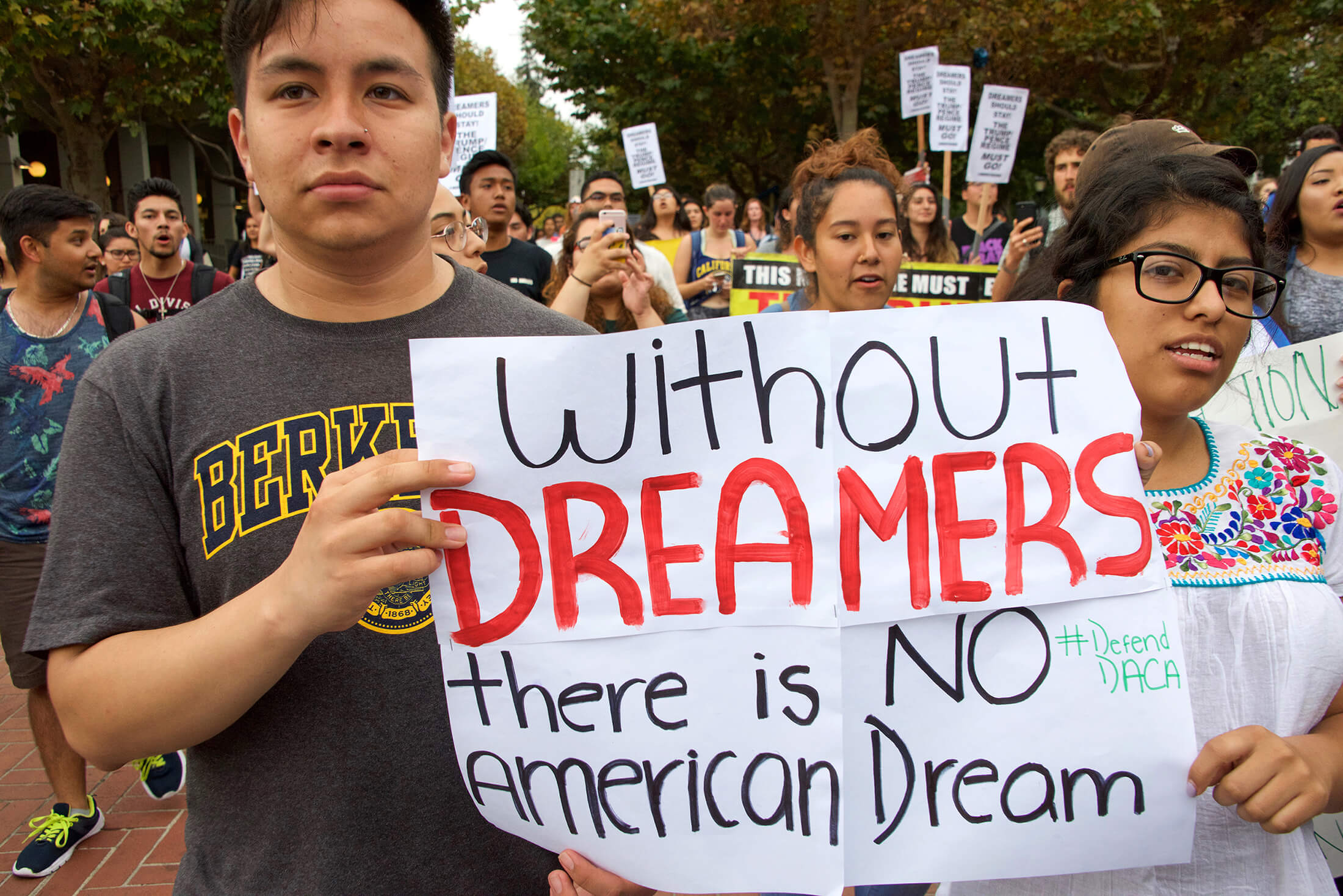
Photo: Berkeley, CA – September 05, 2017: Unidentified participants protesting Trump rescinding DACA,. Approximately 200 demonstrators gathered in UC Berkeley’s Sproul Plaza and marched down Telegraph Avenue. SHEILA FITZGERALD / SHUTTERSTOCK.COM

Filed Under: King's Commentaries Tagged With: DACA, immigration

The Supreme Ugliness of the Deportation Regime

April 20, 2017 by Llewellyn King 1 Comment

It is ugly today, it will be uglier tomorrow and months from now, it will be even uglier. The relentless rounding up of undocumented people living in the United States is the horror that can be ended, if there was a will to end it – and if it were not a source of political feedstock for unyielding positions so close to the Trump presidency.

Mind you, it was not all that pretty under the Obama administration. He signaled his heart was in the right place while the deportations continued. What Obama did was to protect, by executive order, the undocumented who were brought in by their parents while underage. Now there is a report of the first of these dreamers, Juan Manuel Montes, being arrested.

We get little snippets of how ugly the deportations are from time to time in the media: a child bawling her eyes out because ICE policemen have seized her mother. That poor woman is on her way to a country she left because there was little there for her when she committed the crime of settling without papers in the United States; when she availed herself of the opportunity which nearly all American settlers once did: to live and work in freedom and peace.

In writing about the inhumanity of deporting the undocumented, I know what I have opened myself up to a flood of abusive mail, denouncing me as a crypto-communist and much worse. Always the same theme and often the same words inform these communications: “What is it that they don’t understand about illegal?” That is crime enough for those who want mass deportations.

At present the threshold, we are told, is that the deportee should have at some time committed a felony. Under federal law, illegal residence here is not a felony but a misdemeanor. One such crime in some states is driving under the influence. A felony? Yup. By the way, it is a crime for which former President George W. Bush was convicted in 1976.

Things are going to go from ugly to hideous when the federal government brings its might against sanctuary cities. There is the raw combustible material of civil strife here — ugliness in the streets which has not been seen since 1968.

When neither of two options is acceptable, it is time to seek a third way: a compromise.

I have been advocating a compromise which was developed by a quiet, former IRS tax inspector and California university system auditor who lives in Malibu, Calif. He is Mark Jason and his idea is simple: cool things down and get some benefit for local authorities in areas where the undocumented are concentrated.

Jason and his Immigrant Tax Inquiry Group, wholly funded by himself, would recognize the presence of the undocumented and give them a way to remain and live productive lives. His proposal is a 10-year work permit dependent on a tax of 5 percent to be paid by both the worker and the employer. Jason calculates a revenue bounty of $176 billion over 10 years. There would be no citizenship for the worker. This money, Jason says, ought to go to the localities where the undocumented live and to defray the costs of education, healthcare, policing and other essential services.

This third way, this 5-percent solution, would not satisfy the immigrant advocates who want a “path to citizenship” or those who want to throw the baggage out; the dreaded knock on the door, families shattered, dreams turned into nightmares.

I still think we must control immigration, prevent it at points of entry, not when a life has been established and families are at risk.

There is a horror greater than the illegality of an otherwise productive citizen. It is the supreme ugliness of the state sending its agents against the individual, whether it is the state seeking to bivouac troops in private homes, as the English did to the American colonists, or the agents of the state coming into a home to rip it asunder.

That is an ultimate ugliness, unspeakable, unbecoming and, dare I say, un-American.

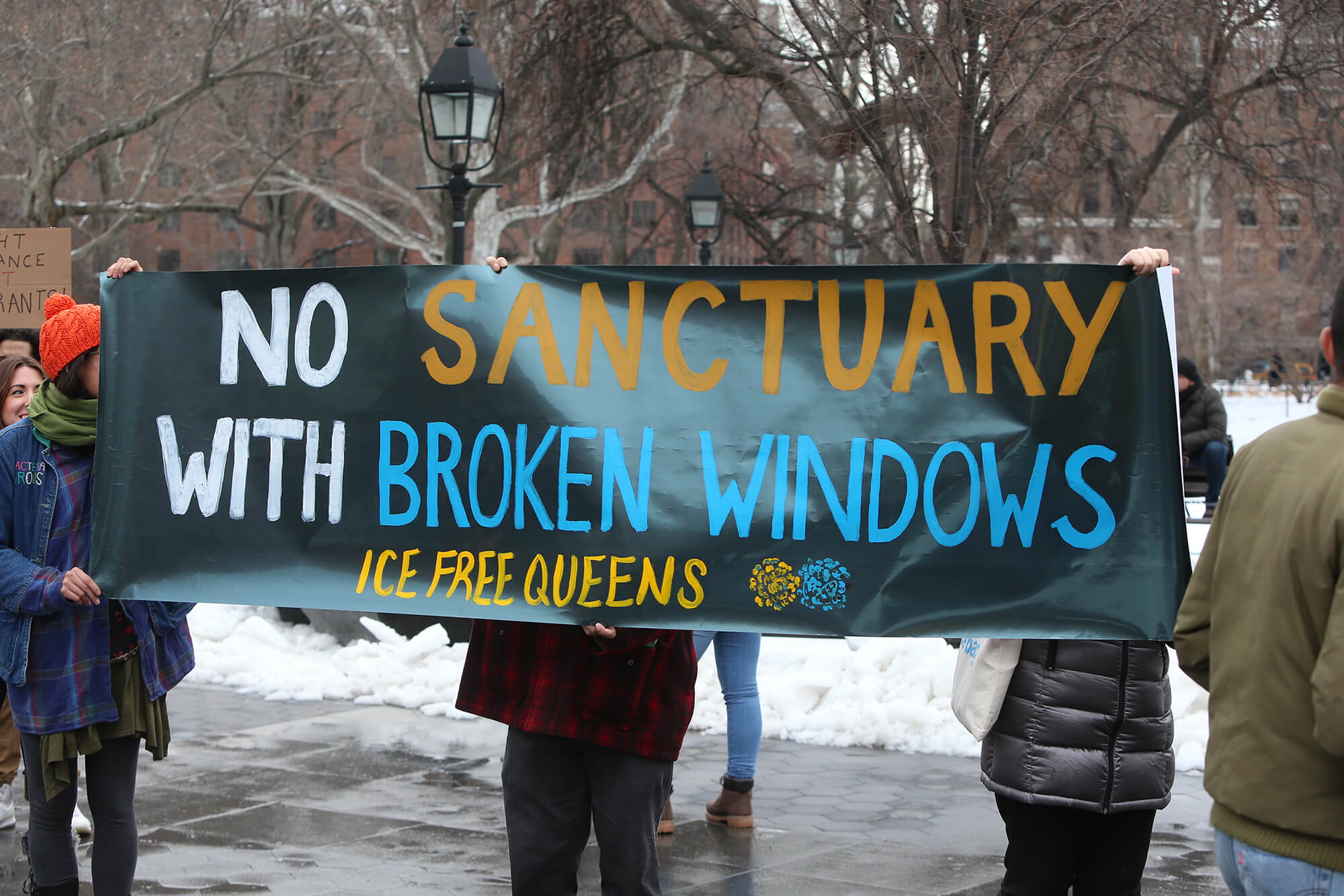
Photo: NEW YORK CITY – FEBRUARY 11 2017: Several hundred protesters gathered in Washington Square Park to voice support for immigrants & Muslims in light of Trump’s travel ban.

Filed Under: King's Commentaries Tagged With: ICE, illegal immigrants, immigration, Mark Jason

St. Patrick’s Day and the Delicate Matter of Irish Immigration

March 10, 2017 by Llewellyn King Leave a Comment

St. Patrick’s Day is hard upon us. The green dye is being added to the beer in bars across the land, while more than 40 million Americans will remember their linkage to the Old Sod, even if that is sometimes tenuous.

Aye, it’s time for a wearing of the green and we will do it on March 17, in the great celebration of a small Irish nation and its relatively obscure patron saint.

On St. Paddy’s Day, we are all Irish whether we are, in fact, African-American, Chinese-American, Italian-American or any other hyphenated American. We all watch the parades, maybe take a drink or two and wear some green, from a hair ribbon to a whole suit.

If Britain has a special relationship with the United States, then Ireland has an extra-special relationship.

As has become a modern tradition, the taoiseach — as the prime minister of Ireland is called — will visit the White House and lobby President Donald Trump.

The prime minister, Enda Kenny, heads Fine Gael, which is more conservative than Ireland’s other two parties. Kenny will, one supposes, present the customary bowl of shamrock and talk of the long history of Ireland and the United States. Ireland has always looked to the United States as kind of safety valve — a place where Irish immigrants could find safety and hope, particularly during and after the Potato Famine of 1845-49.

Kenny also will have a purpose: lobbying Trump on behalf of the 50,000 Irish who are in the United States illegally — “illegal aliens” in the lexicon of the administration.

But the Irish PM will eschew that term in favor of “undocumented immigrants.” He will want to invoke that long history of migration from Ireland to America. He might even point out that the “wearing of the green” was illegal during the Irish Rebellion against the British in 1798.

The language is as loaded in Ireland as it is here. The Irish like to refer to their paperless migrants to the United States as “undocumented” — suggesting a slight matter of language, rather than an implicit indictment of “illegal.”

By contrast, and several Irish commentators have pointed out, workers in Ireland who do not have papers to work or live are referred to by Irish politicians as “illegal aliens.”

The Irish intelligentsia and many Irish analysts say this is racist. That the unspoken message Kenny will convey to Trump is: Take it easy on the Irish undocumented, they are white and Christian. Not brown or Muslim. We are you.

The Irish Times columnist Fintan O’Toole rages against what he sees as the race preference, and points out that the Trump administration is loaded with those of Irish descent. O’Toole calls them the “enablers” of Trump’s immigration policy: They are advisers Steven Bannon and Kellyanne (nee Fitzgerald) Conway, press secretary Sean Spicer and homeland security secretary John Kelly — as was short-lived national security adviser Michael Flynn.

Another Irish journalist, Cillian Donnelly, makes the same points and fears that Kenny, who has said his mission is to speak up for the undocumented Irish in America, will become complicit in the Trump immigration stand and the deportation of “brown” migrants.

Trump himself has links to Ireland. He owns a huge golf course and hotel in Doonbeg, on County Clare’s Atlantic coast.

Ironically, there he is enmeshed in a dispute over building a seawall. It seems when it comes to Ireland, Trump believes in global warming and sea rise: He has tried to get permission to build a 1.7-mile-long wall to keep severe storms from flooding his resort.

Trump’s request to build the original masonry wall were turned down, and he is pushing for two more limited rock and steel structures. Environmentalists are opposing them, too. They maintain that these structures will not end the erosion, but rather will increase it with time, destroying the dunes. However, Trump is the largest local employer and his wall is supported locally.

If all this is enough to drive you to drink, St. Patrick’s Day is a good time to start. Slainte!

Filed Under: King's Commentaries Tagged With: Enda Kenny, immigration, Ireland, St. Paddy's Day

Mass Deportations — the Surfacing of the Worst in Us

February 24, 2017 by Llewellyn King Leave a Comment

The accelerated deportation of illegal immigrants is brainless, cruel, antagonizing to many allies and neighbors and, ultimately, banal. It is antithetical to our better natures and to the humane face of America that has made us an exemplar for human rights, a voice for the voiceless and, as Ronald Reagan said, “a shining city on a hill.”

It is American exceptionalism abandoned for petty prejudice.

There is linkage — there always is linkage — between the desecration of the Jewish Chesed Emeth Cemetery in University City, Mo., and those knocks on the door as the men from Immigration and Customs Enforcement (ICE) perpetrate the obscenity, ordered up by those in authority. Prejudice has been affirmed by government.

No country in this disturbed world can allow unfettered immigration, but to turn on those who have crossed the border for the simplest human reason — need — with the full force of the state and to send them to a place where they fled for a better life, for a dream — the American Dream — is to implement a crime against humanity.

Hate is easily inflamed. The darkest passion of human beings is to love to hate, to blame all of life’s ills on others and to seek to punish them for just being. It is what produced the sectarian violence in Ireland, perpetuated apartheid in South Africa, and caused the great horrors of the last century, including the Armenian massacre in Turkey and the Holocaust. Not only do people love to hate but hate becomes hereditary, handed down through the generations.

The United States has struggled against its incipient hates and even appeared, with the election of Barack Obama, to be able to put them aside. But we have come through a political season where hate has been dog whistled and it has come running.

If you think what you have just read is far-fetched, let me tell you that every time I write about immigration and the plight of the dispossessed, I am deluged with virulent, hate-filled emails. Once this evil genie is loose, no prejudice is out of possibility.

All my emails repeat this political phrase out of last year’s campaign, “What part of ‘illegal’ don’t you understand?” How many things that were illegal in my lifetime are now legal? Try segregated lunch counters and homosexuality, for starters. The goal posts move.

You can build a single act of illegality — in this case crossing a border to get a better life — into a crime of giant proportions without statute of limitations: a mark of Cain, an indelible stain. But it is not. The hard-pressed father and mother, breaking the law by working without papers, and yet holding it all together so that the children might have it easier, is the face of these criminals. Lives in extremis.

Study after study has shown that they are less likely to commit violent crimes or to disturb the peace than Americans whose ancestors arrived on these shores as immigrants in another time.

To break up families, to send people to countries where they are de facto foreigners with no means of supporting themselves and where they will encounter hostility and danger, in the name of legality, is preposterous. It is something that will pass into history as a time when our country — America the Great — did something totally unworthy of its better nature.

When the state moves people by the millions for its own purposes, terrible injustice and human suffering result.

We did that: We have the mark of slavery in our DNA. In small measure we expiated that, until this dark time. Shame!

For InsideSources

Filed Under: King's Commentaries Tagged With: apartheid, deportation, Donald Trump, hate crimes, ICE, illegal immigration, immigration, racism

The Horror When the Men from ICE Come Knocking

February 17, 2017 by Llewellyn King Leave a Comment

I wonder daily, really, what life is like on the other side of the windowpane that separates the legal resident from the illegal.

I wonder if the skinny, young Chinese woman working in the restaurant is legal. I have noticed her because she works so hard: She is there when it opens and when it closes.

The restaurant is family owned, so I wonder if she is there legally — a link in “chain migration” — or illegally, in a kind of servitude. The chain is forged when a legal family sponsors other family members, who can then come here preferentially, welcome and free.

If she came here otherwise, say on a tourist or student visa, and did not return to her home country, then she is in danger of a knock on the door, handcuffs and the horror of deportation. And if she is arrested for a crime, no matter what, she is closer to the door.

I also wonder about the Mexican family that detailed my old car so well in the July heat. Cash work without a paper trail tells part of their story. Did they walk across the border from Mexico together or separately? The women speak English, but not the men. Were they a family before or after coming here? Are some of them here legally; will children lose their fathers, wives their husbands, if there are deportations?

Meeting agents from Immigration and Customs Enforcement (ICE), wearing black windcheaters with “POLICE” on top of “ICE” emblazoned in white on the backs, must be a heart-stopping experience. These are federal enforcement agents, police, not paper-pushers. This is rough stuff, not community policing.

I listen to tales of deportations: families torn apart, and people sent to countries where they were born but had never resided. I wonder if these people are yearning for U.S. citizenship and the ability to vote. Mostly, I think they are yearning just to live here in peace, free from the fear of a knock on the door from ICE agents.

Mark Jason, a friend who lives in Malibu, Calif., has devised a way to deal with illegal immigrants that eschews the brutality of deportations and the emotional hostility that amnesty for them provokes in some Americans. He calls it the “Third Way” and for six years, he has been promoting it with his own money.

Like many good ideas, Jason’s plan is very simple: He wants to create a 10-year, renewable “Special Work Permit” with an additional dimension: holders need to earn the permit by complying with our laws and paying a 5-percent tax on their wages, and their employers will also pay a 5-percent tax.

Taxes collected from these permits would amount to $167 billion in 10 years, according to Jason’s think tank, the Immigrant Tax Group. “Payments could be facilitated by cell phone and computer technology, and the immigrants gain their freedom with certain rights and can assimilate more easily,” Jason said.

“These payments would be used to provide hospitals, schools, policing and prisons in the local communities where the immigrants live. This third way is a win-win that can be implemented simply,” said Jason, who is a retired budget analyst for California’s university system and a former IRS agent.

If I am right about the status of the young Chinese woman and the Mexican family, they could all live the American dream, working without the fear of a knock on the door: the knell that sounds for all who live in fear of the state and its agents, who have terrified down through the centuries.

Filed Under: King's Commentaries Tagged With: deportation, Donald Trump, ICE, illegal immigration, immigration, immigration solutions

  • 1
  • 2
  • Next Page »

White House Chronicle on Social

  • Facebook
  • Twitter
  • Vimeo
  • YouTube
The ‘New Weather’ Reality Will Change the Nation, Defy Politics

The ‘New Weather’ Reality Will Change the Nation, Defy Politics

Llewellyn King

I have never done political consulting. So it was novel to me when a candidate in the midterms asked me what he should be worried about in 2027. I repeated what Harold Macmillan, British prime minister from 1957 to 1963, is believed to have said, “Events, dear boy, events.” Actually, I had a little list […]

How U.S. Natural Gas Came Back from the Dead

How U.S. Natural Gas Came Back from the Dead

Llewellyn King

The Trump administration is proud of America’s dominance in natural gas. The nation is the world’s largest producer and a net exporter. We produce a quarter of the world supply of the fuel, which has become fundamental to electricity production. Forty-three percent of our electricity is generated from natural gas. According to the Energy Information […]

Foreign Aid That Works — the Malawi Story

Foreign Aid That Works — the Malawi Story

Llewellyn King

In 2005, Gordon Brown, British chancellor of the exchequer, later prime  minister, was in Washington, seeking to raise $50 billion annually in  additional international aid for Africa. I hosted a press event for Brown at the National Press Club, and I  asked him how all this money would get to the people who needed it? […]

Is Rubio Starting a Nuclear Arms Race in the Middle East?

Is Rubio Starting a Nuclear Arms Race in the Middle East?

Llewellyn King

The Trump administration has announced and appears to be crowing over an agreement with Saudi Arabia to help the kingdom not only to build nuclear power plants but also to enrich the uranium fuel. There is no reason for the Saudis to enrich uranium. There are plenty of willing suppliers of enriched uranium and more […]

Copyright © 2026 · White House Chronicle Theme on Genesis Framework · WordPress · Log in