White House Chronicle

News Analysis With a Sense of Humor

  • Home
  • King’s Commentaries
  • Random Features
  • Photos
  • Public Speaker
  • WHC Episodes
  • About WHC
  • Carrying Stations
  • ME/CFS Alert
  • Contact Us

A Conversation With 2026 on America’s Meaning to the World

January 2, 2026 by Llewellyn King Leave a Comment

Come on in, 2026. Welcome. I am glad to see you because your predecessor year was not to my liking.

Yes, I know there is always something going on in the world that we wish were not going on. Paul Harvey, the conservative broadcaster, said, “In times like these, it helps to recall that there have always been times like these.”

Indeed. Wars, uprisings, oppression, cruelty and man’s inhumanity to man are to be found in every year. But last year, the world lost something it may not get back. You see, ’26 — you don’t mind if I shorten your title, do you — we lost America. Not the country but the metaphor.

We were, ’26, despite our tragic mistakes — including slavery and wrongheaded wars — a country of caring people, a country that cared (mostly) for its own people and those who lived elsewhere in the world.

It was the country that sought to help itself and to help the world. It was the sharing country, the country that showed the way, the country that sought to correct wrong, to overthrow evil and to excel at global kindness.

It was the country that led by example in freedom of speech, freedom of movement and in free, democratic government.

When John Donne, the English metaphysical poet, described his lover’s beauty as “my America” in the 1590s, he foreshadowed the emergence of the United States a nation of spiritual beauty.

From World War II on, caring was an American inclination as well as a policy.

We rebuilt Europe with the Marshall Plan, an act of international largesse without historical parallel. We rushed to help after droughts, fires, earthquakes, hurricanes, tsunamis and wars.

We were everywhere with open hands and hearts. America the bountiful. We had the resources and the great heart to do good, to show our own overflowing decency, even if it got mixed up with ideology. We led the world in caring.

We bound up the wounds of the world, as much as we could, whether they were the result of human folly or nature’s occasional callousness.

We delivered truth through the Voice of America and aid through the U.S. Agency for International Development. Our might was always at hand to help, to save the drowning, to feed the starving and to minister to the victims of pandemic — as with AIDS and Ebola in Africa.

In 2025, that ended. More than a century of decency suspended, suddenly, thoughtlessly.

America the Great Country became America Just Another Striving Country, decency confused with weakness, indifference with strength, friends with oil autocracies.

It wasn’t just the sense of noblesse oblige, which not only distinguished us in the 20th century, but also earlier. In the 19th century, we opened our gates to the starving, the downtrodden and the desperate. They joined the people already living here to build the greatest nation — a democracy — that the world has ever seen. First in science. First in business. First in medicine. First in agriculture. First in decency.

These people brought to America labor and know-how across the board, from weaving technology in the 18th century to engineering in the 19th century to musical theater in the 20th century, along with movie-making and rocket science.

I would submit, ’26, that it is all about American greatness, and last year we slammed the door shut on greatness, abandoned longtime allies and friends. We forsook people who had been compatriots in war, culture and history for the dubious company of the worst of the worst, aggressors, oppressors, liars, everyone soaked in the blood of their innocent victims.

Yes, ’26, America stood tall in the world because it stood for what was right. Its system of law — including the ability to have small wrongs addressed by high courts — was the envy of foreign lands where law was bent to politics, where democracy was an empty phrase for state manipulation of the vote. The Soviet Union claimed democracy; America practiced it.

America soared, for example, with President Jimmy Carter’s principled and persuasive pursuit of human rights and President Ronald Reagan’s extraordinary explanation of its greatness: the “shining city upon a hill.”

It sunk from time to time. Slavery was horrific; Dred Scott, appalling; Prohibition, silly; the Hollywood blacklist, outrageous.

But ’26, decency finally triumphed and America was great, its better instincts superb — and now worth restoring for the nation and for the troubled, brutalized world.

Good luck, ’26. You will bear a standard that the world has looked to. Lift it high again.


Filed Under: King's Commentaries Tagged With: 2026, Africa, America, decency, Democratic, Europe, freedom, hurricanes, oppression, slavery, war, world

How Europe Stole Christmas and Promoted Snow

December 12, 2025 by Llewellyn King Leave a Comment

The Grinch didn’t steal Christmas. Europe did. Filched it, packed it up and moved it north, where it snows.

In this wholesale looting of the world’s greatest holiday, the U.S., Canada and some other non-European northern habitats were also complicit.

I grew up in the Southern Hemisphere in faraway Zimbabwe — then called Southern Rhodesia, a British colony — and we had to bear Northern hegemony at Christmas. We had to bear it the rest of the year as well, but this is about Christmas and that symbol of the North: snow.

In subequatorial Africa, snow was a distant European asset. We had learned to associate it with Christmas, and we would celebrate the holiday by singing the carol about the good Bohemian King Wenceslas, looking out “on the feast of Stephen, when the snow lay round about, deep and crisp and even.”

Cotton wool was our snow substitute. When we decorated for Christmas, we couldn’t have it lying about “deep and crisp and even.” We just put cotton wool puffs on Christmas trees (another symbol of European expansionism), picture rails and window frames.

The shops used glitter and cotton wool in Christmas window scenes that were out of Victorian-period Europe, not the Holy Land.

Only nativity scenes in churches were exempt from the scourge of cotton wool. Well, mostly. As kids we were confused by the snow mania, and sometimes we tried to embellish the straw in manger scenes with cotton wool.

My mother, who never visited anywhere north of the equator, was a campaigner, in her way, against the theft of Christmas. She would lecture people on what the temperature was at Christmas in Bethlehem. She said it was very hot.

There was no way she could have known what the actual temperature was in Bethlehem, but she didn’t let that inhibit her argument against the Northern appropriation of something that was rooted in the Levant.

In fact, Christmas is the beginning of the coolest time of year in Jerusalem and Bethlehem; the temperature hovers around 40 F. It isn’t a winter wonderland in the way that Christmas is portrayed in Europe and America.

And all that hoopla about sales and shopping till you drop came from those delightful Christmas markets, which you see all over continental Europe at this time of year.

You can blame the Germans for Christmas trees and the Scandinavians for reindeer, but it seems to me that the Brits, my people, have done a rather good job of Christmas appropriation.

Put aside that they have tried to grab the entire concept of the people of Israel. Yes, the British Israelite movement postulates the British are descendants of the 10 lost tribes of Israel.

This is an attempted act of cultural appropriation on a massive scale, and it hasn’t succeeded, but it still has its adherents.

The great English poet William Blake has been more successful. His poem “Jerusalem,” which he wrote in 1804, was put to music by Hubert Parry in 1916 to aid the World War I effort and has become a second British national anthem. People prefer it to “God Save the King” — and it has a better tune.

Blake wrote:

“I will not cease from Mental Fight/ Nor shall my Sword sleep in my hand:/Till we have built Jerusalem,/ In England’s green & pleasant Land.”

Well, that is a very ambitious attempt to steal a legend, and it makes cotton wool seem rather timid in the struggle to own Christmas.

I wish you, yes, a white Christmas. I like the white stuff — snow, not cotton wool.

Filed Under: King's Commentaries Tagged With: Africa, Bethlehem, British, Christmas, Europe, Germany, Grinch, Jerusalem, snow, William Blake

America, for So Long a State of Mind, Is Losing Its Sense of Mission

March 14, 2025 by Llewellyn King 1 Comment

America isn’t just a piece of remarkably fertile real estate between two great oceans. It is also a state of mind.

Even when America has done wrong things (think racism) or stupid things (think Prohibition), it has still shone brightly to the world as the citadel of free expression, abundant opportunity, and a place where laws are obeyed.

When I was a teen in a British colony in Africa, long before I imagined I would spend most of my life in America, I met a man who had seen the promised land. He wasn’t a native-born American or even a citizen, but he had lived in “the States.”

I badgered this man with questions about everything, but mostly things derived from books and movies: Could ordinary people really drive Cadillacs?  As a British writer later said, were taxis in New York “great yellow projectiles”? Did they really have universities where you could study anything, like ice cream manufacturing? Did American policemen actually carry guns?

Our adulation of America was fed by its products. They were everywhere the best. American pickup trucks were the gold standard of light trucks, and American cars — so big — fascinated, although they weren’t ubiquitous like the trucks. Brands such as Frigidaire and General Electric meant reliability, quality and evidence that Americans did things better.

No one thought the streets in the United States were paved with gold, but they did believe they were paved with possibility.

There was criticism, like that of the alleged American hold on the price of gold or the fear of nuclear war. The “shining city upon a hill” idea was paramount long before President Ronald Reagan said it.

And it has been so for the world since the end of World War II. For 80 years, the United States has led the world; even when it spread its mistakes, like the Vietnam War, it led.

America was the bulwark of the liberal democracies — a grouping of European nations, Canada, Australia and much of Asia — that shared many values and outlooks. Call it what it is, or was, Western Civilization, based on decency, informed by Christianity, and shaped by tradition and common expectation.

Central to this was America; central with ideas, with wealth, with technological leadership and, above all, with decency. Now, all of this may be in the past.

This structure has been shaken in less than three months of President Trump’s second administration. It is near breaking point.

This may be the end of days for the Western Alliance, led by America in the ways of democracy and free trade.

Writing in the British monthly magazine Prospect, Andrew Adonis, a peer who sits in the House of Lords as Baron Adonis, states: “Trump doesn’t believe in democracy, just in winning at all costs. He doesn’t believe in an international order based on respect for human rights. He is an authoritarian, lawless plutocrat who admires similar characters at home and abroad.”

Additionally, Adonis says in his article that, unlike the first Trump term, the checks and balances have weakened: “The Republican Party has become a cipher. The Democrats are shell-shocked and demoralized. The courts, the military and Congress are browbeaten, packed with Trump supporters or otherwise compliant.”

I find it hard to argue with this assessment. Why would Trump persist with a tariff regime that was proven not to work with the Smoot-Hawley Tariff Act of 1930, which triggered the Great Depression? Why would he rile up Canada by threatening its independence? Why would he reopen, without a good reason, the issue of the control of the Panama Canal?

Why is he destroying the civil service in thought-free ways? Why is he going after the constitutional freedom of the press and the rights enshrined over millennia for lawyers to represent those who need them regardless of politics? Why is he leading us into a recession: the Trump Slump?

Either the president has no coherent plans, or those plans are devious and not to be shared with the people.

I believe that he enjoys power and testing its limits, that he has no knowledge base and so relies on hearsay to formulate policy. In the end, he may be listed along with Roman emperors who ran amok like Nero and Caligula.

The Western Alliance is at stake, and America is giving away its global leadership. When trust is lost, it is gone forever.

Filed Under: King's Commentaries Tagged With: Africa, America, British, Caligula, Canada, Democrat, gold, New York, Prohibition, Reagan, Republican

Reporter Scores First Cat Interview Since JD Vance’s Comments

August 9, 2024 by Llewellyn King Leave a Comment

After Republican vice-presidential nominee JD Vance denigrated women who keep cats and don’t have children, whom he characterized as sad “cat ladies,” the media erupted. None of my colleagues, to my knowledge, bothered with the No. 1 obligation of their trade: Get the other side of the story.

So, I thought it was my duty to go forth and interview at least one cat.

I can tell you dogs are easy to interview. They will tell you anything you want to hear and are prepared to perform for the camera. Horses are a journalistic dream: They love to be on camera, especially live television, and will tell you the most extraordinary things. The rule is: If it comes from a horse’s mouth, verify.

But cats are a different story. They go for still photographs, preferably on social media. Facebook is a veritable showcase of posing felines.

But moving pictures? Not as much. Actually, interviewing cats and taking candid pictures takes fortitude. It isn’t easy to get a cat that will open up.

After several disdainful rejections (cats really know how to disdain) a Tuxedo house cat of the male persuasion, whose owner is a childless, middle-age lady, agreed to be interviewed if I met certain conditions:

—No moving pictures, just stills suitable for social media.

—No petting or touching of any kind, unless initiated by the subject.

—No attempts to bribe with food or “blandishments.”

The interview took place in a comfortable, suburban home with a cat named “Simba,” but he refused to answer to that name. He seemed to be a cat, as Rudyard Kipling wrote, who walked by himself.

The homeowner gave me permission to interview her cat in his environment: a sofa draped with a plush, anti-scratch slipcover.

ME to CAT: You don’t like the name Simba?

CAT: It is a family name, but only applies to lions in Africa. We are close but we don’t socialize, except on the internet. If you go to Africa, I could arrange for you to be eaten. (A small, red tongue circled the rim of his mouth.)

ME: So you use the internet?

CAT: Of course. Nearly all domestic cats have computer skills and can crack passwords.

ME: What is the deal with childless women?

CAT: We love them because children interrupt our lives at every level, from sleeping to surfing the net. Also, ladies are malleable.  Children manhandle you and have been known to throw cats out of windows, so they can find out how many lives we have.

ME: You are a house cat. How do you feel about that?

CAT: It is a lifestyle choice. I chose comfort over adventure. Would you turn the air-conditioning up two degrees? Do you know we were worshipped in ancient Egypt and, indeed, we are divine. Silly to try to define how many lives we have: We are eternal.

ME: What do you think of people?

CAT: They have their uses, particularly if they leave their computers on, spend oodles of money on you at PetSmart, and provide companionship on demand. Our call, not theirs.

ME: What sites do you visit on the net when you are surfing?

CAT: “Hot Cats” is my favorite, very risqué.

ME: What do you think about JD Vance?

CAT: You are so slow. Why did it take you so long to ask the only question you want answered?

ME: I was seeking context.

CAT: I could scratch you. Would that be context enough?

ME: Well, what about the Republican vice-presidential pick?

CAT: If he sets foot in Africa, I will have one of my lion cousins, Simba or Leo, drive him up a tree and reason with him. He has caused me personal grief.

ME: How come?

CAT: My companion-lady — cats don’t allow people to own them, you know — was a loyal Republican and that was fine. Cats are more conservative. Dogs, I believe, are all Democrats.

She has become a Democrat and is thinking of adopting a child. If that happens, I shall have to consider new living arrangements.

Now, change my litter, take a picture of me sitting on the piano and post it to Facebook. I haven’t been on social media since the unpleasantness with JD Vance. Such a weird man. I may have to rig a voting machine or two.

ME: Can I ask ….

CAT: We are finished. Don’t forget to take the soiled litter on the way out.

Filed Under: King's Commentaries Tagged With: Africa, cats, Democrat, dogs, interview, JD Vance, Kipling, ladies, PetSmart, Republican, Simba

Electricity Can Help Africa’s Growing Population Crisis

September 17, 2017 by White House Chronicle Leave a Comment

A population catastrophe is in the making in Africa that could engulf the world, Europe first. The United Nations predicts that between now and 2050 the populations of 26 African countries are expected to at least double their current size. Nigeria will overtake the United States to become the world’s third most populous country in 2050.

By the year 2050, according to the United Nations, annual increases will exceed 42 million people per year and total population will have doubled to 2.4 billion. “This comes to 3.5 million more people per month, or 80 additional people per minute. At that point, African population growth would be able to refill an empty London five times a year,” Britain’s Guardian newspaper calculates. Poor Africa, with so little to support a doubling population, is on its way to new horrors of food shortage, lack of jobs and misery.

This is not just crisis for Africa but very much one for Europe, and in time one for other countries.

African migrants, fleeing broken societies and imminent famine, have been crossing the Mediterranean in rickety craft, flooding Europe. This flood will grow and it will be joined by people seeking survival from deeper in Africa; not just from the north, but from the center and the south.

Desperate people move. Take the Royhinga refugees, walking with what they can carry from Myanmar to Bangladesh: a journey from unsafe to unwelcome. It is already happening in Africa and it will dominate in future.

India, which knows something about population explosions (the population there has grown from 400 million, when the British pulled out in 1947, to 1.3 billion), has looked for a way of improving expectations as a means of population stabilization. Their solution has not been droves of family planners with suitcases of condoms, but rather a bold, high-tech solution: electricity and lots of it.

In New Delhi, this strategy was explained to me by a professor at the University of Delhi. As an American, I was aghast at the poverty and the minimal lives lived by tens of millions. Almost verbatim, this is what I was told, “We have a solution to this misery: an electric grid. When we electrify a village, everything changes. Someone gets a television — maybe an old black-and-white one, but Indians are good at keeping things running — and then expectations go up, hygiene improves, and birth rates go down.”

He added, “It works.”

That, maybe, is why today India is one of the leaders in building electric capacity of all kinds, including an ambitious nuclear program.

Electricity provides a solution in Africa, but much of the installed electric capacity is old, serves only urban areas and dates back to the colonial era.

In Africa and South America, I have seen electricity transform lives. An electric supply leads to the ability of villages to move basically from the Iron Age to the Ion Age.

I saw this acutely in my childhood in Africa. An electrified village can keep its food supply from rotting, grind its grain instead of shipping it to a mill, allow local businesses to get a footing, and limit family size. But mostly the young, whether through television or radio, are inspired to greater expectations, to horizons beyond the squalor and poverty that has been their inheritance.

The European media have been covering the African population flood with intensity, particularly the BBC. Yet much of this has had a hand-wringing quality.

As we see the lethality of electricity failure in Florida, following Irma, we again get a sharp lesson in the value to human life of electricity, unique in service to human kind.

If Africa is not to become a huge and permanent humanitarian crisis, affecting the whole world, it needs to get in on the electric solution. Ideally, this should be first with the fuels available: sun and wind. These are peculiarly suited to Africa: poor, desperate Africa where people hurt so much, every day.


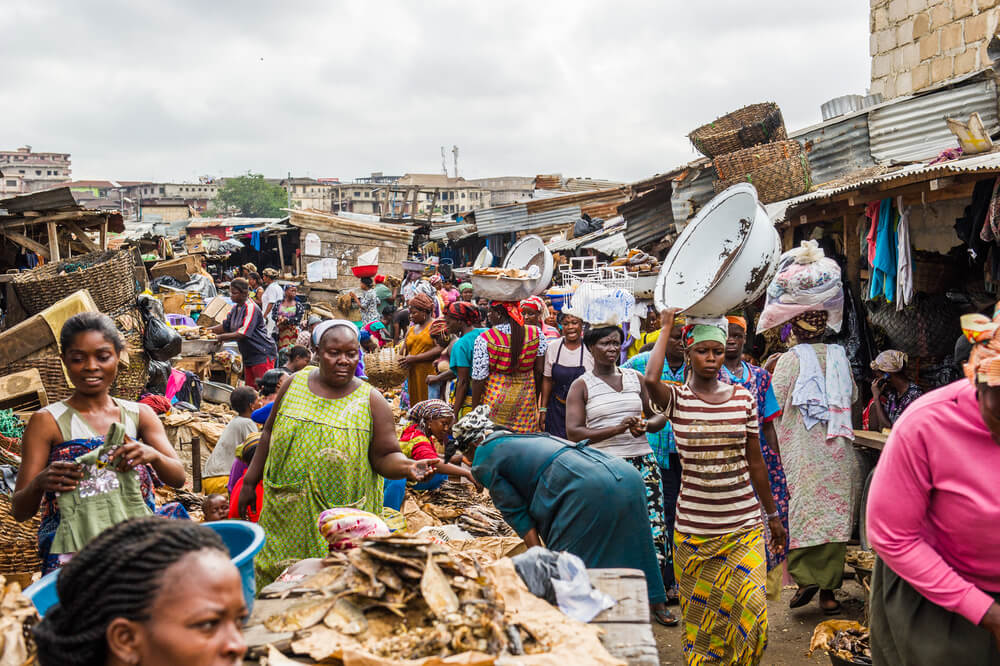
Photo: ACCRA, GHANA – MARCH 4, 2012: Unidentified Ghanaian people at the market in Ghana. People of Ghana suffer of poverty due to the unstable economic situation. Credit: Anton_Ivanov / Shutterstock.com

Filed Under: King's Commentaries Tagged With: Africa, electricity, energy, Europe, humanitarian, population

Electricity Is the Gift That Can Keep on Giving in Africa

April 8, 2017 by Llewellyn King Leave a Comment

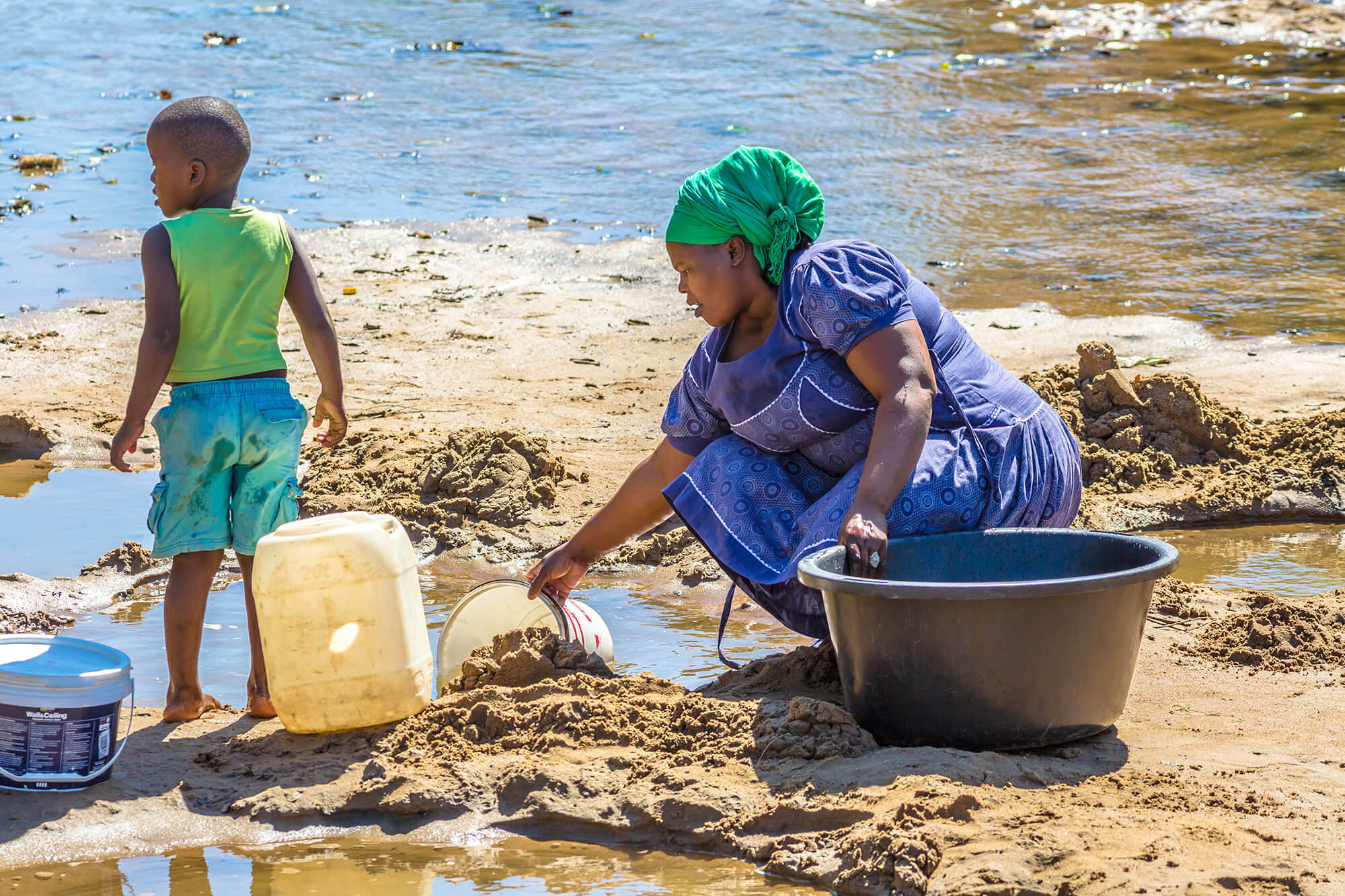
Photo: South Africa – August 24, 2014: African woman with child collecting water from the river on the road leading to local Game Reserve.

He is generic Africa Man. You can see him everywhere, walking barefoot across the Savannah and desert landscapes. He is on a mission that gets harder as time goes on.

His mission is to find enough wood — a few dry sticks here, some roots there — to make a fire for a hot meal and to bathe. He walks and walks, adding a stick and a piece of scrub wood to the bundle carried, in the traditional way, on his head.

Generic Africa Woman is busy, too. Her mission is to draw water. She carries a container on her head, filled with water from a distant well, to make dinner — a meal of maize (corn) porridge with maybe a stew of some meat or even caterpillar — and to bathe.

African life is picturesque, but it is not pretty. Hardship is in daily attendance in much of Africa, blighted from deforestation and polluted water.

Yet Western aid has not been easily delivered. Much of it has been stolen, some of it has been misapplied and some of it has led to aid dependency.

So, as an old Africa hand (I was born in what is now Zimbabwe, and left when I was 20 years old), I was elated to learn of a new and critical partnership just announced between the Edison Electric Institute (EEI) and the U.S. Department of State’s Power Africa initiative. Electricity anywhere is the gift that gives and gives, but especially when it begins to transform lives of hard struggle to ones that are less so.

When I was a boy, the opening of a power station or the building of a power line were events that brought forth celebration. Electricity signaled a better tomorrow.

When a village — whether it is in Bolivia, India or Uganda — is electrified, good things flow. A simple hotplate replaces days of firewood collection and those who can read can do so after the sun sets: hygiene improves, education is facilitated and expectations soar.

When the shantytowns that surround Johannesburg, South Africa, were electrified, the productivity of workers who flood into the city every day went up. Simply, they were saved from the drudgery of collecting animal droppings, wood scraps and other combustible stuff to burn.

The colonizers of Africa realized the need for electricity. Hence, in my part of the continent, two great dams were built on the Zambezi River: the Kariba, between Zimbabwe and Zambia, and the Cahora Bassa in Mozambique.

As a very young reporter, I covered the construction of the Kariba Dam, and its near destruction by unusually heavy flooding, in 1957. It has been the backbone of electricity supply for Zimbabwe and Zambia for more than 50 years.

But in recent years the dam, holding back the world’s largest, man-made impoundment of water, has begun to show deterioration in the concave wall, but especially behind the wall. The outflow has been eroding the plunge pool and threatening the wall. Hundreds of millions of dollars have had to be raised internationally for remediation, which is yet to begin in earnest. If the dam should fail, about 4 million people would die downstream.

The dam also has been producing much less electricity than it had been previously due to multi-year drought in the region. Copper production in Zambia, a vital industry, has had to be curtailed because of severe electric shortages. Blackouts are routine throughout the region.

Electricity is also a problem in South Africa, the industrial and commercial giant of Africa. Delay in ordering new generation, political interference in the decision processes and other problems, stemming from the end of apartheid, have damaged the system. Blackouts are affecting South Africa’s competitive posture.

Now the government is being romanced by Russia, hoping to sell it a new nuclear plant on favorable terms. It would join the two-unit, 1,860-MW Koeberg Nuclear Power Station, which has been operating since 1984. Unfortunately emerging countries have a fascination with big, showy projects, like the national airlines and steel mills that have cost them so dearly in their post-colonial phase.

EEI and the State Department need to guide the countries of Africa to today’s energy solutions, not yesterday’s. Africa needs to turn to its most abundant resource: sunshine. In North Africa, Morocco is building the world’s largest solar installation. Way to go.

Filed Under: King's Commentaries Tagged With: Africa, clean power, coal, electricity, fossil fuels, Infrastructure, Kariba dam, nuclear, nuclear energy, power, South Africa, uganda

The Real Investment Africa Needs Is in Its Women

August 12, 2014 by White House Chronicle Leave a Comment

The great African summit in Washington last week was largely theater; necessary and important, but still a work of fiction.
If you knew nothing about the subject, you might think that U.S. business, in an extraordinary historical oversight, has overlooked opportunity-rich Africa. Actually, America's trade with Africa has been in free-fall since 2008. China’s trade with Africa is reaching new heights every year, including this one. It more than doubles ours now.

For a decade, Africa — nearly all of its 54 countries — has looked east, and China has seized the opening. Yet the Chinese presence in Africa hasn't helped its underlying problems. Instead, it has put money in the pockets of the ruling elites and has turned a blind eye to the excesses of those elites.

China's interest in Africa, brilliantly and cynically exploited, has been in raw materials. A theme at last week's Washington summit was that there was something wrong with exploiting raw materials, and that value-added manufacturing — which creates real wealth and real jobs — could just be wished into being with more investment dollars.

China has flooded the continent with its lowest-quality exports – goods that wouldn’t make it onto the shelves of Walmart — and has even cheated the Africans out of the best jobs that its raw materials-hungry policy has created by bringing in Chinese workers.

The Africans get even less out of the Chinese colonization, by another name, than it did out of the European version in the “scramble for Africa” in the last decades of the 19th century. But the elites are allowed a free hand with their kleptocracy, their human rights violations, and their indifference to the condition of their own people. This sets up an asymmetrical competition with Western laws against bribery, fair trade practices, and the fact that American and international companies cannot be directed to serve a political purpose by their home governments.

President Obama made a good, even a great start, before the summit when he called for an end to the bad old ways of Africa. But his words weren't echoed by the delegates.

The long-term future of Africa lies in fundamental reforms within its social and political structures — and one in particular: its attitude toward women. If you spend any time there, two things are apparent: women have a raw deal, yet they — not the oil or the chrome or the copper, but the used and abused women of Africa — are its future.

Women hold Africa together and suffer in silence. They are the ones bent over with primitive implements in the fields, inevitably with their latest infant strapped to their backs. They are the ones who must endure marriage during puberty, bear children before their bodies are fully formed, and face the world’s highest rates of death during childbirth.

In shiny office buildings in Accra or Lusaka, it is the women who are moving the work forward. If you need something done, from a permit to an airline reservation, seek out a woman in an office. However, very few women make it to those jobs.

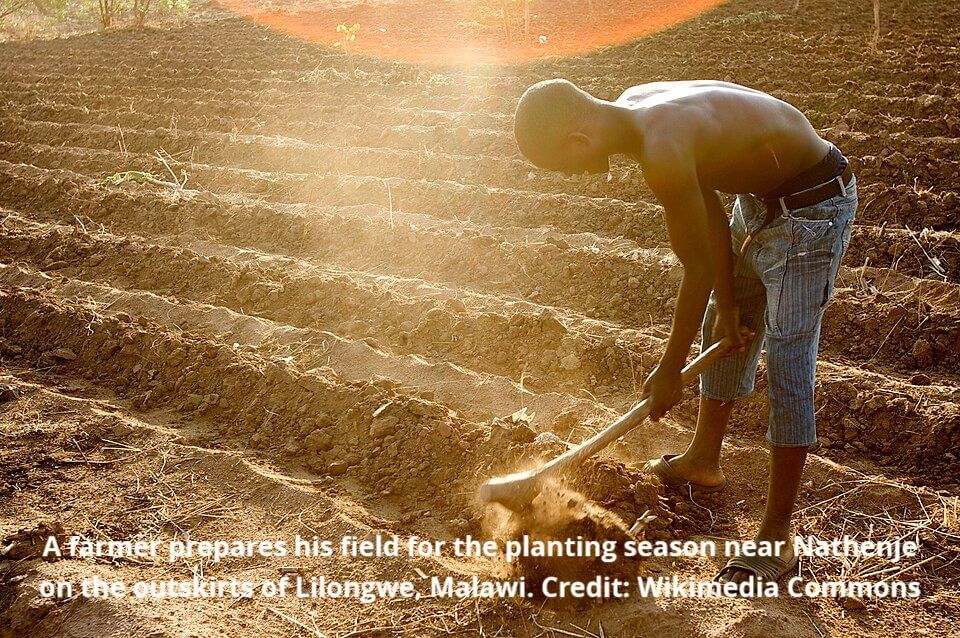
On the farms in Africa, it is the women who have managed small cooperatives, mastered micro-credit and provide family life. But they still must bend over their budzas with their youngest child strapped to their backs. The budza is a kind of hoe used for weeding, tilling and sowing. In its way, it is also a symbol of female enslavement; light enough for a woman to use all day long.

The women of Africa need to be told often and in every way they are special. They need to know that they have value beyond sex and work; that they are not an inferior gender, that they are the future.

The summit touched, in passing, on the talent and the plight women, as the male leaders talked the talk of international good intentions. But the women of Africa need recognition. Give them the tools of education and opportunity and they will do the job.

The budza needs to be retired, as does the culture of female enslavement of which it is the symbol. — For the Hearst-New York Times Syndicate

Filed Under: King's Commentaries Tagged With: Africa, African leaders summit, African women, China, Chinese in Africa, President Obama

Motorcades Are a Symbol of Africa’s Values Deficit

August 3, 2014 by White House Chronicle Leave a Comment

This week, Washington will seize up. Roads will be closed and traffic will be snarled in maybe the worst tie-ups the city has ever seen, except for those on Sept. 11, 2001.

This will not be because of a national security drill, but because 50 heads of state from Africa will be in town to meet with President Obama – and apparently every one of these leaders will have a motorcade. A motorcade?

The leaders of some of the poorest countries on earth — where starvation prevails – will be riding around Washington in motorcades. This is not just appalling, it is symptomatic of the troubles of Africa.

The peoples of Africa are not monolithic: they are divided by culture, language and religion. But they are united by the throughgoing ineptitude of their leaders; those leaders' love of the trappings of power, including motorcades and grand homes; and a far-reaching sense that the wealth of the nationals they lead is also primarily their own wealth.

Whoever in the Obama administration thought that the visitors should have motorcades not only did a disservice to the workers and residents of Washington, but also to the kind of expectation he needs to instill in African leadership: service, rectitude and real care for their people.

The kleptocracy that has characterized so much post-colonial government in Africa is fed by delusional grandeur, insane egoism and a profound indifference to the people who suffer for want of food, shelter, sanitation, medicine, education and employment. The people of Africa cry out for real leadership in their need.

There is a kind of thinness that Africans suffer that one does not see in Europe or America. I am always struck by this cadaverous appearance of people in Africa; often they have had enough food to stay alive, but just.

Living as we do in a country where obesity is widespread, I shudder at what I see in Africa, which is diverse in so many ways and bound by the same awful bonds: bonds of hunger, bonds of joblessness. They are there to be seen in Senegal or Malawi, Kenya or Ghana, and even in rich South Africa.

Outside of bad government and relentless unemployment — 80 percent, and more in some countries — the other scourge is violence and the promiscuous spread of small arms.

To me this is the most perplexing because when I grew up roaming around what are now Malawi, Zambia and Zimbabwe, violence was unknown. The prime minister of those countries, which were linked for a decade by the British administration into a federation, Roy Wilensky, drove his own car every day and gave lifts to strangers thumbing a ride. I used to ride with him to school, and later to the newspaper office where I worked.

I can tell you that in giving rides, this prime ministerial chauffeur was color- blind and security blind. Motorcades did not exist and the prime minister lived in a suburban house without so much as a policeman on duty, so much as I am aware. He lived up the street from us.

My youth colored my view of Africa. I see it not as the Dark Continent, but rather as the Light Continent; a place of beauty and talented people.

Obama should tell his African colleagues to forget the trappings of leadership and try the real thing. He should persuade them that Africa’s wealth is in its people, but they will not be free if they grow up in a culture of corruption that is so inhibiting, so draining and so self-defeating.

The symbol of bad government in Africa is the Mercedes-Benz automobile. Dictators and plain incompetents love them. There are jokes in local languages about the “Mercedians,” meaning politicians.

So endemic is the political class in Africa's commitment to this luxury automobile, that Mercedes-Benz is building a plant in South Africa to manufacture the most extravagant of these vehicles, the 12-cylinder S600.

Sadly there is a market in the political hierarchy of Africa as, even sadder, there always is for military equipment. “Nkosi Sikelel’ iAfrica” was the slogan of the African National Congress. It means “God Bless Africa.” Indeed. — For the Hearst-New York Times Syndicate


Filed Under: King's Commentaries Tagged With: Africa, African leaders, corruption, Mercedes-Benz, motorcades, Roy Wilensky

Power Africa: The Grass Is Singing

July 9, 2013 by White House Chronicle Leave a Comment

It is a lasting memory of Africa: men walking dozens of miles searching for firewood. No stick is dismissed and is added to a bundle, mostly carried on the head.
 
In most of Africa, all 54 countries lying south of the Sahara Desert, food is a problem and so is something to cook it with. As populations have grown, so has destructive deforestation.
 
The problem is not confined to rural areas. It spreads out from the shanty towns that surround the cities. There is no electricity, so something must be burned. Of course, it means dismal living conditions. Life without electricity fits Hobbes' description of life after war: “solitary, poor, nasty, brutish, and short.”
 
Against this background, President Barack Obama has proposed a $7 billion electrification initiative. To use an expression adopted from T.S. Eliot but popular in Africa, the grass must be singing.
 
It is the right proposal at the right time, but it is also fraught with huge difficulties of implementation.
 
The administration is quick to admit that to bring electricity to the 70 percent of Africans who do not have it will cost $300 billion, more to maintain the deteriorating electric systems that already exist in and around the cities.
 
Barry Worthington, executive director of the United States Energy Association, part of the World Energy Council (WEC), and an expert on African energy, says the president is to be commended “at least for raising the issue of the people who have no electricity and what that does to economies as well as the lives of the people.”
 
For years, Worthington says, the WEC and organizations like the World Bank have been trying to draw attention to the pitiable electric supply situation in Africa.
 
But he also says the fix will not be quick. The 54 countries that make up Africa south of Sahara Desert are among the most difficult in which to do business.
 
To start, there is something a little dreamy about Obama's belief that the task will be undertaken by public-private partnerships. This is a concept more alluring in theory than in practice.
 
Obama will find that before they invest, corporations need to know what their chances of making money commensurate with the risks will be be. To do this they need political stability, respect for property rights, and a legal system where they can seek redress if things go wrong. These basics are in short supply in nearly all over Sub-Saharan Africa, with the possible exception of South Africa.
 
But looming above all is the destructive force of corruption. Corruption in Africa is interpreted as capitalism in practice. It has no shame; it is the way of the world.
 
In Zambia, for example, western mining companies that had operated copper mines there before and after a period of nationalization pulled out a decade ago abandoning hundreds of millions in new investment because corruption — sometimes operating as a kind of political protection money – became so severe that the mines could not operate and needed investment was wasted. The Chinese became major players.
 
Two years ago, it appeared the Chinese had found new ways of dealing with the corruption issue but that seems to be faltering. Ghana is awash with Chinese freelance gold prospectors, who were initially encouraged to come and pan for alluvial gold; now they are being driven from the mining claims by corrupt licensing officials and gangs of thugs. China is not exempt.
 
Africa is rich in energy with coal, gas, oil, rivers suitable for hydroelectrical development, sunshine and uranium. Yet global non-governmental organizations (NGOs) have a proprietorial attitude to Africa, and they subscribe to a kind of environmental imperialism in which only “renewable” technologies that get their seal of approval should be pursued.
 
Hardly had Obama finished his speech than Emira Woods of the Institute for Policy Studies was on the PBS NewsHour denouncing coal, gas and hydro as environmentally unacceptable African power systems. One assumes that leaves wind and solar; not enough heft there to lift up a continent.
 
There have been electric power successes in countries like Botswana, Cameroon and Tanzania. Worthington says: “At least the president has shone a light on the crisis. The need is great.”
 
The grass may indeed be singing, but softly. — For the Hearst-New York Times Syndicate


Filed Under: King's Commentaries Tagged With: Africa, Barry Worthington, electricity, President Obama, U.S. Energy Association

A Cotton Wool Christmas

December 23, 2011 by White House Chronicle Leave a Comment


It wasn’t the Grinch who stole Christmas; it was Northern Europe.

As a child born and raised in Central Africa, I was very aware of this confiscation. It outraged my mother, who was also born and raised in Africa.

We lived in British colony of Southern Rhodesia; and we were dominated by British immigrants who insisted on “dreaming of a white Christmas.” Well, tough luck.

As my mother liked to point out, not one more flake of snow fell in Central Africa than fell in the Holy Land, where Jesus Christ was born.

But we were — indigenous Africans and settlers alike — in the thrall of snow imperialism.

Being so close to the equator, snowfall was a meteorological impossibility. So those under the European cultural thumb decorated everything in sight with cotton wool. We could only dream of a cotton-wool Christmas.

Unlike my mother, my father felt no pressure from the European and North American inauthentic portrayal of Christmas as a white, cold affair. He didn't mind that the retailers edged their windows in cotton wool or that the Anglican Church went along with the Northern Hemisphere’s implication that Joseph and Mary struggled through the snow to get to the manger in Bethlehem.

The one thing my parents agreed upon was that Christmas began on December 24 and lasted for the traditional 12 days.

Not only was no snow substitute allowed in our house, but also no commercially produced ornaments; flowers and greenery were fine. As a result the whole family would go to a marshy area, known as a vlei, on Christmas Eve and cut great quantities of ferns which would be strung along the picture rails.

Decorations could be added to the green frieze, but only if we made them out of painted paper. Mostly, we stuck fresh flowers in it. It was a green Christmas.

When it came to food, my mother relented completely and we made English Christmas pudding (boiled for hours in muslin), fruit cake and pies made with mincemeat (an all-fruit mixture).

We weren't a drinking family, but a bottle of sweet sherry appeared at Christmas. My mother — who otherwise drank only tea and sometimes coffee (no water, milk, alcohol or sodas) — would take, ostentatiously, a very small glass of sherry. Having downed this half-ounce or so of fortified wine, she'd announce that she wasn't responsible for her actions, that she could feel her legs getting heavy and that she was drunk.

My brother and I watched Christmas after Christmas to see if there was any sign that there had been a physiological or psychological change in Mamma, but none was recorded.

We then ate a very English meal and listened to very English Christmas carols, like “The Holly and the Ivy” and “God Rest Ye Merry Gentlemen.” My mother, who hadn’t signed her separate peace treaty with Germany, wasn’t too keen on “Silent Night.”

It wasn't until I had turned 20 and was working in London at United Press International that I saw real snow. Sorry, Mamma, it beats cotton wool and it makes for a splendid Christmas, even if things were a bit different in Royal David’s City two millennia ago.

Now for some wassail. – For the Hearst-New York Times Syndicate

Filed Under: King's Commentaries Tagged With: Africa, Britain, Christmas, Southern Rhodesia

  • 1
  • 2
  • Next Page »

White House Chronicle on Social

  • Facebook
  • Twitter
  • Vimeo
  • YouTube
Entrepreneur Weir Says Kilowatts Need Liquidity To Be Banked, Traded Like Money

Entrepreneur Weir Says Kilowatts Need Liquidity To Be Banked, Traded Like Money

Llewellyn King

  Chase Weir isn’t easy to unpack. But it is an endeavor that is worth it. Weir gives the impression of being a quiet, perhaps contained man. But when he talks, ideas flow, and particularly about the electricity supply ecosystem. I spent the best part of two days at the University Club in Washington talking […]

Iran War May Speed Nuclear Proliferation Elsewhere

Iran War May Speed Nuclear Proliferation Elsewhere

Llewellyn King

The story goes that a weakling gets sand kicked in his face on the beach. He then joins a gym, pumps iron and returns to the beach, where all he has to do is flex his new muscles, and he is left alone. That, it would seem, is one lesson of nuclear weapons. Small countries […]

Loving Ireland on St. Patrick’s Day — for Its Contradictions

Loving Ireland on St. Patrick’s Day — for Its Contradictions

Llewellyn King

I won’t let St. Patrick’s Day pass without wearing something green and reaching for a glass of something that has been produced through fermentation or distillation. It is the least I can do for all the ways the Irish have enriched the world, but especially the English language, and me. When it comes to writing, […]

How Loneliness Became a Pandemic and What You Can Do

How Loneliness Became a Pandemic and What You Can Do

Llewellyn King

You don’t have to be sitting by yourself on an island to be lonely. Loneliness is everywhere. Studies from universities, governments and public health groups find that the world is in the grip of a loneliness pandemic. More than half the U.S. population is said to be suffering from loneliness. It is classified globally as […]

Copyright © 2026 · White House Chronicle Theme on Genesis Framework · WordPress · Log in