White House Chronicle

News Analysis With a Sense of Humor

  • Home
  • King’s Commentaries
  • Random Features
  • Photos
  • Public Speaker
  • WHC Episodes
  • About WHC
  • Carrying Stations
  • ME/CFS Alert
  • Contact Us

Fusion Power Is Now a Possible Dream

June 21, 2024 by Llewellyn King Leave a Comment

Fusion power, the Holy Grail of nuclear energy for decades, may finally be within our grasp.

If the scientists and engineers at Commonwealth Fusion Systems (CFS), a company with close ties to the Massachusetts Institute of Technology Plasma Science and Fusion Center, are right, fusion is nearly ready for power market entry. In Devens, Mass., CFS says it will be ready to ship its first devices in the early 2030s.

That is astounding news, which has been so long in the making that much of the nuclear industry has failed to grasp it.

I first started writing about fusion power in the 1970s. Having been on hand for many of its false starts, I was one of the doubters.

However, after I visited the CFS factory in Devens and saw the precision production of the giant magnets, which are the key to the company’s system, I am on my way to being a believer.

I think CFS can likely manufacture a device it can ship to users — utilities or big data centers — in the early 2030s. If so, the news is huge; it is a moment in science history, like the first telephone call or incandescent light bulb.

Governments, grasping the potential for clean and essentially limitless power without weapons proliferation or radioactive waste, have lavished billions of dollars on fusion energy research worldwide. Intergovernmental efforts in recent years have concentrated on the Joint European Torus, which has wrapped up in Britain, and the International Thermonuclear Experimental Reactor, a mega-project involving 35 nations. Both are firmly in the category of scientific research.

However, in the commercial world, there is a sense that fusion power is at hand, and many companies have raised money and are pressing forward. CFS is on the front of that pack.

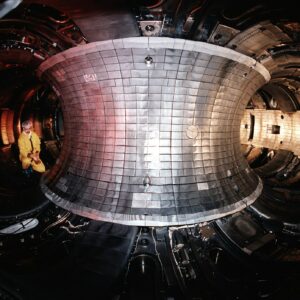
There are two technologies chasing the fusion dream: magnetic fusion energy (MFE) and inertial fusion energy (IFE). The former contains plasma at millions of degrees in a magnetic bottle. The trick here isn’t in the plasma but in the bottle.

A version of MFE, called the tokamak, is the technology expected to produce the first fusion power plant. Worldwide, dozens of startups are looking at fusion, and in the United States, eight are considered frontline.

The other method, IFE, consists of hitting a small target pellet with an intense beam of energy, which can come from a laser or other device. It is still in the realm of research.

CFS has raised more than $2 billion and is seen by many as the frontrunner in the fusion power stakes.  Italian energy giant ENI supported it from its inception in 2018. Bill Gates’ ubiquitous Breakthrough Energy is an investor. Altogether, there are 60 investors, mostly looking for a huge return as CFS begins to sell its devices.

According to Brandon Sorbom, co-founder and chief scientist at CFS, the big advance has been in the superconducting magnets that create containment bottles for plasma. He told me this had enabled them to design a device many times smaller than had previously been possible.

What makes CFS magnets different and revolutionary is the superconducting wire wound to make the magnets.

Think of the tape in a tape recorder, and you have an idea of the flat wire, called HTS, that is wound into each magnet. The HTS tape is first wound into VIPER cable, or NINT pancakes — acronyms for two types of magnet technology developed by MIT in conjunction with CFS. Then, the VIPER cable, or NINT pancakes, are assembled into magnets that make up the tokamak.

This superconducting wire enables a large amount of current to course through the magnet at many times the previously unavailable levels. This means the device can be smaller — about the size of a large truck.

The next stage is completing the first full demonstration device at CFS, known as SPARC. It is already half-built and should become operational next year.

After that will come the first commercial fusion device, called ARC, which may be deployed in a decade. It will contain, as Sorbom said, “a star in a bottle using magnetic fields in a tokamak design,” and perchance, bring abundant zero-carbon energy to users near you.

Filed Under: King's Commentaries Tagged With: Brandon Sorbom, Commonwealth Fusion Systems, Devens, Fusion power, magnetic, magnets, nuclear, scientists, superconducting, tokamak

The Case for Saving Nuclear Is Not the Case for Saving Coal

July 13, 2018 by Llewellyn King 2 Comments

Coal and nuclear power have been yoked together for decades. Nuclear power and nuclear science have both paid the price for this double harness. Now it looks as though nuclear will pay again.

The electric utilities in the 1950s and 1960s were faced with runaway demand for electricity as air conditioning was deployed and new home construction boomed. This was before acid rain became a problem and when global warming was just a minor scientific theory.

As the utilities struggled to deal with electricity demand that was doubling every 10 years, nuclear appeared as the brave new fuel of the future. They loved nuclear, the government loved nuclear and the public was happy with it.

So, utilities went hellbent into nuclear: In all, starting in the 1950s, utilities built over well over 100 reactors for electricity production.

Then opposition to nuclear began to appear, at first in the late 1960s and then with intensity through the 1970s.

Horror stories were easy to invent and hard to counter. Being anti-nuclear was good for the protest business. The environmental movement — to its shame — joined the anti-nuclear cavalcade. Indeed, in the 1970s and 1980s, environmentalists were still hard against nuclear. They advocated advanced coal combustion, particularly a form of coal boiler known as “circulating fluidized bed.”

For their part the utilities defended nuclear, but never at a cost to coal. They were worried about their investments in coal. They would not, for example, sing the safety, reliability and, as it was then, the cost-effectiveness of nuclear over coal.

They said they were for both. “Both of the above” meant that the nuclear advocates in the industry could not run serious comparisons of nuclear with coal.

Now the Trump administration is seeking that history repeat itself. To fulfill the president’s campaign promises to the coal industry and to try to save coal-mining jobs, the administration is invoking national security and “resilience” to interfere in the electric markets and save coal and nuclear plants, which the utility industry is closing or will close.

The predicament of these plants is economic; for coal, it is economic and environmental.

Both forms of electric generation are undermined by cheap natural gas, cheap wind power and cheap solar power. In a market that favors the cheapest electricity at the time of dispatch, measured to the second, these plants do not cut it financially. The social value or otherwise is not calculated.

The fight between coal and nuclear, and more realistically between nuclear and natural gas, misses the true virtue of nuclear: It is a scientific cornucopia.

Nuclear science is reshaping medicine, enabling space travel and peering at the very nature of being. In 100 years, nuclear science will be flowering in ways undreamed of today. A healthy nuclear power industry grows the nuclear science world, brings in talent.

Even without the science argument, there is a case for saving the nuclear plants: They produce about 20 percent of the nation’s electricity without hint of carbon effluent, which gas cannot say.

A fair market allows for externalities beyond the cost of generation and dispatch at that second. Clean air is a social value, scientific progress is a social value, and predicting the life of a plant (maybe 80 years) is a social value.

Natural gas, the great market disrupter of today, does not meet these criteria.

As electricity is unique, the national lifeblood, it deserves to be treated as such. That cries out for nuclear to be considered for a lifeline in today’s brutal market.

If it embraces a long-term solution through carbon capture and use, then coal may hold a place in the future. But the industry is cool to this solution. Robert Murray, CEO of Murray Energy Corporation, denounced it to me.

The administration has put money into a new nuclear through incentives and subsidies for small modular reactors even while linking established nuclear to the sick man of energy, coal.

Electricity is a social value as well as a traded commodity. The administration is working against itself with its coal strategy.

Filed Under: King's Commentaries Tagged With: coal, energy, Murray Energy Corportation, nuclear, renewable

China’s Not-So-Secret Weapons — Rare Earths

August 4, 2017 by Llewellyn King 1 Comment

In October 1973, the world shuddered when the Arab members of the Organization of Petroleum Exporting Countries imposed an oil embargo on the United States and other nations that provided military aid to Israel in the Yom Kippur war. At the same time, they ramped up prices.

The United States realized it was dependent on imported oil — and much of that came from the Middle East, with Saudi Arabia the big swing producer. It shook the nation. How had a few foreign powers put a noose around the neck of the world’s largest economy?

Well, it could happen again and very soon. The commodity that could bring us to our knees isn’t oil, but rather a group of elements known as rare earths, falling between 21 and 71 on the periodic table. This time, just one country is holding the noose: China.

China controls the world’s production and distribution of rare earths. It produces more than 92 percent of them and holds the world in its hand when it comes to the future of almost anything in high technology.

Rare earths are great multipliers and the heaviest are the most valuable. They make the things we take for granted, from the small motors in automobiles to the wind turbines that are revolutionizing the production of electricity, many times more efficient. For example, rare earths increase a conventional magnet’s power by at least fivefold. They are the new oil.

Rare earths are also at work in cell phones and computers. Fighter jets and smart weapons, like cruise missiles, rely on them. In national defense, there is no substitute and no other supply source available.

Like so much else, the use of rare earths as an enhancer was a U.S. discovery: General Motors, in fact. In 1982, General Motors research scientist John Croat created the world’s strongest permanent magnet using rare earths. He formed a company, called Magnequench. In 1992, the company and Croat’s patents were sold to a Chinese company.

From that time on it became national policy for China to be not just the supplier of rare earths, but to control the whole supply chain. For example, it didn’t just want to supply the rare earths for wind turbines; it insisted that major suppliers, such as Siemens, move some of their manufacturing to China. Soon Chinese companies, fortified with international expertise, went into wind turbine manufacture themselves.

“Now China is the major manufacturer of wind turbines,” says Jim Kennedy, a St. Louis-based consultant who is devoted to raising the alarm over rare earths vulnerability. A new and important book, “Sellout” by Victoria Bruce, details the way the world handed control of its technological future to China and Kennedy’s struggle to alert the United States.

At present, the rare earths threat from China is serious but not critical. If President Donald Trump — apparently encouraged by his trade adviser Peter Navarro, and his policy adviser Steve Bannon — is contemplating a trade war with China, rare earths are China’s most potent weapon.

A trade war moves the rare earths threat from existential to immediate.

In a strange regulatory twist the United States, and most of the world, won’t be able to open rare earths mines without legislation and an international treaty modification. Rare earths are often found in conjunction with thorium, a mildly radioactive metal, which occurs in nature and doesn’t represent any kind of threat.

However, it’s a large regulatory problem. The Nuclear Regulatory Commission and the International Atomic Energy Agency have defined thorium as a nuclear “source material” that requires special disposition. Until these classifications, thorium was disposed of along with other mine tailings. Now it has to be separated and collected. Essentially until a new regime for thorium is found, including thorium-powered reactors, the mining of rare earths will be uneconomic in the United States and other nuclear non-proliferation treaty countries.

Congress needs to look into this urgently, ideally before Trump’s trade war gets going, according to several sources familiar with the crisis. A thorium reactor was developed in the 1960s at the Oak Ridge National Laboratory in Tennessee. While it’s regarded by many nuclear scientists as a superior technology, only Canada and China are pursuing it at present.

Meanwhile, future disruptions from China won’t necessarily be in the markets. It could be in the obscure but vital commodities known as rare earths: China’s not quite secret weapon.

Filed Under: King's Commentaries Tagged With: China, Donald Trump, metals, nuclear, Peter Navarro, rare earth elements, trade

Electricity Is the Gift That Can Keep on Giving in Africa

April 8, 2017 by Llewellyn King Leave a Comment

Photo: South Africa – August 24, 2014: African woman with child collecting water from the river on the road leading to local Game Reserve.

He is generic Africa Man. You can see him everywhere, walking barefoot across the Savannah and desert landscapes. He is on a mission that gets harder as time goes on.

His mission is to find enough wood — a few dry sticks here, some roots there — to make a fire for a hot meal and to bathe. He walks and walks, adding a stick and a piece of scrub wood to the bundle carried, in the traditional way, on his head.

Generic Africa Woman is busy, too. Her mission is to draw water. She carries a container on her head, filled with water from a distant well, to make dinner — a meal of maize (corn) porridge with maybe a stew of some meat or even caterpillar — and to bathe.

African life is picturesque, but it is not pretty. Hardship is in daily attendance in much of Africa, blighted from deforestation and polluted water.

Yet Western aid has not been easily delivered. Much of it has been stolen, some of it has been misapplied and some of it has led to aid dependency.

So, as an old Africa hand (I was born in what is now Zimbabwe, and left when I was 20 years old), I was elated to learn of a new and critical partnership just announced between the Edison Electric Institute (EEI) and the U.S. Department of State’s Power Africa initiative. Electricity anywhere is the gift that gives and gives, but especially when it begins to transform lives of hard struggle to ones that are less so.

When I was a boy, the opening of a power station or the building of a power line were events that brought forth celebration. Electricity signaled a better tomorrow.

When a village — whether it is in Bolivia, India or Uganda — is electrified, good things flow. A simple hotplate replaces days of firewood collection and those who can read can do so after the sun sets: hygiene improves, education is facilitated and expectations soar.

When the shantytowns that surround Johannesburg, South Africa, were electrified, the productivity of workers who flood into the city every day went up. Simply, they were saved from the drudgery of collecting animal droppings, wood scraps and other combustible stuff to burn.

The colonizers of Africa realized the need for electricity. Hence, in my part of the continent, two great dams were built on the Zambezi River: the Kariba, between Zimbabwe and Zambia, and the Cahora Bassa in Mozambique.

As a very young reporter, I covered the construction of the Kariba Dam, and its near destruction by unusually heavy flooding, in 1957. It has been the backbone of electricity supply for Zimbabwe and Zambia for more than 50 years.

But in recent years the dam, holding back the world’s largest, man-made impoundment of water, has begun to show deterioration in the concave wall, but especially behind the wall. The outflow has been eroding the plunge pool and threatening the wall. Hundreds of millions of dollars have had to be raised internationally for remediation, which is yet to begin in earnest. If the dam should fail, about 4 million people would die downstream.

The dam also has been producing much less electricity than it had been previously due to multi-year drought in the region. Copper production in Zambia, a vital industry, has had to be curtailed because of severe electric shortages. Blackouts are routine throughout the region.

Electricity is also a problem in South Africa, the industrial and commercial giant of Africa. Delay in ordering new generation, political interference in the decision processes and other problems, stemming from the end of apartheid, have damaged the system. Blackouts are affecting South Africa’s competitive posture.

Now the government is being romanced by Russia, hoping to sell it a new nuclear plant on favorable terms. It would join the two-unit, 1,860-MW Koeberg Nuclear Power Station, which has been operating since 1984. Unfortunately emerging countries have a fascination with big, showy projects, like the national airlines and steel mills that have cost them so dearly in their post-colonial phase.

EEI and the State Department need to guide the countries of Africa to today’s energy solutions, not yesterday’s. Africa needs to turn to its most abundant resource: sunshine. In North Africa, Morocco is building the world’s largest solar installation. Way to go.

Filed Under: King's Commentaries Tagged With: Africa, clean power, coal, electricity, fossil fuels, Infrastructure, Kariba dam, nuclear, nuclear energy, power, South Africa, uganda

An Open Letter to Rick Perry, U.S. Energy Secretary Nominee

December 16, 2016 by Llewellyn King 11 Comments

Dear Gov. Perry:

Welcome to the Department of Energy. It is a cornucopia of scientific wonders, brilliant people and, to be true, some duplication and wasted effort.

Oil, natural gas and coal are not the overriding concern of the DOE. Until President Jimmy Carter created it in 1977, fossil fuels were the province of the Department of the Interior.

The DOE was preceded by the Energy Research and Development Administration. This was a short-lived agency that combined the non-regulatory functions of the Atomic Energy Commission with the fossil fuel responsibilities of the Interior Department.

To be sure, DOE has had a manful role in coal gasification, fracking and carbon capture and storage.

But its main role is to be the nation’s armorer; to build and maintain the U.S. stockpile of nuclear weapons, and to detect bad guys testing weapons in places like North Korea and Iran.

The department has 17 major laboratories, headed by the three big weapons labs: Los Alamos, Sandia and Lawrence Livermore.

In your own state of Texas, as you must know, is the Pantex facility. That is where the weapons are constructed and dismantled. That is ground zero, if you will, of weapons making. That where the “pits” are assembled and disassembled. Weapons are designed and engineered in the weapons laboratories.

You will find that cleanup of nuclear waste — much of it from earlier weapons production — in places like Hanford, Wash., and Los Alamos, N.M., is a continuing and seemingly endless task that chews up talent and money.

Some of the other work of the DOE may surprise you. It was a major player in the human genome project and it helps U.S. companies improve their manufacturing technology. It has developed ceramics for all sorts of non-nuclear uses, like car engines. Its work with 3-D seismic and advanced drill bits has made the fracking revolution possible.

You are, in fact, about to lead the largest science department anywhere in the world.

When you get the feel of the place, one hopes that talk of disbanding it will disappear. Likewise wild talk about rooting out climate science, which has the department in shock. The DOE is not part of climate science conspiracy. Please examine your charge before you trash it.

The DOE national laboratory system is a national treasure, the science mind of the nation. It collaborates with dozens of universities.

If President-elect Trump is determined to renegotiate the Iranian deal, you will be a player. The present secretary, Ernie Moniz, handled the negotiations brilliantly for the treaty we have with Iran. He knew as much about the workings of a hydrogen bomb and its supply chain as his opponent, Ali Akbar Salehi, who also went MIT. If there is another negotiation as the president-elect has suggested, you will have to support the chief negotiator, the secretary of state, with expertise from your department.

First and foremost, the DOE is a nuclear agency, charged with making the weapons that protect the nation. But it also does some amazingly disparate things at its labs, from improving coal combustion to studying cancer to examining the very nature of matter. And, of course, climate science. It has been said that it takes a new secretary a year to find out what the department does.

Because the DOE operates in many states through the laboratory system, Congress rides it hard. Congressmen fight for dollars and projects in their states. An example — and one you will have to adjudicate — is the battle over whether to continue with the construction and operation of the mixed oxide fuel fabrication facility at the Savannah River Site. The Obama administration has said it should be terminated; Congress says no.

As there is throughout government, there is waste in the lab system. But it is a small problem compared with its huge value to the nation. A suggestion: work on making it even more user friendly to technology transfer. That is how we assure the future of U.S. competitiveness: science and more science.

You have a great charge, Gov. Perry, and it has very little to do with oil.

For InsideSources

Filed Under: King's Commentaries Tagged With: cabinet appointments, DOE national labratory, Donald Trump, nuclear, President-Elect, Rick Perry, weapons

The Efficient, Stupid Market for Nuclear Electricity

September 13, 2015 by Llewellyn King Leave a Comment

By Llewellyn King

The market is a wondrous place. It ensures you can drink Scotch whisky in Cape Town and Moscow, or Washington and Tokyo, if you prefer. It distributes goods and services superbly, and it cannot be improved upon in seeking efficiency.

But it can’t think and it can’t plan; and it’s a cruel exterminator of the weak, the unready or, for that matter, the future.

Yet there are those who believe that the market has wisdom as well as efficiency. Not so.

If it were wise, or forward-looking, or sensitive, Mozart wouldn’t have died a pauper, and one of the greatest — if not the greatest architecturally — railway station ever built, Penn Station, wouldn’t have been demolished in 1963 to make way for the profit that could be squeezed out of the architectural deformity that replaced it: the Madison Square Garden/Penn Station horror in New York City.

End of the line

End of the line

Around Washington, Los Angeles and other cities are the traces of the tracks of the railroads and streetcar lines of yore. These were torn up when the market anointed the automobile as the uber-urban transport of the future. As Washington and Los Angeles drown in traffic, many wish the tracks — now mostly bike paths — were still there to carry the commuter trains and streetcars that are so badly needed in the most traffic-clogged cities.

Now the market, with its concentration on the present tense, is about to do another great mischief to the future. An abundance of natural gas is sending the market signals which threaten carbon-free nuclear plants before their life is run out, and before a time when nuclear electricity will again be cheaper than gas-generated electricity. World commodity prices are depressed at present, and no one believes that gas will always be the bargain it is today.

Two nuclear plants, Vermont Yankee in Vernon, Vt. and Kewaunee in Carlton, Wisc., have already been shuttered, and three plants on the Exelon Corp. system in the Midwest are in jeopardy. They’ve won a temporary reprieve because the Federal Energy Regulatory Commission (FERC) says the fact that they have round-the-clock reliability has to be taken into account against wind and solar, which don’t. In a twist, solar and wind have saved some nuclear for the while.

Natural gas, the market distorting fuel of the moment, is a greenhouse gas producer, although less so than coal. However gas, in the final analysis, could be as bad, or worse, than coal when you take into account the habitual losses of the stuff during extraction. Natural gas is almost pure methane. When this gets into the atmosphere, it’s a serious climate pollutant, maybe more so than carbon dioxide, which results when it is burned.

Taken together — methane leaks with the carbon dioxide emissions — and natural gas looks less and less friendly to the environment.

Whatever is said about nuclear, it’s the “Big Green” when it comes to the air. Unlike solar and wind, it’s available 24 hours a day, which is why three Midwest plants got their temporary reprieve by the FERC in August.

When President Obama goes to Paris to plead with the world for action on climate change in December, the market will be undercutting him at home, as more and more electricity is being generated by natural gas for no better reason than it’s cheap.

As with buying clothes or building with lumber, the cost of cheap is very high. The market says, “gas, gas, gas” because it’s cheap – now. The market isn’t responsible for the price tomorrow, or for the non-economic costs like climate change. 

But if you want a lot of electricity that disturbs very little of the world’s surface, and doesn’t put any carbon or methane into the air, the answer is nuclear: big, green nuclear. — For InsideSources.com

Filed Under: King's Commentaries Tagged With: Big Green, climate change, electricity, Exelon Corp., Federal Energy Regulatory Commission, FERC, Kewaunee, King Commentary, market forces, natural gas, nuclear, President Obama, United Nations, Vermont Yankee

Obama’s Second Blow to a Nuclear Waste Solution

July 26, 2015 by Llewellyn King Leave a Comment

When the Obama administration came into power, one of its first actions was to end work on the Yucca Mountain nuclear waste repository in Nevada. In so doing, it delivered a shuddering blow to the U.S. nuclear industry, trashing the project when it was nearly ready to open. The cost to taxpayers was about $15 billion.

Now the administration is going through the motions to suspend another costly nuclear waste investment when it is about 67 percent complete. Money expended: $4.5 billion. Shutdown cost: $1 billion.

The object of its latest volte face is the Mixed Oxide Fuel Fabrication Facility (MFFF) on the Department of Energy’s Savannah River site in South Carolina. Work started on the facility in 2007, with a 2016 startup envisaged.

But unlike Yucca Mountain, few people outside of the nuclear industry know about the genesis and purpose of the MFFF project.

The project was initiated as a result of a 2000 agreement with the Russians, later amended, in which both countries agreed to dispose of no less than 34 metric tons of excess weapons-grade plutonium — the transuranic element that is the key component of a modern nuclear weapon, and remains radioactive essentially forever.

The DOE’s plan was for the facility to mix the plutonium with uranium to create a fuel for civil nuclear reactors to produce electricity. This recycling technology, developed in the United States originally, has been used in France since 1995.

The DOE has not yet taken a wrecking ball to the MFFF, but it is taking the first steps toward demolition. On June 25, the DOE issued a press release that the industry read as a precursor to a death warrant. The department announced that it was creating a “Red Team,” headed by Thom Mason, director of the Oak Ridge National Laboratory in Oak Ridge, Tenn., to review “plutonium disposition options and make recommendations.”

The DOE statement said the team would “assess the MOX [mixed oxide] fuel approach, the downblending and disposal approach, and any other approaches the team deems feasible and cost effective.”

Industry sources say the choice is between the MOX approach and so-called downblending. In that application, the plutonium is not burned up but is spiked and mixed with a modifier that makes it unusable in weapons. Then it would be disposed either in the Waste Isolation Pilot Plant in Carlsbad, N.M., or in a new repository, if one is commissioned.

The American Association for the Advancement of Science has been pushing the downblending option. But it is using numbers that many believe to be extremely speculative. They come from a private consulting firm hired by the DOE, Aerospace Corporation.

The first number is that the life-cycle cost of the MFFF would be $30 billion, while the life-cycle cost for downblending would be only $9 billion. These numbers are contested by the contractor building the facility, a joint venture between the construction firm Chicago Bridge & Iron Company and the French nuclear technology giant Areva. They point out that plutonium has never been downblended and that the WIPP in New Mexico has had its own problems. On Feb. 5, 2014, the plant closed after a salt truck caught fire; there was an unrelated radiological release nine days later. The plant is still closed.

It is believed that Secretary of Energy Ernest Moniz favors the MFFF approach as a permanent and scientifically attractive solution, rather than burying the plutonium in New Mexico or elsewhere. However, he may be overruled by the White House and the military chiefs, who know that they are going to have to raise money on a huge scale for nuclear weapons modernization, in light of the deteriorated relationship with Russia and China’s continuing military buildup.

If the MFFF is canceled, it will join a long list of nuclear projects that the government has ordered up and canceled later, often with a huge waste of public money. Another negative is the wastage of engineering talent. Families move to sites, buy houses and send their children to local schools. Then come the pink slips and years of demanding engineering effort are nixed by policy, politics and general incoherence in Washington.

Filed Under: King's Commentaries Tagged With: AAAS, American Association for the Advancement of Science, Areva, Carlsbad, Chicago Bridge & Iron Company, Department of Energy, DOE, MFFF, Mixed Oxide Fuel Fabrication Facility, MOX, Nevada, New Mexico, nuclear, nuclear industry, nuclear waste, plutonium, President Barack Obama, Savannah River, South Carolina, uranium, Waste Isolation Pilot Plant, WIPP, Yucca Mountain

Nuclear Teetering on the Economic Precipice

December 12, 2014 by Llewellyn King 8 Comments

This will be a bleak Christmas for the small Vermont community of Vernon. It is losing its economic mainstay. The owner of its proud, midsize nuclear plant, which has sustained the community for 42 years, Entergy, is closing the plant. Next year the only people working at the plant will be those shuttering it, taking out its fuel, securing it and beginning the process of turning it into a kind of tomb, a burial place for the hopes of a small town.

What may be a tragedy for Vernon may also be a harbinger of a larger, multilayered tragedy for the United States.

Nuclear – Big Green – is one of the most potent tools we have in our battle to clean the air and arrest or ameliorate climate change over time. I've named it Big Green because that is what it is: Nuclear power plants produce huge quantities of absolutely carbon-free electricity.

But many nuclear plants are in danger of being closed. Next year, for the first time in decades, there will be fewer than 100 making electricity. The principal culprit: cheap natural gas.

In today’s market, nuclear is not always the lowest-cost producer. Electricity was deregulated in much of the country in the 1990s, and today electricity is sold at the lowest cost, unless it is designated as “renewable” — effectively wind and solar, whose use is often mandated by a “renewable portfolio standard,” which varies from state to state.

Nuclear falls into the crevasse, which bedevils so much planning in markets, that favors the short term over the long term.

Today’s nuclear power plants operate with extraordinary efficiency, day in day out for decades, for 60 or more years with license extensions and with outages only for refueling. They were built for a market where long-lived, fixed-cost supplies were rolled in with those of variable cost. Social utility was a factor.

For 20 years nuclear might be the cheapest electricity. Then for another 20 years, coal or some other fuel might win the price war. But that old paradigm is shattered and nuclear, in some markets, is no longer the cheapest fuel — and it may be quite few years before it is again.

Markets are great equalizers, but they're also cruel exterminators. Nuclear power plants need to run full-out all the time. They can’t be revved up for peak load in the afternoon and idled in the night. Nuclear plants make power 24/7.

Nowadays, solar makes power at given times of day and wind, by its very nature, varies in its ability to make power. Natural gas is cheap and for now abundant, and its turbines can follow electric demand. It will probably have a price edge for 20 years until supply tightens. The American Petroleum Institute won't give a calculation of future supply, saying that the supply depends on future technology and government regulation.

Natural gas burns cleaner than coal, and is favored over coal for that reason. But it still pumps greenhouse gases into the atmosphere, though just about half of the assault on the atmosphere of coal.

The fate of nuclear depends on whether the supporters of Big Green can convince politicians that it has enough social value to mitigate its temporary price disadvantage against gas.

China and India are very mindful of the environmental superiority of nuclear. China has 22 power plants operating, 26 under construction, and more about to start construction. If there is validity to the recent agreement between Chinese President Xi Jinping and President Barack Obama, it is because China is worried about its own choking pollution and a fear of climate change on its long coastline, as well as its ever-increasing need for electricity.

Five nuclear power plants, if you count Vermont Yankee, will have closed this year, and five more are under construction in Tennessee, South Carolina and Georgia. After that the new plant pipeline is empty, but the number of plants in danger is growing. Even the mighty Exelon, the largest nuclear operator, is talking about closing three plants, and pessimists say as many as 15 plants could go in the next few years.

I'd note that the decisions now being made on nuclear closures are being made on economic grounds, not any of the controversies that have attended nuclear over the years. 

Current and temporary market conditions are dictating environmental and energy policy. Money is more important than climate, for now. — For the Hearst-New York Times Syndicate

Filed Under: King's Commentaries Tagged With: Big Green, China, electricity, Georgia, King Commentary, natural gas, nuclear, President Obama, renewables, solar, South Carolina, Tennessee, United States, Vermont, Vermont Yankee, Vernon VT, wind, Xi Jinping

Europe and Its Slippery Energy Slope

December 3, 2013 by White House Chronicle 2 Comments

BRATISLAVA, Slovakia — Europe, at present the world's largest market and largest economic bloc, is decline and living standards are in danger. That was the sober message at an energy conference here, delivered by a battery of speakers from across eastern Europe.
 
The narrative is that energy is what is dragging Europe down – not low birthrates and pervasive social-safety networks, but increasing dependence on expensive energy imports and hopelessly tangled markets.
 
Although delegates gathered to discuss the particular problems of eastern Europe, many had comments about the energy dependence across Europe; its labyrinthine regulations in nearly all 28 countries, its inability to form capital for large projects like nuclear, and governments intruding into the market.
 
The result is a patchwork of contradictions, counterproductive regulations, political fiats and multiple objectives that leave Europeans paying more for energy than they need to and failing to develop indigenous sources, such as their own shale gas deposits in Ukraine and Poland. It also leaves countries dependent on capricious and expensive gas from Russia, unsure of whether they can build needed electric generating plant in the future and poorly interconnected, sometimes by both gas pipelines and electric lines.
 
Good intentions have also had their impact. The European Commission has pushed renewable energy and subsidized these at the cost of others. The result is imperfect markets and, more important, imperfectly engineered systems.
 
Germany and other countries are dealing with what is called “loop flow” – when the renewables aren't performing, either because the wind has dropped or the sun has set, fossil fuels plant has to be activated. This means that renewable systems are often shadowed by old-fashioned gas and coal generation that has to be built, but which isn't counted toward the cost of the renewable generation.
 
With increasing use of wind, which is the most advanced renewable, the problem of loop flow is increased, pushing up the price of electricity. Germany is badly affected and the problem is getting worse because it heavily committed to wind after abandoning nuclear, following the Fukusima-Daiichi accident in Japan.
 
Frank Umbach, associate director of the European Center for Energy and Resource Security at King's College, London, said energy costs in Germany are now driving manufacturing out of the country and to the United States.
 
Umbach said that as Britain de-industrialized 15 years ago, Germany was beginning to go the same way. He said Britain had been able to sustain itself through financial services and other service sector jobs, but that was not a prospect for Germany, the industrial mainstay of the European Union. Now Britain, with its new nuclear policy, is trying to re-industrialize, he said.
 
Umbach urged that Europe get serious about shale gas and even burning coal. His argument was that there are environment safeguards available and that more are being developed, such as the new less environmentally assaulting techniques in hydraulic fracturing (fracking) used to extract tightly bound natural gas from shale formations.
 
Several speakers said the region has to face the reality that it is no longer able to generate the capital it needs for liquefied natural gas terminals, nuclear power plants and unconventional gas recovery in Ukraine, Poland and in the Black Sea offshore Romania and Bulgaria.
 
Many countries, particularly in eastern Europe, still balk at foreign ownership of their energy infrastructure and have actively driven away investment. Poland, for example, has frightened off shale gas developers from the United States by insisting that as the resource is developed, 50 percent of the developing company must be ceded to the state. The companies left.
 
In other places, the Czech Republic, for example, landowners have no claim to the resource under their land; that remains the property of the government and, therefore, they are hostile to any development on their property, whether it is for oil, gas or minerals.
The United Kingdom, by contrast, declared a spokesman for its energy ministry, Hergen Haye, is open for business. That means if the Americans, the Chinese of the Middle Easterners want to “buy into” Britain's new nuclear undertaking, “they are welcome.”
 
Europe's sad energy situation was summed up by Iana Dreyer of the EU Institute for Security Studies. She said Europe is still the largest trading bloc in the world, the largest economic machine and the largest market, but that it is slipping. By 2030, she calculated, Europe will have slipped to No. 3, behind the China and the United States, unless it can untangle its energy Gordian knot.
 
Europeans here cite the United States as the way to go in energy. It makes a body feel good. — For the Hearst-New York Times Syndicate

Filed Under: King's Commentaries Tagged With: alternative energy, coal, electric generation, energy, European Union, liquefied natural gas, LNG, nuclear, shale gas, Slovakia, wind power

New Oil Discoveries Threaten Obama’s Energy Strategies

March 4, 2010 by White House Chronicle 5 Comments


“When an irresistible force such as you

“Meets and old immovable object like me

“You can bet just as sure as you live

“Something’s got to give …”

— Johnny Mercer

When Johnny Mercer penned those words, he was speaking of love not politics, and not the politics of energy. But he could have been.

In energy, there are two great forces that collide: public policy and the market. Despite the love affair of recent decades with markets, neither is always right.

Consider the struggle between old energy –market-tested and with a mature infrastructure — and new, alternative energy.

Public policy, under Republicans and Democrats, has sought to discourage the nation’s ever-greater dependence on imported oil (about 60 percent). But the market has sung a siren song, tempting us to more oil consumption.

Back in the 1970s, when we imported only 30 percent of our oil, the country was frightened into making great efforts in research and development to find alternatives to oil. Most of those concentrated on oil substitution and new ways of making electricity. None of the new ideas penetrated the market in any serious way, with the possible exception of wind, and that took many years to gain general acceptance and to overcome institutional and technical issues.

The Big Enchilada, oil, proved to be recalcitrant. President Jimmy Carter wanted to make it from coal; a nascent ethanol industry was tentatively testing the forbearance of government in seeking tax breaks and subsidies.

The search for a way out began after the Arab oil embargo of 1973-74, and reached a zenith with the Iranian Revolution of 1979. Many well-intentioned programs were undertaken, concentrating primarily on coal — coal as a gas, coal as a fluid and the improved combustion of coal.

But it was then, as it is now, a wild time for new entrants. Dozens of projects were funded including magneto-hydrodynamics, in situ coal gasification, garbage to electricity, battery research, cryogenic transmission research and energy storage in fly wheels.

Some, if not a majority, of the projects were pure science fiction.

The energy establishment favored not so much the new as the duplicative. Its members leaned to coal, oil shale, more oil and gas leasing and more nuclear. The old Mobil Oil Company paid a whopping $212 million for a Colorado oil shale lease without regard to how it could be worked.

Across the Southwest, banks lent to every energy project that came through the door. Natural gas got short shrift because it was wrongly thought to be a depleted resource.

Then in the mid-1980s, Saudi Arabia opened its oil spigot all the way (10 million barrels a day) and the market annihilated expensive energy from new sources. With gasoline cheap again, SUVs hit the roads in giant numbers; a string of Southwest banks collapsed; and the energy debate turned not to changing consumption but to deregulation, facilitating profligate use across the board.

The market spoke and it shouted down concerns about national security or technological substitution. Public policy surrendered to the market. Despite fine speeches from secretaries of energy on the danger of exporting our security and our money, the market continued its advocacy of excess.

The George W. Bush administration identified our vulnerability in oil and identified a looming crisis in electricity. But it faltered when it came to government coercion of markets; for example, getting more nuclear plants built.

Bush himself fell for the temptations of ethanol from corn and the possibility of switch grass. Now these are under threat from new discoveries of oil off Brazil and far greater estimates of oil production from Iraq. In fact, Iraq is being touted as a rival to Saudi Arabia with Brazil right behind it.

The Obama administration is hell-bent on getting off old energy. It loves “alternatives” and it’s committed to doing something about global warming.

But in research, money does not equal results. While the Department of Energy is chock full of money for new energy research and development, cheap natural gas and new potential oil from unexpected quarters may do to Obama’s new energy hopes what it did to Carter’s: undermine and expose them to ridicule.

Public policy may again be pushed around by the irresistible force of the market, even if it is not serving the national interest.


Filed Under: King's Commentaries Tagged With: alternative energy, biofuels, Brazil, gas, Iraq, nuclear, oil, President Barack Obama, President George W. Bush, President Jimmy Carter, Saudi Arabia, U.S. energy policy

  • « Previous Page
  • 1
  • 2

White House Chronicle on Social

  • Facebook
  • Twitter
  • Vimeo
  • YouTube
The Question That Must Be Answered: How Dangerous Is AI?

The Question That Must Be Answered: How Dangerous Is AI?

Llewellyn King

Races have winners and losers — at least so I have always thought. At some point, the competition ends and a winner is identified, whether it is first-past-the-post as in a horse race, or first in the marketplace as in a commercial race. Think about VHS and Betamax. Similarly, we knew who won the space […]

9/11 — The Tragedy That Didn’t Have To Happen

9/11 — The Tragedy That Didn’t Have To Happen

Llewellyn King

There is a terrible truth about 9/11: It didn’t have to happen. Something as simple as a hardware store lock could have deterred the perpetrators. The arguments against hardening cockpits were numerous, and now seem unconvincing to the point of being risible. They included: It would cost too much; the public had to see the […]

Medicare for All Is the Wrong Fix for the Healthcare Crisis

Medicare for All Is the Wrong Fix for the Healthcare Crisis

Llewellyn King

As Charles Dickens might have said, “It is the best of times in medicine, it is the worst of times in healthcare.” It is a time of great medical discovery with artificial intelligence, it is a time of the poorest outcomes for the sick. One of America’s most distinguished pediatric cardiologists says the nation is in […]

My Maiden Flight Without a Necktie

My Maiden Flight Without a Necktie

Llewellyn King

Friday, Aug. 14, was a seminal day for me. For the first time in my long life, I boarded a flight without a necktie. In seven decades of flying, I have never done that. Truth is, I felt underdressed on the flight from Providence, R.I., to Jacksonville, Fla., as if I were wearing my pajamas […]

Copyright © 2026 · White House Chronicle Theme on Genesis Framework · WordPress · Log in