
White House Chronicle

News Analysis With a Sense of Humor

  • Home
  • King’s Commentaries
  • Random Features
  • Photos
  • Public Speaker
  • WHC Episodes
  • About WHC
  • Carrying Stations
  • ME/CFS Alert
  • Contact Us

My Maiden Flight Without a Necktie

August 28, 2026 by Llewellyn King Leave a Comment

Friday, Aug. 14, was a seminal day for me. For the first time in my long life, I boarded a flight without a necktie. In seven decades of flying, I have never done that.

Truth is, I felt underdressed on the flight from Providence, R.I., to Jacksonville, Fla., as if I were wearing my pajamas at the White House. Oh, the shame of it. 

Men don’t wear neckties anymore. No matter that they look incomplete in a suit with an open-neck shirt, as though they hadn’t finished dressing.

Also with age, the neck loses any appeal it might have had. Nora Ephron, brilliant journalist, author, filmmaker and sometime wife of Watergate reporter Carl Bernstein, wrote a book titled “I Feel Bad About My Neck,” about the ravages of age.

Anyway, gentlemen, you looked a lot better with a necktie than with the neck open in a shirt clearly designed to be closed. A pocket square adds color, but also draws attention to the egregious omission: something around the neck.

Sitting tieless on the aisle was a traumatic, maybe even a life-changing experience for me — this sense of being partly naked in a very public place. I was wearing a blazer, shirt, long pants and socks, not the weekend-at-the-beach garb. Even so, my self-respect was in the tank.

I will say without hesitation that the necktie is a useless piece of clothing, unless you use it to wipe your eyeglasses — a no-no. It doesn’t keep you warm or keep rain off. You could use it to tie up a burglar after you have subdued him. Or you could use it as a dog leash, especially if you are walking the dog on Park Avenue.

Day in and day out, the necktie, no matter how fine the silk, how great the designer’s name, or how overpriced this strip of cloth may be, has no purpose besides acting as a security blanket for your correspondent.

I had an English master in secondary school who turned up one day with an old necktie holding up his trousers. He averred that this was an old English tradition.

Indeed so. At English public schools (private in British tradition), boys sometimes wore neckties in lieu of belts, and it was tolerated. Sometimes this was because a belt had been lost or failed, or the lad was just seeing whether he could get away with it.

From time to time, quite a few men went in for the tie that upholds.

Fred Astaire, that master of urbanity, often danced around with a necktie through his belt loops, knotted at the hip in a dashing way. Don’t try that at home — his eclectic-dancing style, that is.

I first wore a necktie and learned to tie it in primary school. It was part of the first day and remained a part of every day until I left school, got a suit on credit, and launched myself into the grown-up world — with just one necktie.

If a boy in my senior school were to wear his uniform without a necktie, he would be summoned by the headmaster for “four of the best.” If you aren’t familiar with the English nomenclature, that is four strokes with the cane, administered by the headmaster himself. Check that out with a Freudian scholar, if you like.

These days I favor bow ties, thanks to Tucker Carlson. Years ago, before he joined Fox and became part of the bric-à-brac of American politics, he wore a bow tie. When I was going to interview him on television, I donned one and, as they say, the rest is history.

The makeup artist said it made me look sexy, and I am susceptible to suggestions like that. All these years later, it is bow ties for me — even though women and men say they love my bow tie because it reminds them of their grandfathers.

Bow ties can’t hold up your pants, but they do hoist your self-esteem. I wonder why Tucker doesn’t wear them anymore.
Filed Under: King's Commentaries Tagged With: American, Astaire, British, English, flight, Fox, necktie, Nora Ephron, security

Loving Ireland on St. Patrick’s Day — for Its Contradictions

March 6, 2026 by Llewellyn King Leave a Comment

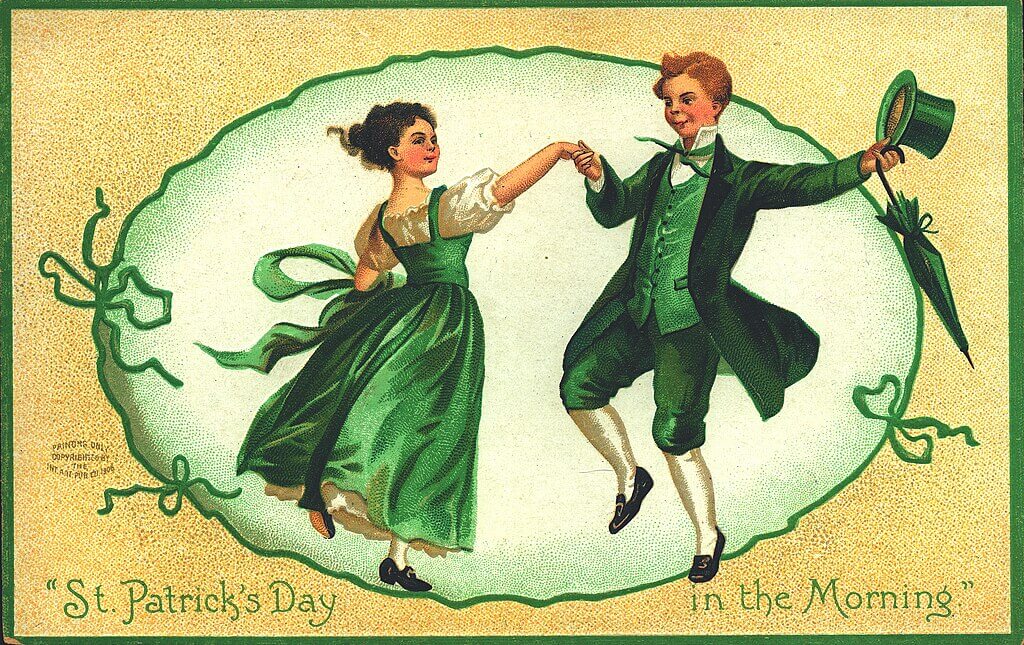
I won’t let St. Patrick’s Day pass without wearing something green and reaching for a glass of something that has been produced through fermentation or distillation. It is the least I can do for all the ways the Irish have enriched the world, but especially the English language, and me.

When it comes to writing, the Irish have what might be termed an ethnic advantage, from the literary game-changers in the last century — George Bernard Shaw, James Joyce, Samuel Beckett and Brendan Behan — to two of the top practitioners of novel-writing today, Sally Rooney, who is only 35, and the prolific and so-readable John Banville.

When it comes to poets, William Butler Yeats is, to my mind, seated among the immortals.

Yet, as I enjoy my St. Patrick’s Day libation, I shall reflect on the contradictions that are Ireland. These are summed up in a personal experience.

I was, for over 20 years, the American organizer of the Humbert Summer School in Ballina, Co. Mayo. One of my missions was to take Americans — often Irish Americans who had never been to their ancestral land — to Ireland and the school.

Summer schools in Ireland are akin to Renaissance weekends or Aspen Institute meetings in America. Some are literary, like the Yeats Summer School in Sligo, or political, like the Parnell Summer School in Co. Wicklow, or musical, like the Willy Clancy Summer School in Co. Clare.

Mine, alas, is defunct, but it was named after the French General Jean Joseph Humbert who landed in Killala Bay to help the United Irishmen’s rebellion against the British in 1798, which was celebrated in Thomas Flanagan’s novel “The Year of the French,” and the movie based on it.

The Humbert School was the creation of its director, John Cooney, a distinguished journalist and major historian. Its mission was to discuss Ireland’s future at home and abroad.

Before the start of one year’s summer school, I briefed my Irish American charge, Ray Connolly, on just how awfully the British, my people, had behaved in the northwest of Ireland, from colonization in 1611 to the 1798 rebellion, to the famine of 1846, when so many perished or fled in the great diaspora, to the notorious Black and Tans after World War I. They were a paramilitary force formed in 1920 to reinforce police posts, act as escorts, and conduct counter-insurgency operations. But their cruelty caused many Irish people to join the Irish Republican Army.

I spared nothing in the telling of Albion’s perfidy in Ireland.

After the weeklong summer school, on our drive to Dublin Airport and our flight back to Washington, we stopped in a pub. When the publican heard my English accent, he asked, ”How’s the weather over there?” I knew he meant in England. I had to explain that I was now an American and had been for years.

The publican threw his arms around me and declared, “God bless you. You never lost your accent.”

Our exchange confused Ray. He reminded me that I had recounted the full litany of English horror in the northwest of Ireland including, after the 1798 rebellion, how Gen. Charles Cornwallis, chagrined after his defeat in America, hanged 20 Irish rebels per day.

“That,” I said of the enthusiastic publican, “is part of the wonder of Ireland: its contradictions.”

Ireland’s relationship with Britain is a fine example of those.

Britain is a prime destination for work and for career opportunities for the Irish. They talk of London with affection, although they may still sing rebel songs with gusto, and mention the horrors of the past as though they were last week.

Under a treaty, the Common Travel Agreement (CTA), Irish citizens have the right of abode in England. For them, there is no frontier; although, I learn, that may change as people who have acquired Irish citizenship, but aren’t Irish-born, are abusing it, adding to the immigration woes in Britain.

If the CTA should end, Britain will lose much, just as America is set to lose Irish talent because of immigration restrictions.

When talking about the impact of Ireland on America – 23 presidents were of Irish descent — it should be noted that America has also had an impact on Ireland.

On the downside, there is fast food. When I asked a cab driver in Dublin about where to get good fish and chips, he said he preferred Kentucky Fried Chicken.

On the upside, there is the celebration of St. Patrick’s Day, which started in America.

But before Americans went crazy for all things Irish on March 17, it was a quiet religious day in Ireland. Now it is more of a celebration there, as it is here and much of the world. Sláinte!

Filed Under: King's Commentaries Tagged With: Americans, Army, British, citizenship, Cornwallis, English, Irish, rebellion, Renaissance, St. Patrick's Day, Yeats

White House Chronicle on Social

  • Facebook
  • Twitter
  • Vimeo
  • YouTube
9/11 — The Tragedy That Didn’t Have To Happen

9/11 — The Tragedy That Didn’t Have To Happen

Llewellyn King

There is a terrible truth about 9/11: It didn’t have to happen. Something as simple as a hardware store lock could have deterred the perpetrators. The arguments against hardening cockpits were numerous, and now seem unconvincing to the point of being risible. They included: It would cost too much; the public had to see the […]

Medicare for All Is the Wrong Fix for the Healthcare Crisis

Medicare for All Is the Wrong Fix for the Healthcare Crisis

Llewellyn King

As Charles Dickens might have said, “It is the best of times in medicine, it is the worst of times in healthcare.” It is a time of great medical discovery with artificial intelligence, it is a time of the poorest outcomes for the sick. One of America’s most distinguished pediatric cardiologists says the nation is in […]

My Maiden Flight Without a Necktie

My Maiden Flight Without a Necktie

Llewellyn King

Friday, Aug. 14, was a seminal day for me. For the first time in my long life, I boarded a flight without a necktie. In seven decades of flying, I have never done that. Truth is, I felt underdressed on the flight from Providence, R.I., to Jacksonville, Fla., as if I were wearing my pajamas […]

Brain Injuries From Blasts Driving Young Vets to Suicide

Brain Injuries From Blasts Driving Young Vets to Suicide

Llewellyn King

We all get a warm glow when we hear the airline gate agent inviting active-duty service members to board early. What isn’t said, isn’t known, is that some of those young men and women will die eventually by their own hands, and at nearly three times the rate of civilians in the same under-34 age […]

Copyright © 2026 · White House Chronicle Theme on Genesis Framework · WordPress · Log in