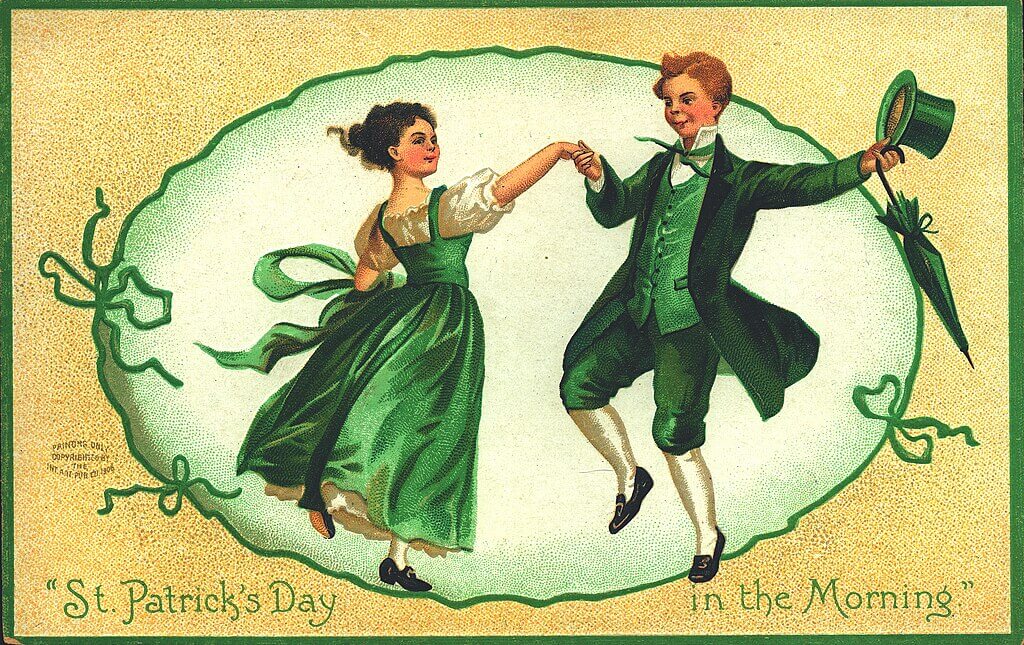
I won’t let St. Patrick’s Day pass without wearing something green and reaching for a glass of something that has been produced through fermentation or distillation. It is the least I can do for all the ways the Irish have enriched the world, but especially the English language, and me.
When it comes to writing, the Irish have what might be termed an ethnic advantage, from the literary game-changers in the last century — George Bernard Shaw, James Joyce, Samuel Beckett and Brendan Behan — to two of the top practitioners of novel-writing today, Sally Rooney, who is only 35, and the prolific and so-readable John Banville.
When it comes to poets, William Butler Yeats is, to my mind, seated among the immortals.
Yet, as I enjoy my St. Patrick’s Day libation, I shall reflect on the contradictions that are Ireland. These are summed up in a personal experience.
I was, for over 20 years, the American organizer of the Humbert Summer School in Ballina, Co. Mayo. One of my missions was to take Americans — often Irish Americans who had never been to their ancestral land — to Ireland and the school.
Summer schools in Ireland are akin to Renaissance weekends or Aspen Institute meetings in America. Some are literary, like the Yeats Summer School in Sligo, or political, like the Parnell Summer School in Co. Wicklow, or musical, like the Willy Clancy Summer School in Co. Clare.
Mine, alas, is defunct, but it was named after the French General Jean Joseph Humbert who landed in Killala Bay to help the United Irishmen’s rebellion against the British in 1798, which was celebrated in Thomas Flanagan’s novel “The Year of the French,” and the movie based on it.
The Humbert School was the creation of its director, John Cooney, a distinguished journalist and major historian. Its mission was to discuss Ireland’s future at home and abroad.
Before the start of one year’s summer school, I briefed my Irish American charge, Ray Connolly, on just how awfully the British, my people, had behaved in the northwest of Ireland, from colonization in 1611 to the 1798 rebellion, to the famine of 1846, when so many perished or fled in the great diaspora, to the notorious Black and Tans after World War I. They were a paramilitary force formed in 1920 to reinforce police posts, act as escorts, and conduct counter-insurgency operations. But their cruelty caused many Irish people to join the Irish Republican Army.
I spared nothing in the telling of Albion’s perfidy in Ireland.
After the weeklong summer school, on our drive to Dublin Airport and our flight back to Washington, we stopped in a pub. When the publican heard my English accent, he asked, ”How’s the weather over there?” I knew he meant in England. I had to explain that I was now an American and had been for years.
The publican threw his arms around me and declared, “God bless you. You never lost your accent.”
Our exchange confused Ray. He reminded me that I had recounted the full litany of English horror in the northwest of Ireland including, after the 1798 rebellion, how Gen. Charles Cornwallis, chagrined after his defeat in America, hanged 20 Irish rebels per day.
“That,” I said of the enthusiastic publican, “is part of the wonder of Ireland: its contradictions.”
Ireland’s relationship with Britain is a fine example of those.
Britain is a prime destination for work and for career opportunities for the Irish. They talk of London with affection, although they may still sing rebel songs with gusto, and mention the horrors of the past as though they were last week.
Under a treaty, the Common Travel Agreement (CTA), Irish citizens have the right of abode in England. For them, there is no frontier; although, I learn, that may change as people who have acquired Irish citizenship, but aren’t Irish-born, are abusing it, adding to the immigration woes in Britain.
If the CTA should end, Britain will lose much, just as America is set to lose Irish talent because of immigration restrictions.
When talking about the impact of Ireland on America – 23 presidents were of Irish descent — it should be noted that America has also had an impact on Ireland.
On the downside, there is fast food. When I asked a cab driver in Dublin about where to get good fish and chips, he said he preferred Kentucky Fried Chicken.
On the upside, there is the celebration of St. Patrick’s Day, which started in America.
But before Americans went crazy for all things Irish on March 17, it was a quiet religious day in Ireland. Now it is more of a celebration there, as it is here and much of the world. Sláinte!