
White House Chronicle

News Analysis With a Sense of Humor

  • Home
  • King’s Commentaries
  • Random Features
  • Photos
  • Public Speaker
  • WHC Episodes
  • About WHC
  • Carrying Stations
  • ME/CFS Alert
  • Contact Us

Birth of an Institution in Boston

April 5, 2015 by Llewellyn King Leave a Comment

Do think tanks really think? It’s not that these organizations — mostly centered in Washington, D.C., but also scattered across the country – don’t harbor some fine minds among their scholars and fellows, but the problem is we know what they think — and have often known for a long time. The rest is articulation.

Among Washington think tanks, we know what to expect from the Brookings Institution: earnest, slightly left-of-center analysis of major issues. Likewise, we know that the Center for Strategic and International Studies will do the same job with a right-of-center shading, and a greater emphasis on defense and geopolitics.

What the tanks provide is support for political and policy views; detailed argument in favor of a known point of view. By and large, the verdict is in before the trial has begun.

There a few exceptions, house contrarians. The most notable is Norman Ornstein, who goes his own way at the conservative American Enterprise Institute (AEI). Ornstein, hugely respected as an analyst and historian of Congress, often expresses opinions in articles and books which seem to be wildly at odds with the orthodoxy of AEI.

A less-celebrated role of the thinks tanks is as resting places for the political elite when their party is out of power. Former U.N. ambassador John Bolton, rumored to be favored as a future Republican secretary of state, is hosted at AEI. National Security Adviser Susan Rice was comfortable at Brookings between service in the Clinton and he Obama administrations. At any time, dozens of possible office holders reside at the Washington think tanks, building reputations and waiting.

My interest in think tanks and their thinkers has led me to what might be developing into a think tank, although it’s too early to say. It’s so early that it has no headquarters, secretariat or paid staff. But this nascent think tank has gathered a loose faculty from a coterie of public intellectuals, mainly in and around Boston, and abroad in Hanoi, Tokyo and Berlin.

It’s called the Boston Global Forum. Formed in 2012, it’s led by two very different but, apparently, compatible men: Michael Dukakis, former Massachusetts governor and Democratic presidential nominee, and Nguyen Anh Tuan, who founded a successful internet company in Vietnam and now lives in Boston.

The concept of the forum is to study and discuss a single topic for a year. Last year, in forums and internet hookups between Boston and Asian and European cities, the topic was security in the South and East China seas, where war could easily erupt over territorial disputes. After a year of discussion, the participants concluded that a framework for peace in the region needs to be established and that current international arrangements and organizations don’t go far enough in that direction. This year’s topic is cybersecurity.

The Boston Global Forum has strong ties to the faculties at Harvard and Northeastern University, where Dukakis is a professor. Most forum meetings take place on the Harvard campus. Two of the forum’s most conspicuous champions are Harvard professors Joseph Nye and Tom Patterson. Patterson’s office at the John F. Kennedy School of Government serves as a kind of de facto headquarters.

This new entrant into the think tank cohort is very East Coast-tony, and very energetic. This year it has plans for meetings in Vietnam, Tokyo and somewhere in Europe, and has attracted media heavyweights like David Sanger of The New York Times and Charles Sennott, one of the founders of the online GlobalPost.

As the Boston Global Forum is a new think tank, questions abound: Will it get funding? Will it find premises and staff ? Will it get public recognition?

The big question about anything that looks like a think tank is, will thinking happen there? Will the Boston Global Forum be a crucible for big ideas? Or will it, like other think tanks, develop its own binding ideology?

Will the Boston Global Forum become, like so many, a smooth propaganda machine? Or will it be a place where the outlandish can live with the orthodox?  — For the Hearst-New York Times Syndicate

Filed Under: King's Commentaries Tagged With: American Enterprise Institute, Boston Global Forum, CSIS, Harvard University, John Bolton, Joseph Nye, King Commentary, Michael Dukakis, Nguyen Anh Tuan, Norman Ornstein, Northeastern University, Susan Rice, The Brookings Institution, think tanks, Tom Patterson

The Rare Earths Problem: A U.S. Solution

March 30, 2015 by Llewellyn King Leave a Comment

Rare earth elements – there are 17 of them – have the world’s manufacturing by the throat. They are, as John Kutsch, director of the Thorium Energy Alliance, says, “the great multipliers.” They make metals stronger, generators more efficient, cell phones smaller, television sets sharper, and laptops lighter. They are, in their way, as important to modern manufacturing as energy.

At one time, the United States was a major supplier of rare earths — with supplemental supplies coming from countries around the world, including Australia and Brazil. Today, 90 percent of the rare earths the world uses come from China.

The use of rare earths is as important in lasers and jet engines as it is in aiming cruise missiles, which means the United States, and the rest of the world, has a huge vulnerability: China controls the supply of new war-fighting material. All U.S. defense manufacturers – including giants Boeing, General Electric and Lockheed Martin — are dependent on China. Now China is demanding that U.S. companies do more of their manufacturing there: China wants to control the whole chain.

Yet, as the rare earth elements industry is quick to assert, rare earths are not rare; they are scattered generously throughout the world. So why China’s dominance?

China has three main advantages. The first is that in 1984, leader Deng Xiaoping adopted a major initiative, the so called 863 Program, to move China from being a simple supplier of raw materials and products, enhanced by cheap labor, to being an industrial powerhouse and scientific giant. Rare earths were one of the areas singled out in the program.

The second advantage is that the Chinese ignored – and, to a large extent, still do — the environmental costs of rare earths’ extraction. The environmental damage is described by those who have been to one of two major Chinese sites, which have a combined population of 17 million, as catastrophic, with mountains bathed in acid to remove the sought-after rare earths, resulting in lakes of acid.

China’s third advantage is a natural one: It has a lot of ionic clay, which contains rare earths without the associated uranium and thorium.

About the time China was ramping up its plans to dominate the world rare earths market, the United States, in conjunction with the International Atomic Energy Agency in Vienna, began to regulate so called source materials. These are materials which, at least in theory, could be fashioned into weapons. In reality, those associated with rare earths are not in sufficient quantity to interest potential proliferators.

But the regulations are there. Many in the rare earths elements industry believe that it was these regulations — particularly as affecting thorium — that crippled production around the world and essentially closed down the U.S. industry, just as demand was escalating.

There is a commercial market for uranium. While hardly any thorium is used nowadays, it was once used in some scientific instruments and mantles for lighting. Thorium is akin to uranium in atomic weight, and it is a fertile nuclear material. That means that it can be used in a nuclear reactor, but it has to be ignited by a fissile material, such as enriched uranium or plutonium.

Thorium is radioactive, but mildly so. It is an alpha emitter, which means it can be shielded with tissue paper and will not penetrate the skin. However, it has a half-life of 1.5 billion years.

The answer, according to James Kennedy, a science consultant and rare earths expert, is to develop a reactor using thorium instead of uranium. This reactor, called a molten salt reactor, is inherently safe, say its passionate advocates, and would be a better all-around nuclear future. The technology was pioneered by one of the giants of the early nuclear age, Alvin Weinberg, at the Oak Ridge National Laboratory, but abandoned under pressure from enthusiasts for light water reactors, the kind we have today.

The Thorium Energy Alliance believes that the United States and other countries should develop a cooperative to source rare earths from the existing mining of phosphates and metals and store the thorium until it becomes a useful fuel. A bill to do this is making its way through Congress, but its chances are slim. Short of putting a value on thorium and isolating it, the chances of a rare earth elements industry reawakening in the United States, or elsewhere, is rare. — For the Hearst-New York Times Syndicate

Filed Under: King's Commentaries Tagged With: 863 Program, Alvin Weinberg, China, Deng Xiaoping, International Atomic Energy Agency, ionic clay, King Commentary, nuclear reactor, Oak Ridge National Laboratory, plutonium, rare earth elements, rare earths, thorium, Thorium Energy Alliance, United States, uranium

ISIS Is Turning the Cradle of Civilization into a Grave

March 17, 2015 by Linda Gasparello 1 Comment

There is horror in the recent news that the Islamic State bulldozed the ruins of two of the greatest Assyrian cities, Nimrud and Nineveh. And there is irony. These ancient cities, located in what is now northern Iraq, were built by a ferocious people whose profession was war – people for whom the Hebrew prophets, including Isaiah, Nahum, Zechariah and Zephaniah, reserved some of their fiercest denunciations.

In the 9th century B.C., Assurnasirpal II, a brutal militarist, erased entire nations as far as the coast of the Mediterranean Sea, stretching through what is now Syria, Lebanon and northern Israel. But he restored the ancient city of Nimrud and established his capital there. His magnificent Northwest Palace, first excavated by the British explorer Austen Henry Layard in the 1840s, was probably completed between 865 and 869 B.C. Its dedication was celebrated with a banquet for 70,000 guests.

Sennacherib, who moved the capital to Nineveh in 704 B.C., was as bellicose as his forefathers. When the city of Babylon rebelled against his despotic rule, Shennecherib destroyed it, saying, “ The city and its houses, from its foundation to its top, I destroyed, I devastated, I burned with fire. The wall and outer wall, temples and gods, temple towers of brick and earth, as many as there were, I razed and dumped them into the Arahtu canal.” But in Nineveh, he built a palace decorated with precious metals, alabaster and woods. Mountain streams were diverted to provide water for the city’s parks and gardens, resplendent with trees and flowers imported from other lands – along with captives who were enslaved and brought back to Assyria to build and tend them.

It is a wonder that these Assyrian kings who were capable of such ruthlessness were also capable of building cities filled with such majestic architecture.

In the 1970s and 1980s, in the time of another ruthless leader, Saddam Hussein, the Iraqi antiquities board reconstructed large parts of Assurnasirpal II’s palace, including the restoration and re-installation of the carved-stone reliefs lining the walls of many rooms, according to Augusta McMahon, professor in the Department of Archaeology, University of Cambridge.

“The winged bulls that guard the entrances to the most important rooms and courtyards were re-erected. The winged bull statues are among the most dramatic and easily recognized symbols of the Assyrian world,” McMahon wrote in a BBC report.

Nimrud, she added, “provided a rare opportunity for visitors to experience the buildings’ scale and beauty in a way that is impossible to find in a museum context.”

That is lost for all of us, now and in future generations.

Fortunately, a significant number architectural artifacts from Nimrud and Nineveh are housed safely in museums in Europe and North America, including the limestone and alabaster reliefs, portraying Assurnasirpal II surrounded by winged demons, or hunting lions or waging war, and the monumental, human-headed winged lions that guarded important palace doorways, currently displayed in the British Museum in London and the Metropolitan Museum of Art in New York.

As if the loss of Nimrud and Nineveh were not horrible enough for world heritage, ISIS continued its campaign to eradicate ancient sites it says promote apostasy last week by leveling the ruined city of Hatra, also located in northern Iraq, founded in the days of the Parthian Empire over 2,000 years ago. Hatra’s massive walls withstood attacks by the Romans.

Irina Bolkova, director-general of UNESCO, said, “The destruction of Hatra marks a turning point in the appalling strategy of cultural cleansing underway in Iraq.”

I hope it does. And I hope that what Zephaniah prophesized for Assyria will befall the Islamic State: “Assyria will be made a desolation.” –For the Hearst-New York Times Syndicate

Filed Under: King's Commentaries Tagged With: Assyrian Empire, culture cleansing, Hatra, Iraq, ISIS, Islamic State, Nimrud, Nineveh

A Third Way for Immigration: More and Less

March 16, 2015 by Llewellyn King Leave a Comment

Mark Jason, director of the Immigration Tax Inquiry Group, is trying to fix immigration.

Mark Jason, director of the Immigrant Tax Inquiry Group, is trying to fix immigration.

Is there a big, new idea about immigration? Is there a way of looking at the issues beyond polarization? Is there a way of stabilizing the lives and the living conditions for the estimated 11 million illegal immigrants who hide in the shadows of society, living in fear, and costing the United States as much as $100 billion a decade in services and lost taxation revenue?

Is there a way of making those who employ undocumented workers, or those with dubious papers, from falling into unintended criminality themselves? Is there a “third way?”

The Immigrant Tax Inquiry Group (ITIG), based in Malibu, Calif., has been pondering the implications of taxation in the immigration debate. It was formally established as a not-for-profit foundation in 2010.

ITIG’s idea is big — a new front, in effect. It brings the immigrants out of the shadows, identifies them and gives them respect, while mitigating the impact on the rest of us. It also soothes those who want nothing to do with paths to citizenship.

As I understand it, the ITIG proposal is simple: cater to the illegal worker by issuing a 10-year, renewable work permit and taxing the employer at 5 percent of the wage for employing one of these workers. This would bring the undocumented worker, and his or her family, out of the shadows, provide revenue for their cost to society, and enable them to have dignity and security without citizenship. I can attest, from my own reporting, that not every immigrant wants citizenship and a vote.

The plan has been incubating for decades among a coterie of thinkers who want a practical humane solution to the problem.

Mark Jason, executive director of ITIG, knows something about immigrants. He was educated partly in Mexico and has worked there to improve conditions so fewer people will take the long walk north.

Over the years, Jason, has discussed his ideas with people as disparate as Ronald Reagan (a family friend, when Reagan was governor of California), Cesar Chavez, the National Farm Workers Association founder and leader, and recently retired Rep. Henry Waxman (D-Calif.).

Jason told me Reagan was interested, although this was before he became president and enacted his own immigration plan in 1986, which was straight amnesty. Chavez, he said, was more concerned with conditions in the fields than with the legal status of immigrants, partly because many farm workers come on contract. Waxman, who was a prolific legislator, liked Jason’s ideas and encouraged him to “think big.”

The ITIG plan is put forward in a detailed report on the Web, complete with revenue projections in graphs and charts.

Jason has worked as a tax consultant, an IRS agent and a farmer in Mexico, where he helped establish a honeydew melon farm near Puerto Vallarta. The farm has three missions: produce and export melons (350 tons in 2014), teach the local farmers better practices, and end the incentive to leave.

What frustrates Jason is the difficulty he has had in getting his ideas circulated in the immigration debate. Although the report by ITIG is detailed and clearly represents an important new dimension in the debate, it has not yet gotten traction in Congress nor, more surprisingly, among immigrant advocacy groups.

The plan, under which workers would get a 10-year work permit, get drivers licenses where states allow it, and travel freely between the United States and their country of origin. It would also convey the benefits enjoyed by American families on the immigrant family, such as education and the protections of the law.

Jason is using his own resources to push the plan. “It is not a panacea, but a practical way to get people out of the shadows and into the economy,” he says.

He sees his plan as the solution not to the whole immigration dilemma but as a recognition of reality; as a way of protecting society from the cost of a shadow population. Jason believes it creates an asset where there is a liability — but real legal status is not changed.

Jason told me his wife fell in love with him because “she said I liked to fix things.”

Immigration is a big job for a handyman, but Mark Jason is at work.  — For the Hearst-New York Times Syndicate

Filed Under: King's Commentaries Tagged With: California, Cesar Chavez, immigration, Immigration Tax Inquiry Group, ITIG, King Commentary, Mark Jason, National Farm Workers Association, President Ronald Reagan, Rep. Henry Waxman

The Changing Face of Electricity Supply

March 12, 2015 by Llewellyn King Leave a Comment

Management theory says, “Stick to what you know. Don’t stray from you core business.” That’s all well and good, but what happens when the core is changing and it’s no longer a reliable source of profit and continuity?

At the top of my list of companies that didn’t make changes fast enough is one that is still around, but is far different from the ubiquitous giant it used to be: Western Union.

Until change swept away its core business, this was the company that had an iron grip on the business of leased wires, cables and telegrams. Western Union was the communications giant of its day, but it was overwhelmed by disruptive technology — technology it failed to grasp.

Gone are the days when it was a household word and anyone who wanted to move anything electronically, from newspaper copy to birthday wishes, used Western Union. Today it’s a money transfer service.

Western Union could not have foreseen the Internet, but it could’ve grasped it. What’s more, the telegraph business began to falter just about the time the overnight package business exploded.

So here’s the question: Why didn’t Western Union, which already blanketed the country with offices and messengers, gravitate to the parcels delivery business?

The answer is that the history of old-line companies adjusting to new realities is not good. Being willing to change and changing are not the same thing.

These are issues that are beginning to buffet the nation’s electric utilities, as they face the disruptive effects of new technologies. So far the winds of change are blowing lightly, just a zephyr.

A conference in Washington on April 9-10, organized by Public Utilities Fortnightly, will examine the issue of the disruptions that are transforming the industry. Ken Silverstein, editor in chief, says, “My own research is showing that people at all levels of all utilities are thinking about the new energy paradigm. But thinking about it and acting are two different things. Some utilities are really moving aggressively, and others are far more deliberate in their approach.”

The immediate agents of change encroaching on the electric utilities are rooftop solar, installed by homeowners, and microgrids, where a group of alternative generators are linked together and hook into the utility grid as one entity.

Rooftop solar generation is growing exponentially, pushed by tax advantages, politics and the preference of individuals to embrace green alternatives. Large vendors, such as SolarCity, have made a business of leasing rooftop collectors to homeowners. Self-generation often makes economic sense, particularly if surplus electricity can be sold back to the electric grid: a practice called “net-metering.”

But net-metering is distressing to the utilities because the self-generators have become customers of convenience and don’t contribute to the maintenance of the grid on which everyone relies. Long term this means high rates for those who can’t go solar, like apartment dwellers.

This challenge to the economics of the grid comes at a time when the utilities are implementing their own changes in the form of the so-called “smart grid,” which incorporates remote meter-reading and data collection on user habits, and offers the chance for the utilities to offer customers advantageous off-peak rates, known as “demand-side management.”

The Washington conference is likely to hear how some utilities are hoping to embrace the changes while others are hoping that regulation will save their core business.

Among those big utilities that have embraced the changes that are coming is NRG Energy, a holding company which owns two utilities, and San Diego Gas & Electric.

New players on the horizon suggest that rooftop solar may just be the beginning of what is shaking up the traditionally staid utility industry. These include Google and Tesla Motors, which are both investing in the renewable future and which may not care who they push aside.

The question for the utilities: Can they adjust fast enough to save the economics of the grid and honor their obligations to serve? They might want to ponder the words of David Lloyd George, the British prime minister, who said: “It is dangerous to leap a chasm in two bounds.”

Filed Under: King's Commentaries Tagged With: King Commentary

Hanoi Diary

March 12, 2015 by Linda Gasparello 1 Comment

DSCN3574

Making your way through the traffic in Hanoi, whether by foot, bike, motorbike or automobile, is like playing the game of pick-up sticks.

In the game, a bundle of 50 sticks is released on a tabletop. Each player in turn tries to pick up a stick from the jumbled pile without disturbing any of the others. It is a mentally and physically challenging game.

When the pile is gone, the player with the most sticks wins. Like a pick-up sticks player, a pedestrian, bicyclist or motorist becomes a winner when they have picked a path unharmed through Hanoi‘s traffic tangle.

During my December visit, I saw few traffic accidents in the city. Considering the millions of motorbikes (often ridden by a mother with an infant sitting on her lap and a child clinging to her back, or a deliveryman obscured by his cargo) that cross paths with those of cars, buses, trucks, people pulling handcarts, bicycles and pedestrians, that is a miracle. Or, maybe, it is just common courtesy.

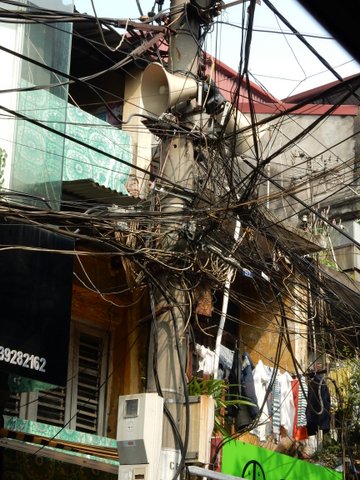
DSCN3349Speaking of tangles, I have never seen anything quite like the mess of overhead power lines, telephone and television cables in Hanoi. The wires, all twisted together and hanging from poles or banyan trees, look like mad dreadlocked hair.

These wires are an eyesore and a huge public hazard.

In June 2013, the English-language daily Viet Nam News reported, Nguyen Thi Nga, a resident in Hai Ba Trung District’s Lang Yen Street, received an electric shock while opening her shop door near an electric pole after heavy rain. Even though uninjured, she has a panic attack when she thinks of it.

“ ‘The whole area is covered with messy and dangerous wires, and they threaten local lives when it rains,” said Nga, adding that after big rains last year, electric discharges damaged many appliances in nearby homes.”

Electric poles holding hundreds of heavy, tangled wires particularly threaten residents in the capital city’s old tenement houses. A group of tenement houses at 30 Pham Van Dong Street is an example, Viet Nam News reported. “Many loose wires hang down from power poles and some even touch the heads of passers-by.

DSCN3470“ ‘Wires even hang down near the public playground, which threatens out children’s safety, said Dam Thi Diu, a 33-year-old resident in Tu Liem District, adding that promises to clean up the problem had been made many times.”

Vu Quoc Hung, deputy director of the Ha Noi Power Corporation, told Viet Nam News that “Hanoi will try its best to have the cables buried on 321 city streets by 2015.” That effort is now coming down to the wire.

The Red River runs through North Vietnam and its folk theater, which includes Cheo and water puppetry.

Thang_Long_Water_Puppet_Theatre2Dating back to the 11th century, water puppetry was created by Red River Delta rice farmers who built simple stages on the surfaces of ponds and paddy fields. The shows were supposed to entertain the villagers and the spirits, so that they wouldn’t make mischief.

Nowadays, water puppetry is performed at the Thang Long Water Puppet Theater in Hanoi. After entering the theater, you walk up a narrow, wooden staircase to a first-floor landing. Wooden puppets, laquered white — and some around 30 pounds — are piled on the floor.

The puppets perform in a big pool of water; they enter the water stage through a curtain strung behind it. They are controlled through a pole-and-string rig, hidden beneath the water surface, by eight puppeteers standing in waist-deep water behind the stage.

Water_Puppet_Theatre_Vietnam(1)

Musicians, sitting on one side of the pool, provide music and sound effects on traditional Vietnamese instruments. They also do the puppets’ voices.

The night I went to the Thang Long theater, the program included a folk music opening, followed by a 14-scene water puppet performance portraying rural life (planting rice, fishing, chasing the fox that tries to catch ducks); sacred animals (dragon, unicorn, tortoise and phoenix danse); and national history (Le Loi, a 15th-century hero, returning a sword to Kim Quy, the Golden Tortoise God, on a lake in Hanoi).

The puppets, either vividly lit or shrouded in fog, moved on the water stage like ballet dancers, twirling, diving and swooping in intricate patterns. At the end of the performance, the puppeteers emerged from the water to take a dripping bow.

Water_puppets_2508154456_bbb0c9b315_b

Water puppetry is a preserved art form. “The secret of how water puppet shows work has been kept quiet for centuries. The puppeteers even have their own dialect and codewords to prevent someone from overhearing talk of a particular technique,” according to the Thang Long theater.

“Trying to figure out exactly how puppeteers can control the intricate movements blindly is part of the magic of each water puppet show. Great shows of skill include passing objects from puppet to puppet and other coordinated movements, which have to be done by instinct rather than sight. The musicians, who can see the puppets, sometimes shout code words to warn the puppeteers when a puppet is not where it should be.”

The performance I saw delighted children, adults – and, not doubt, spirits with mischief on their minds.

DSCN3420

China has its Peking Opera. Japan has its Noh Opera. Vietnam has its Hat Cheo theater. Tales of life in North Vietnam’s Red River Delta are told through musicals at the Cheo theater, Nha Hat Cheo Vietnam, in Hanoi.

This form of musical theater (“hat” means “to sing”) satirizes social classes in North Vietnam, from farmers, monks and students to wealthy people, dates back to around the 11th century. Until the 16th century, these musical tales were performed by traveling, amateur troupes in village squares and building courtyards. Today, they are performed by professionals at Nha Hat Cheo Vietnam, a theater in Hanoi.

Hat Cheo has little in the way of scenery, costumes and makeup. The accompanying orchestra comprises drums, bamboo flutes, fiddles, lutes and zithers.

Every Friday and Saturday night at 8 p.m., the Hanoi theater offers a top-of-the-pops program, titled “5 Most Favored Lyrics of Cheo Art Music.” The program is “a new and innovative approach to introducing audiences to the traditional Cheo art,” according to the theater.

There’s no place like Hang Ma Street for the holidays – any seasonal holiday, from traditional Vietnamese to Christmas.

Christmas is celebrated in Vietnam, and widely across Asia, as a major shopping holiday. And in December, Hang Ma shops were brimming with yuletide treasures: synthetic Christmas trees leaning against front windows; Santa Claus suits and hats in all sizes, from baby to daddy, hanging from rafters; ornaments, tinsel and wrapping paper crowding shelves; and glitter banners reading “Merry Christmas” adorning entrances.

DSCN3379
The legendary white horse of Hanoi.


Instead of a full-length musical, the program includes pieces played by the Cheo orchestra and individual members. One piece, titled “Ways To Pass the Hardship and Sorrows,” is played on a bau, a one-stringed zither which makes a soulful sound. Another piece, titled “Xuy Van Sharing Her Sad Mood and Broken Heart,” is played on a bamboo flute.

The program closes with the orchestra playing “Fate of a Bad Luck Lady,” a piece with a decidedly downbeat title. After hearing it, audiences may wonder whether to give the musicians a standing O, or a standing Oh dear!

*****

On the road from Hanoi to Halong Bay, you’ll see mile after mile of industry. In fact, almost no stretch of the 100-mile-long, main highway is without some form of industry, from single human to heavy. DSCN3378

Just across the Red River, on the outskirts of Hanoi, I saw workers with bodies shaped like question marks tending rice fields. An hour away, I saw mountains with red gashes from clay mining; a nearby village had bricks and clay pottery stacked high in front of shops. Passing through another village, I saw garage-like shops displaying elaborately carved, wooden furniture – massive bed headboards, dining sets and sofas fit for the palaces of ancient kings, or the new Vietnamese McMansions.

Nearing Halong Bay, there is a dreary stretch of highway. The road and villages are covered in soot. “This is a coal-mining area,” my guide, Tran Huong, said. I didn’t need to be told.

DSCN3359
The Old City temple courtyard, strung with birdcages.

Between these villages, I saw all sorts of highway vendors: women in triangular straw hats, selling fruit and vegetables, squatting on the side of the road, their toes within inches of bicyclists and speeding vehicles; men keeping a nonchalant eye on black sandals and shoes, displayed in rows, looking like dashed lines along the highway.

The industry of the Vietnamese is one of the country’s wonders.


Filed Under: King's Commentaries Tagged With: WHC In Vietnam

The Environmental Voices in Obama’s Ear

March 1, 2015 by Llewellyn King Leave a Comment

In the South they ask, “Who’s your daddy?” In the North, “Where did you go to college?”
In Washington we ask this very real question, “Who’s advising him?” Washington believes in advisers, who are often the authors of big decisions made by others.
When George W. Bush was running for president the first time, I raised the question about his lack of knowledge in foreign policy. One of his staunch supporters countered, “He’ll have good advisers.”
Advisers come in all shapes and sizes in politics. A trusted aide may shape a senator’s understanding of an issue, and set the legislator on a path that later might be regretted but cannot be reversed. “Flip-flop” is a deadly accusation in public life.
When President Obama makes a decision, one wonders on whose advice? Who started the locomotive rolling down the track?
This week, one wonders who led Obama to endlessly delay a decision on the Keystone XL pipeline, which should have been a rather mundane issue until he was backed into vetoing a congressional effort to move the project forward?
There are 2.5 million miles of pipe buried in the ground in the U.S.,190,000 of which carry crude oil. The Keystone XL pipeline would have carried crude for 1,179 miles. It should have been a no-brainer for the State Department, which has jurisdiction because a foreign country, Canada, is involved. It is not hard to make a pipeline safe, and this one would be engineered as no other has.
But a core of dedicated environmentalists saw it as a wedge. Their target was not then and never has been the pipeline, but rather the Alberta oil sands project, where much of the oil would originate. By cutting off deliveries of the oil to the U.S. market, they hoped to wound the project and eventually close it down.
I am no fan of the oil sands – which used to be called “tar sands” – project. I think it is abusive of the earth. It involves massive surface mining and has so scarred the region that the great pit can be seen from space. It is also a contributor to air pollution because the sands have to be retorted with natural gas.
It is not a pretty business wringing the oil from the sands. However, not building the pipeline will not close down the oil sands project as environmentalists have hoped. Only low prices can do that.
The Canadians are angry. They feel betrayed by the White House and stigmatized by outside forces like the Natural Resources Defense Council (NRDC), which has been a relentless antagonist of the pipeline and the oil sands project.
The question is who persuaded Obama? In November 2011, Canada’s minister of natural resources, Joe Oliver, told me at an energy meeting in Houston that he had been told privately that the pipeline deal was done, and he was expecting Obama to sign off on a State Department decision in weeks.
But it did not happen. One or more people in the White House – Obama takes advice from a small circle of advisers in the White House rather than his cabinet secretaries — was able to sow doubt in the president’s mind about the pipeline.
The results: More oil moves by rail car which is resulting in accidents in Canada and the United States. An ally is offended, and there is bad blood that will affect other trade issues. Thousands of construction jobs in the Midwest are lost. Obama looks bad: the captive of a very small part of the constituency that elected him.
There is an echo here of the folly of the president in abandoning the Yucca Mountain nuclear waste repository. On the surface, Obama bowed to the wishes of Harry Reid, then Senate majority leader. It has been accepted by the nuclear industry as a cold, hard political gift to a vital ally.
But as time has gone on, the nuclear spent fuel has piled up at the nation’s power plants, as the cost of the abandonment has risen – it stands at $18 billion. One has to wonder whether one of Obama’s advisers, with an agenda of his or her own, did not whisper to the president, “Harry Reid is right.”
There are no winners on the pipeline issue, just as there were no winners on Yucca Mountain, except those who are celebrating in places like NRDC. On sparkling, organically grown apple juice, perchance? — For the Hearst-New York Times Syndicate

Filed Under: King's Commentaries Tagged With: Canada, Keystone XL, King Commentary, Natural Resources Defense Council, NRDC, nuclear industry, nuclear waste, oil sands, pipeline, President Obama, Yucca Mountain

New Miracle Commodity: None Other than Bamboo

February 23, 2015 by Llewellyn King Leave a Comment

In a time of new materials, a very old one is sneaking into our lives. You may have noticed that bamboo is making an appearance everywhere. There are bamboo floors – I hear there is one in the Holman Lounge of the National Press Club in Washington, D.C.— cutting boards and walking sticks.
But Troy Wiseman, a Chicago entrepreneur, sees future growth for bamboo in clothing, paper and activated charcoal — which has hundreds of industrial and medical uses. And he sees it as the next big, green forest products industry.
Bamboo is a grass whose fiber is similar to timber. After a six-year, initial growing period, it can be harvested yearly. It can be cultivated on land abused by clear-cutting, poor crop rotation and over-grazing. For the soil, bamboo is a healing grass.
The Chinese have known of the wonders of bamboo for centuries. They construct houses from it, eat it (Giant Pandas will eat nothing else), make baskets, chopsticks, hats and weapons from it. In Hong Kong, bamboo scaffolding is used to erect skyscrapers; in Mainland China, this practice has been limited to five stories.
Yet in the West, bamboo has traditionally been thought of as a curiosity, not a valuable agricultural commodity. Wiseman, who is chief executive officer of EcoPlanet Bamboo Group, aims to change that with large-scale bamboo production, which also has positive environmental and social impacts.
There are around 1,200 species of bamboo, and some have given it a bad name. Gardeners have reason to be wary of bamboo which, if they plant the wrong variety, can grow like kudzu and is a virulent invasive species.
Wiseman’s company plants better-behaved “clump” bamboo that is native to and approved by the country he is operating in. EcoPlanet Bamboo has established two plantations in Ghana, and one each in South Africa and Nicaragua. He is negotiating to make a big land purchase in Asia that will produce bamboo for clothing, paper and activated charcoal, and will convert the plant remains into fuel for electric generation.
Wiseman describes himself as a “capitalist with a conscience,” and has the enthusiasm of a tent preacher when it comes to the business opportunities and the social and environmental benefits of bamboo farming. For bamboo plantations, you ideally need hot, wet weather – the very areas where old-growth forests are most under threat.
He describes the financial rewards, the jobs for third-world laborers, and the saving of forests as “my three bottom lines.” But he is quick to emphasize, “Don’t get me wrong, we’re a capitalist company. We’re about profit, but there’s a right way to do it.”
As a businessman, Wiseman can claim a record. He told me in an interview that he had co-founded the global B.U.M. clothing line which went public, a private equity-based financial services firm, which financed, among other things, a company that made “turducken,”which is a dish consisting of a deboned chicken, stuffed into a deboned duck, which is stuffed into a deboned turkey.
A competitive wrestler in his youth, Wiseman says he is more excited about grappling with the challenges of bamboo than anything else. He says he has interest from a large number of Fortune 500 companies, including retailer Costco and paper giant Kimberly Clark. Bamboo has natural anti-bacterial properties, which is why bamboo cutting boards are desirable in the kitchen — my wife has one. But these properties, it is believed, will make bamboo fiber popular for bandages, diapers, tissues, sanitary napkins and underwear.
I have not knowingly worn bamboo-fiber clothes, but bamboo and I have a history. As a boy, before the days of hobby shops, I made kites using bamboo slats for the frames. Bamboo was light, strong and available. Little did I know that I was continuing a fine Chinese tradition of kite making and flying. My kites were rather primitive — bamboo frame, brown paper sail, and glue made with egg white or flour paste — but they flew.
Now I am captivated not by kites, but whether the world has overlooked a valuable and beneficial source of wood and fiber substitute. Troy Wiseman thinks so, and I am inclined to believe it. Incidentally, my bamboo walking stick (which cost $24 at Walgreens) is light, good-looking and maybe a trendsetter. — For the Hearst-New York Times Syndicate

 

Filed Under: King's Commentaries Tagged With: B.U.M. clothing, bamboo, climate change, EcoPlanet Bamboo Group, environment, King Commentary, old-growth forests, Troy Wiseman, turducken

The New Work: The Individual as Microbusiness

February 15, 2015 by Llewellyn King Leave a Comment

The genius of Uber is dumbfounding. I’m not talking about what it pays its drivers (not enough), whether it’s putting taxis out of business (it is). I’m talking about the sheer brilliance of unleashing the value stored in the family car. Likewise, Airbnb which isn’t denting the hotels, but is causing tax collectors to go apoplectic.
These Internet companies are unleashing the value that families have had hidden in their driveways and spare bedrooms.What’s next? Your guess is as good as mine. If your guess is right, there are folk over at Google who’d like to talk to you.
Airbnb (which connects people looking for accommodation with those offering it in their homes) may be a tad more exciting than Uber (which puts private car owners in the transportation business) because it is catering to a specific traveler market. Hotels have become so unpredictable in their opportunistic pricing that private travelers are happy to leave them to business travelers who are less price-sensitive.
Then there’s GrubHub, which offers free online ordering from thousands of delivery and takeout restaurants. It may well be the next big thing in the market.
These are three examples of how the Internet, which giveth and taketh away, is reordering the economy. They’re beacons for how the economy might replace the jobs that are being lost to computers. They also offer extra income or full employment for people who don’t have marketable educations: driving a car and keeping a pretty home don’t require college degrees in science.
The nature of work is changing, and one of the consequences is that more of us are becoming self-employed: private contractors.
The Internet enables a large number of artisan skills to be marketed. I’ve just found an online advertisement for a dressmaker. Long before Walmart and “Project Runway,” dressmakers abounded. Women would ask their neighborhood dressmaker to “run up something” for a special occasion or whatever. Mass retailing, plus the difficulty of marketing beyond word-of-mouth, pretty well ended that, but it may come back. Now you may live in Atlanta, but you can order a bridal gown from an Etsy dressmaker in Seattle.
The Red Truck Bakery & Market, housed in an old gas station in Warrenton, Va., sends its Meyer Lemon and other goodies across the country. Artisanal baking meets the Internet.
Years ago, a friend of mine developed a knit teddy bear. It was a beautiful thing; tactile, safe for small children. I don’t recall whether my friend had gotten around to naming her stuffed bruin, but he was a darling — although I don’t know why stuffed bears have to be male.
Anyway the said unnamed, unsexed, stuffed bear didn’t make it into many young arms because of marketing. The big retailers didn’t want it. Things are very competitive in Bear Land, and Paddington Bear and company don’t want other teddy bears crashing their picnic on the store shelves.
That was more than 30 years ago. Today, Bear X could be sold on the Internet. Now I’d wager the big chain retailers would come begging — offering the little thing a whole shelf for itself.
The miracle of today is that it could happen differently. The concomitant fact is that we’re going to need more cottage industry and more self-employed contractors because the jobs of yesterday are disappearing, and the companies are less and less inclined to hire permanent staff.
Years ago, the jewelry business moved offshore; now it’s moved to American homes. It’s possible for a creative person to make jewelry at home and sell it online.
A new age of self-employment is at hand. Recently, I’ve worked with two inspiring millennials. One is a gifted and filmmaker, and the other a computer wizard. Both are making a living, and neither has given any serious thought to getting a job in the conventional way.
It’s not the age of small business, but microbusiness: the individual with something to sell, whether it’s artisanal furniture or a skill. The millennials seem to know this instinctively, the rest of us are learning it.
Want to hire a veteran journalist who works from home? Call me. — For the Hearst-New York Times Syndicate
Filed Under: King's Commentaries Tagged With: Airbnb, Etsy, GrubHub, King Commentary, microbusiness, millenials, self-employed, Uber

It Isn’t Your Father’s Workplace Anymore

February 9, 2015 by Llewellyn King Leave a Comment

One thing we think we know about the Republicans is that they take a dim view of waste, fraud and abuse. So how come the U.S. House of Representatives, in Republican hands, has voted 56 times to repeal or cripple the Affordable Care Act, better known as Obamacare?

They’ve put forth this extraordinary effort despite an explicit veto threat from President Obama. Their repeated effort reminds one of Onan in the Bible, which politely says he spilled his seed on the ground.

It’s a waste of the legislative calendar and the talents of the House members. It’s a fraud because it gives the impression that the House is doing the people’s business when it is holding a protracted political rally. It’s an abuse of those who need health care because it introduces uncertainty into the system for providers, from the insurers to the home-care visitors.

It’s symptomatic of the political hooliganism which has taken over our politics, where there is little to choose between the protagonists.

Republican groups think that Obama is the doer of all evil in the nation – especially to the economy — and the world. Daily their Democratic counterparts gush vitriol against all the potential Republican presidential candidates, only pausing for an aside about the wickedness of Fox News.

Their common accusation is middle-class job woes. They’re on to something about jobs, but not the way the debate on jobs is being framed.

The political view of jobs is more jobs of the kind that we once thought of as normal and inevitable. But nature of work is changing rapidly, and it cries out for analysis.

The model of the corporation that employs a worker at reasonable wages which rise every year, toward a defined benefit pension, is over. Today’s businesses are moving toward a model of employment at will; the job equivalent of the just-in-time supply chain.

While more of us are becoming, in fact, self-employed, the structure of law and practice hasn’t been modified to accommodate the worker who may never know reliable, full-time employment.

The middle-class job market is being commoditized, as the pay-per-hour labor market includes everything from construction to network administration. Sports Illustrated — synonymous with great photography — has just fired all six of its staff photographers. Don’t worry the great plays will still be recorded and the Swimsuit Issue will still titillate, but the pictures will be taken by freelancers and amateurs.

Two forces are changing the nature of work. First, the reality that has devastated manufacturing: U.S. workers are in competition with the global labor pool, and business will always take low-cost option. If unemployment goes up in China, that will be felt in the U.S. workplace. Second is the march of technology; its disruptive impact is the new normal — accelerated change is here to stay.

All is not gloom. The trick is to let the old go – particularly difficult for Democrats — and to let the new in. There will be new entrepreneurs; more small, nimble businesses; and whole new directions of endeavor, from gastro-tourism to cottage-industry manufacturing, utilizing 3-D printing. Individuals will be free in a new way.

Government needs to think about this and devise a new infrastructure that recognizes that the nature of work is changing. The emerging new economy should have simplified taxes and Social Security payments for the self-employed; portable, affordable health care; and universal catastrophe insurance, so that those who are not under an employer umbrella can benefit from the equivalent of workers’ compensation. The self-employed, rightly, fear the day they can’t work.

Rugged individualism has a new face. The political class needs to look and see the new workplace. — For the Hearst-New York Times Syndicate

Filed Under: King's Commentaries Tagged With: 3-D printing, Democrats, employers, employment, jobs, King Commentary, middle class, new economy, President Obama, Republicans, workplace

  • « Previous Page
  • 1
  • …
  • 65
  • 66
  • 67
  • 68
  • 69
  • …
  • 106
  • Next Page »

White House Chronicle on Social

  • Facebook
  • Twitter
  • Vimeo
  • YouTube
Spot the Illegals — a Chilling, Sad Neighborhood Game

Spot the Illegals — a Chilling, Sad Neighborhood Game

Llewellyn King

Here is a disturbing game: Try to spot the illegal immigrant. Is it the waitress, the winning one from Bulgaria, or is it the charming emergency room doctor from Pakistan, or is it one of the Mexican men working on the housing site at the corner? Maybe it is the Haitian caregiver in your home, whom […]

The Question That Must Be Answered: How Dangerous Is AI?

The Question That Must Be Answered: How Dangerous Is AI?

Llewellyn King

Races have winners and losers — at least so I have always thought. At some point, the competition ends and a winner is identified, whether it is first-past-the-post as in a horse race, or first in the marketplace as in a commercial race. Think about VHS and Betamax. Similarly, we knew who won the space […]

9/11 — The Tragedy That Didn’t Have To Happen

9/11 — The Tragedy That Didn’t Have To Happen

Llewellyn King

There is a terrible truth about 9/11: It didn’t have to happen. Something as simple as a hardware store lock could have deterred the perpetrators. The arguments against hardening cockpits were numerous, and now seem unconvincing to the point of being risible. They included: It would cost too much; the public had to see the […]

Medicare for All Is the Wrong Fix for the Healthcare Crisis

Medicare for All Is the Wrong Fix for the Healthcare Crisis

Llewellyn King

As Charles Dickens might have said, “It is the best of times in medicine, it is the worst of times in healthcare.” It is a time of great medical discovery with artificial intelligence, it is a time of the poorest outcomes for the sick. One of America’s most distinguished pediatric cardiologists says the nation is in […]

Copyright © 2026 · White House Chronicle Theme on Genesis Framework · WordPress · Log in