White House Chronicle

News Analysis With a Sense of Humor

  • Home
  • King’s Commentaries
  • Random Features
  • Photos
  • Public Speaker
  • WHC Episodes
  • About WHC
  • Carrying Stations
  • ME/CFS Alert
  • Contact Us

Covering the White House, From Twilight to Dark

June 23, 2017 by Llewellyn King 1 Comment

Freedom of the press, in my view, has two parts. First there is the freedom to publish, to criticize and to petition. Then there is the critical issue of the freedom to gather the news — not just to report it but also to gather it.

Without the freedom to gather the news, the freedom to print it, broadcast it or comment on it becomes pyrrhic. The official line predominates.

Right now, the freedom to report the news at the White House is under attack and the public’s right know is being impinged. What you get: all the news that can be leaked.

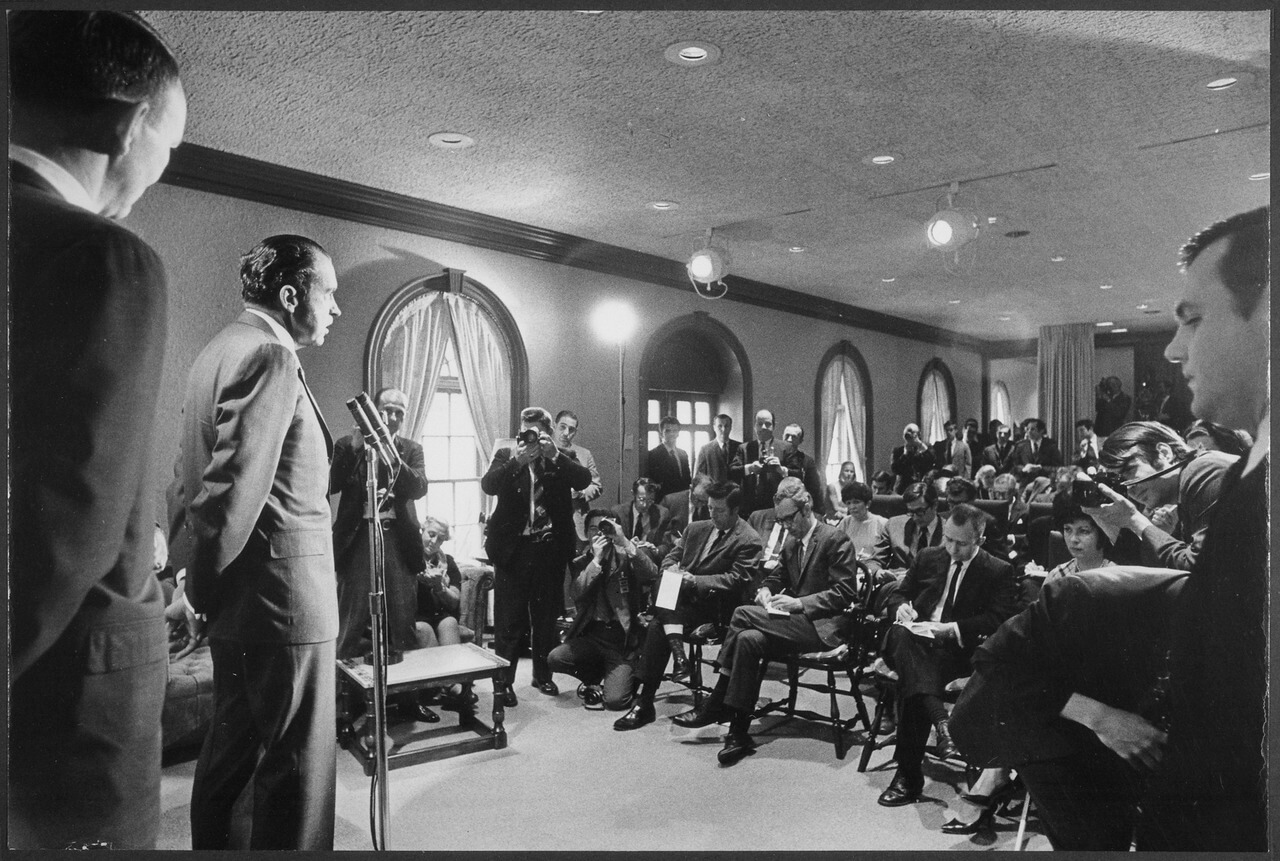
Covering the news at the White House has gotten progressively harder since the days of Lyndon Johnson and Richard Nixon, the first administrations I covered.

The Trump administration has attacked the press, ridiculed it and is starving it of critical access. Now there is talk of doing away with the daily press briefing, honored and needed. It is where the government is asked what it is doing and ideally tells the people. It is America’s answer to the much admired “Question Time” in Britain’s House of Commons.

It has never been easy to cover the White House, and history is littered with the ways in which presidents sought to affect the way in which they were covered. Jack Kennedy, a darling to some reporters, so hated the coverage he was getting from The New York Herald Tribune that for a while he forbade it in the White House.

Lyndon Johnson worked over the press corps the way he worked over members of Congress: punishment and reward.

At The Washington Daily News, Wauhillau La Hay worried aloud — often in my presence — that the file from the Scripps-Howard Washington bureau (it was an afternoon newspaper owned by Scripps-Howard) would make it hard for her to cover the social side of the White House, her assignment.

Richard Nixon believed that the press was out to get him and his famous enemies list was real. Yet he ran a surprisingly open White House, as had Johnson.

Compared to what was to follow, it was wide open. Once a reporter got through the gate you were a free agent to roam much of the grounds and to visit the West Wing, if you had someone to see. More important, you got one-on-one interviews with principles without some minder from the press office sitting in and acting as a double agent, reporting back on both the journalist and the interviewee.

After your interview, you were sometimes invited into the office of another staffer. As often as not, they wanted to know what you knew as much as you wanted to know what they knew, even during Watergate.

The best information is the information you get face-to-face, one-on-one. That has become very difficult as time has rolled on. Personally, I found the George H.W. Bush open enough. I remember going over to see his chief of staff, John Sununu, without problem. I phoned him, got a time and went over. No press office involvement. Once, he asked me if I would like to write a speech for the president. I averred.

Excessive leaking is a symptom, a cry from within the belly of the beast that all is not well. At this point the leakers are patriots, not criminals.

In recent administrations, the only way for White House reporters to get into conversations with White House staffers has been to travel with the president overseas: a very expensive stab in the dark. A European trip can cost more than $20,000, and few news outlets can afford the gamble. Even if you are in the pool and sitting on Air Force One, nothing is guaranteed.

If, as has been suggested, the daily briefings stop, more leaks are inevitable. If you cannot seek the information directly, you have to try to get it otherwise. If the front door is closed, a ladder up to the window is the next step. At the same time, relationships become more devious. Like an illicit love affair, no public acknowledgment in public places.

If the right to gather the news is abridged, the whole concept of a free press is diminished. The diminishment is underway.

Government in the dark is the government of authoritarians; not the kind of government one expects from a nation that prohibits the “abridging” of the press in its Constitution. Shame.


For InsideSources

Photo: Richard M. Nixon press conference. General Services Administration. National Archives and Records Service. Office of Presidential Libraries. Office of Presidential Papers. (01/20/1969 – ca. 12/1974); President (1969-1974 : Nixon). White House Photo Office. (1969 – 1974)

Filed Under: King's Commentaries Tagged With: Donald Trump, freedom of the press, journalism, National Union of Journalists, Sean Spicer

Notebook: The Limits of the Writing Life for a Journalist

May 8, 2017 by Llewellyn King Leave a Comment

As opportunities in journalism have tightened, many of my colleagues have tuned to writing books. I admire them. Actually, I more than admire them: I’m astounded by them.

Among them is my friend Richard Whittle, a former Pentagon correspondent for The Dallas Morning News, who has written two first-rate books. His first was about the V-22 Osprey vertical takeoff aircraft and his second was about drones.

Whittle is hard at it on a third. He tells me that he loves his second career – and, as an elegant writer and an impeccable reporter, he’s doing well.

I’m frequently asked why I don’t take this path and write books about the subjects I know something about or, to be exact, subjects about which I’m supposed to know something. The answer is simple: fear. Not fear about my ability, but fear of boredom. Fear of waking up every day and having to take up where I left off the day before.

The peripatetic journalistic life suits me; maybe too well. I love the idea that each day could bring something new, unexpected and thrilling, just because it’s new.

Like many newspapermen, I answer phones with alacrity because the next call might, as it says in “The Rubaiyat of Omar Khayyam,” could “in a trice life’s leaden metal into gold transmute.”

The poet was referring to liquor, and it might be why liquor and newspapering have been so indelibly linked. Certainly, the drinking by newpapermen — and I’ve worked on newspapers in colonial Africa, London, New York, Baltimore and Washington, D.C. — was endemic and awesome.

Less now, I gather. The venerable National Press Club in Washington used to support two bars and, at lunch and in the evening, drinkers crowded them 15- deep. Now the only bar is sadly empty most of the time.

Once I ran into a colleague at the end of the day at the Paris Air Show. “How are you?” I asked. “I’m cold, I’m wet, my feet hurt and I haven’t found a story,” he said. I knew why he was miserable: Life’s leaden metal hadn’t been transmuted into gold nuggets of news.

The book writers, if they’re any good, unearth many stories, but the thrill of publication isn’t daily. It can take a year or longer. Not for me.

News writing, like drinking, produces its thrills predictably, and I’m for the early gratification. More power to my colleagues who are undaunted by the long haul.


Why Are the Bus Riders Left Out in the Cold?

Rhode Island, where I live, is, as I have found, a kindly place: people look out for one another. So why, I wonder, are there so few bus shelters and even benches?

I find the public transportation users (I’m one) standing forlornly, in all kinds of weather, waiting for a bus. Recently, in the heavy rains, they were especially bedraggled. This must negatively affect ridership. Since I have difficulty standing for long periods, I don’t take the buses in Providence and its surrounding communities. But I’d take them if I could sit down while waiting.

In Washington, D.C., where I’m often, I take the buses a lot. There are seats in shelters that don’t keep you warm but do keep you dry.

It’s cruel to leave those who ride buses without shelter or seating.


Sleeping Rough in a Place of Learning

I travel to Cambridge, Mass., quite a bit. But recently, in this self-regarding gyre of great ideas, I’ve noticed more homeless people than ever sleeping on the streets. One wonders, wandering the streets so close to the Great Minds, whether some of them haven’t thought of a solution? Is it a step too far from the ivory towers to the hard pavement where the luckless sleep?


Second Story To Add Restaurant, Lose One Stage

I went to Warren, R.I. to see “Art” at 2nd Story Theatre. At the end Ed Shea, the dominant force there – by turns actor, director and manager — came on stage to announce that the building, which now includes two small theaters and a very pleasant bar, is to be refurbished, and that the first-story theater will be transformed into a restaurant.

I wish them well, but it’s unclear how this will work. Will the restaurant be complimentary or competitive? If I’m going to eat and go to the theater, I favor supper after rather than dinner before. Going to a good restaurant is, in itself, a theatrical experience and competes with theater for entertainment hours.

One of the joys of Rhode Island is its profusion of really good places to eat. Warren is no exception. New Orleans has the reputation, but Rhode Island has the vittles.

Second story will lose a stage, but Shea still plans to cook up some imaginative theater on the remaining one.

Filed Under: Random Features Tagged With: 2nd Story Theatre, journalism, Rhode Island, theater

The New Language of the New Trumpian Politics

May 5, 2017 by Llewellyn King Leave a Comment

President Trump may or may not have done good things in his first 100 days in office. But have no doubt, he has affected the language of politics, uprooted the tried-and-true meanings of the past for a new more ambiguous, fluid and hazier speech.

These words and phrases are the language of the day:

Takeaways: These are the facts which you try and sort out from the presidential utterances. Takeaways mostly are the nuggets, the nub, the likely policy in the mattress of words. Takeaways are nearly as good as facts, but not quite as tricky. Takeaways don’t have to be facts, they can be hints, even insults or praise, which indicate which way the presidential wind is blowing; whether it is a zephyr or a gale, a wind of change or just hot air.

Double down: This is when President Trump or his staff cling to a position for a while. For example, the president has doubled down on his demand for wall along the southern border. He has not wavered in his desire to see masonry separating us from Mexico, from the bad hombres there who have never heard of airplanes, boats or Canada. A fence won’t do; nor will an electronic barrier. It has to be a wall, like Hadrian’s Wall, separating England from Scotland, or the Great Wall of China or the Berlin Wall. History loves walls. History doesn’t do fences.

Walk back: Walking back statements, positions, accusations and policies is a kind of wiggle room on steroids. If it stirs up a storm, walk it back. If the historical facts you’ve quoted are pure nonsense, walk them back. If your international agenda has changed, walk back the old one.

Take the strange matter of Chinese currency manipulation. Candidate Trump was going to straighten out that one. But when he needed the Chinese to pressure North Korea, he walked back the issue of currency manipulation. He also did a few backward steps on Chinese incursion into the South China Sea.

Historians might note that in relation to China, President Trump has traded away a lot for little or nothing. The Chinese aren’t going to topple the dictatorship of Kim Jong-un in North Korea, or even cut off a lot of their trade with him. “Smart cookies” are in Beijing, too.

Fake news: This is the new aspirin of politics. Take two and recant in the morning. Fake news is, by presidential dictate, anything you don’t like on the news; or the entire purveyor of the news, like CNN or The New York Times. Fake has not yet lost its old meaning: It means made up, false, fictitious.

In the Land of Trump, there are no facts, except those on which he has doubled down, and which might be walked back at some time in the future.

Enemies of the people: That means journalists. All of them, if they don”t work for Fox News — and a few of those are suspect.

Now the president, the negotiator-in-chief, the man who can look across the table at an adversary and get the wretch to sign and concede, is taking on the Arab-Israeli conflict. Trump may not have negotiated the Russians into submission or the Chinese into compliance, but no matter. When at first you don’t succeed, go for the big one. Double down.

Maybe Trump and his son-in-law, Jared Kushner, will walk through the Valley of Failed negotiations and succeed. But no matter. It’s a no-brainer. You can walk that one back, littering the way with accusations of intransigence and ill will. One doesn’t have to walk back failure in the Middle East. That one walks itself.

Author’s note: I’ll walk back all my negative comments as needed or, perchance, double down on them. They are, of course, fake and have been penned by a certifiable enemy of the people.

Filed Under: King's Commentaries Tagged With: Donald Trump, fake news, glossary, headlines, Jared Kushner, journalism, language, lexicon, Politics

The Loud Silence from Islam

January 10, 2015 by Llewellyn King 2 Comments

A dark shadow passed over Paris, the City of Light, on Wednesday, January 7.. Well-organized, well-trained killers murdered 13 people in the name of Allah. As Shakespeare said 500 years earlier, about the heinous murder of King Duncan by Macbeth, “O horror, horror, horror! Tongue nor heart cannot conceive nor name thee.”
Indeed, recent horrors in the name of Allah have been so gruesome it is impossible to conceive the mutilated reason, the perverted concept of God’s will, and the unvarnished rage that has subverted the once admired religion.
The killers are ruthless and depraved, but those who inspire them are evil and those who tolerate them are guilty.
In 2005, when a Danish newspaper published 12 cartoons depicting the Prophet Mohammed and riots were stirred up against the publishers, a meeting was arranged at a community room in the basement of The Washington Times. It was not organized by the newspaper but, as I recall, by an interfaith group. There were several fringe “let’s be nice” speakers before the main event.
The main event was the Danish ambassador and, to a lesser extent, myself. The ambassador spoke about life in Denmark and what the Danish government would do to understand and listen to the concerns of the Muslim community. My role was to defend and explain the Western concept of freedom of speech and the place satire. The overflow audience, which by dress and appearance was dominated by emigrants from Pakistan, was implacable.
I have spoken to some hostile audiences in my time, but this one was special: No compromise, no quarter. Nor interest in cultures other than their own. Ugly and insatiable rage came out in their questions.
They did not want to know about the values of the country that had given their brethren sanctuary, education, healthcare and a decent life. My audience only wanted to know why the blasphemers in Denmark and Norway (the cartoons were reprinted there) were not being punished. For good measure, they wanted to know why the American media was so committed to heresy against Islam. No thought that they had moved voluntarily to the United States and were enjoying three of its great freedoms: freedom to assemble, freedom of speech and freedom of religion.
They wanted absolute subjection of all Western values to the dictates of Islam. They had been fired up and they were angry, self-righteous and obdurate.
In 2009, I was invited to a conference of world religions in Astana, Kazakhstan. There were maybe 100 religions present, but at a featured session the conference degenerated into an Islamic diatribe against sexuality and the treatment of women (mostly in advertising) in the West. No dialogue. No discussion. Absolute certainty.
I mention this because of the reaction to the barbarity in Paris, and to a string of other barbarous murders across the world, from Muslims has been so muted.
“Je Suis Charlie” said millions of people in dozens of countries in sympathy with the murdered journalists and with their fight for press freedom. From Muslim leaders in the West, including the Council on American-Islamic Relations in the United States, there were statements of condemnation but no sense of outrage. From the bulk of the followers of Islam there was nothing. There never is. Not when innocent children are shot in their schools, or when aid workers are beheaded, or when or when satirical journalists are executed. The Muslim multitudes have acquiesced to evil.
When will those who believe deeply in Islam take to the streets to denounce the excesses of the few? After the horror in Paris, British Muslims took to the BBC to mildly criticize the murders, but more to vigorously demand a better deal for Muslims in Britain.
The medieval certainty of the leadership of Islam is endorsed by the silence of its congregants. The silence of the millions gives a kind of absolution to the extremists, intoxicated with fervor and hate. It will all go on until the good Muslims stand up and are heard. The guilt of silence hangs over Islam. — For the Hearst-New York Times Syndicate


Filed Under: King's Commentaries Tagged With: American freedoms, BBC, cartoons, Charlie Hebdo, Council on American-Islamic Relations, Denmark, France, Islam, journalism, Kazakhstan, King Commentary, media, Norway, Pakistan, Paris, satire, terrorism, The Washington Times

WikiLeaks and Journalism Lore

January 17, 2011 by White House Chronicle Leave a Comment

“Publish and be damned,” the Duke of Wellington told the courtesan Harriette Wilson, who threatened to publish her memoirs and the general’s love letters in 1825.

In challenging Wilson, Wellington gave publishers and journalists a rallying cry that has echoed down through the years.

The irony here is that “The Iron Duke” despised anything that suggested opening up to the people: Indeed, he may have been history’s greatest elitist. He is not likely to have endorsed the dumping of hundreds of thousands of classified diplomatic dispatches by WikiLeaks. As for WikiLeaks founder Julian Assange, Wellington would have had him shot or maybe hanged for better effect.

Yet Wellington gave us the famous phrase and, by and large, it has been a serviceable rule for journalism.

Publications that have sought to censor themselves—sometimes out of fear and sometimes for political reasons–have paid a high price. In 1963, the Profumo affair nearly brought down the Conservative government in Britain. But The Sunday Mirror, which had learned that war minister John Profumo was sharing the favors of party girl Christine Keeler with the Soviet naval attaché and a few others to boot, did not publish for fear of libel.

In the end the scandal leaked out in the United States, and the newspaper was left looking very foolish. I know because I was working at The Sunday Mirror.

A few decades later, Newsweek sat on the Monica Lewinsky–Bill Clinton scandal and inadvertently boosted the fortunes of Matt Drudge.

It is easier to say “publish and be damned” about a sex scandal involving public figures than it is about national and international security, which is orders of magnitude more difficult.

Is WikiLeaks doing a public service in posting hundreds of thousands of classified diplomatic dispatches on the Web and hand-feeding them to five major news outlets, The New York Times, Le Monde, The Guardian, El Pais and Der Spiegel? Or is Assange indulging in a grand act of anti-Americanism; or an equally grand act of anarchy, using technology in furtherance of the petulance of one man and his small band of accomplices?

The measurable good is slight. It may be confined to improved computer security, itself lamentable.

The evil is ongoing and will take years to assess. The first casualty will be in the quality of information sent back from the field to Washington: It will be sanitized, bowdlerized and neutered. The free exchange of ideas and information is compromised. The integrity of diplomatic communications cannot be taken for granted in future.

Then there are those, uncountable, whose careers have been ended because they were friends of the United States; not spies, just friends.

During the first tranche of leaks, I was the guest of the U.S. ambassador in a small country. Although there was nothing incriminating released, our diplomats suffered acute embarrassment and wondered how difficult their jobs would be in the future.

The gravest category is where vicious regimes are exploiting the WikiLeaks information to punish their political enemies: Step forward Robert Mugabe, the savage and ruthless dictator in Zimbabwe who has trashed what was once the jewel of Africa. He has seized on meetings his political rival Morgan Tsvangira held with Western diplomats, seeking to save the people of Zimbabwe from the predations of Mugabe and his band of thugs.

“Treason”cries Mugabe, who is as promiscuous in accusing his enemies of treason as was Henry VIII.

Relying on a law from the colonial days, Mugabe has appointed a commission to rule on whether Tsvangirai should face trial for treason. He has also picked out negative comments about Tsvangirai from various American dispatches to vilify his political rival.

Assange knew exactly what he was doing because he provided early access to his data dump to the five most reputable news organizations he knew. Clearly he hoped they would treat the material gingerly, as they have.

In so doing Assange must have hoped to mitigate the really serious damage–including executions–that might result from his mischief. He was hoping they would save him from the damnation of his own publishing.

Filed Under: King's Commentaries Tagged With: Duke of Wellington, Harriette Wilson, journalism, Julian Assange, Morgan Tsvangirai, Profumo affair, Robert Mugabe, WikiLeaks

  • « Previous Page
  • 1
  • 2

White House Chronicle on Social

  • Facebook
  • Twitter
  • Vimeo
  • YouTube
The Woman Behind Trump’s Overnight Truth Social Raging

The Woman Behind Trump’s Overnight Truth Social Raging

Llewellyn King

President Trump’s press secretary, Karoline Leavitt, likes to say that his administration is the most transparent in history. Possibly, she is right. That is, if you think letting it all hang out is the kind of transparency Leavitt has in mind. Certainly, it all hangs out in a way we have never seen in Washington. […]

In the Turmoil, Challenges for Graduates in the Class of ’26

In the Turmoil, Challenges for Graduates in the Class of ’26

Llewellyn King

Dear Graduates of 2026, Welcome to the world you will be taking jobs in and where you will begin building careers, and at times shaping history. It isn’t the world of your parents, and it isn’t the world your college has taught you about, because it is changing too fast. It begins anew daily. As […]

Watch Out When the Political Class Forgets Cause and Effect

Watch Out When the Political Class Forgets Cause and Effect

Llewellyn King

Anyone who has spent time in criminal court knows this: One of the characteristics of lawbreakers is a poorly developed sense of cause and effect. At the low end, the folly of the defendants is always on display. The young man who takes a gun with him on a night of drinking. He has increased […]

The Electricity Future for New England: Uncertainty and High Prices

The Electricity Future for New England: Uncertainty and High Prices

Llewellyn King

These days, in terms of resources, New England is poorly positioned to make electricity. As Gregg Cornett, president of Rhode Island Energy, told me in an interview, it doesn’t sit on abundant coal reserves and natural gas — the critical fuel in today’s electricity generating mix — or hide beneath the surface, waiting for the […]

Copyright © 2026 · White House Chronicle Theme on Genesis Framework · WordPress · Log in