White House Chronicle

News Analysis With a Sense of Humor

  • Home
  • King’s Commentaries
  • Random Features
  • Photos
  • Public Speaker
  • WHC Episodes
  • About WHC
  • Carrying Stations
  • ME/CFS Alert
  • Contact Us

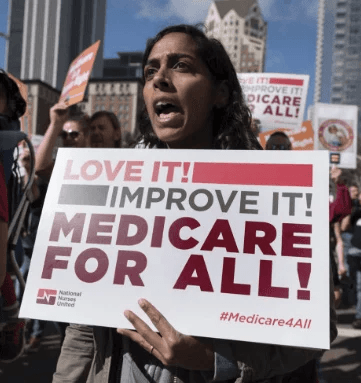
Medicare for All Is the Wrong Fix for the Healthcare Crisis

September 4, 2026 by Llewellyn King Leave a Comment

As Charles Dickens might have said, “It is the best of times in medicine, it is the worst of times in healthcare.” It is a time of great medical discovery with artificial intelligence, it is a time of the poorest outcomes for the sick.

One of America’s most distinguished pediatric cardiologists says the nation is in desperate shape with the end of Medicaid subsidies and the 28 million people — or almost 10 percent of the population — who lack insurance. The number is growing as people trade off the cost of insurance and prescriptions against rent, food and electricity.

Cardiologist Dr. Arthur “Tim” Garson Jr., a clinical professor at the University of Houston, College of Medicine, is keen to head off those who think the answer is Medicare for All.

“It seems to me that politicians of either party, especially those who are new to healthcare, say, ‘Medicare for All’ when they mean ‘universal coverage,’” Garson said, adding, “Coverage for all people is essential, but Medicare for All is only one way — and a terrible way.”

Garson, who is a former University of Virginia provost and an elected member of the National Academy of Medicine, said: “Let me be clear: Traditional Medicare works beautifully for 34 million of us. It’s easy, actually too easy, with essentially no pre-approvals for care. But that won’t work for 338 million people — allowing anyone to have anything.”

According to Garson, analyses that say Medicare for All saves money have it wrong. “We know that with no guardrails, care can go up 25 percent to 30 percent. They showed that in South Texas.”

Particularly, he takes aim at the Medicare for All Act of 2025, which is still before Congress. It contains coverage of everything from elective surgery to dental, hearing and vision care without copays or any cost-sharing, and eliminates all insurance.

The answer for the uninsured, according to Garson, is basic, tax-supported healthcare for everyone. That may not be enough for some, so private insurance must be permitted — a system he calls the “single safety net.”

That system operates in most of the developed world.

Behind Garson’s concern for those who go without insurance and who can’t afford prescriptions is a close-to-home tragedy. He helped save a toddler’s life and watched her grow over the next 19 years. Then, when her Medicaid ran out, she died because she couldn’t afford her sustaining prescriptions and was too ashamed to ask for help.

Garson shared a draft paper with me that explains the ruinous cost of Medicare for All and the basic healthcare he believes is affordable and achievable.

It states: “We spend more than twice the average of other developed countries on healthcare per person, and waste about one-third of the $5.5 trillion that we spend on healthcare — that’s about $1.6 trillion wasted. Yet, other countries provide healthcare for everyone.”

Garson isn’t advocating for a more expensive system. He says getting rid of even a portion of the waste can pay for perfectly adequate care.

I know a bit about the healthcare systems in three countries: England, where I used to be a beneficiary of the National Health Service, and where members of my family have used it since it began in 1947; France, where I received extraordinary care after a bad fall in Paris two years ago; and Ireland, where the two-tier system is praised by friends.

If people across the developed world can have the security of illness without going into penury, and they get that for half of what we spend on healthcare, what are we waiting for?

Garson thinks it will take a long time to eliminate the waste before America can move toward coverage for all.

I am not so sure. I think the effect of tens of millions without medical insurance could be dramatic. They will clog the emergency rooms where the law says they must get treatment.

In education, Garson notes, we have public schools and private schools for those who want them, so why not at the doctors’ offices?

I say that if your house catches fire, you expect to see the fire brigade. All of you.

Time to hear the fire bell in medicine. Many wonderful things are on the way with AI medical research. Everyone should get the benefits.

Filed Under: King's Commentaries Tagged With: education, England, France, healthcare, Medicare, medicine, pediatric, prescriptions, schools, sick

America’s Year of Thinking Dangerously

February 14, 2016 by Llewellyn King 1 Comment

By Llewellyn King

If you accept that seminal means an event or moment after which things will never be the same again, then we are living through a seminal year.

In matters big and small, change is in the wind.

This wind blew through Iowa and New Hampshire, and is defining the 2016 presidential election. Donald Trump and Bernie Sanders are not so much the leaders of this time of change, but rather the products.

The product is something hard to pin down, but it is there nonetheless — a sense that it is time to turn the page, to read the next chapter; a yearning for something fresh.

The millennials, hunched over their cell phones, are looking for the future in their small screens. The rest of us are looking for it in new leaders, new lifestyles; and new thinking, sometimes about old ideas.

Societies go through periods when they feel the need to change up things. But they want a sped-up evolution rather than a full-fledged revolution. This is such a time.

Change is everywhere from the bold, new things television is doing — frontal nudity, gay coupling and interracial love — to the kind of car we favor.

While we grapple with change and yearn for the new, we are surprisingly open-minded. American values appear to be undergoing a recalibration: We are getting more socially tolerant. Social conservatives are a diminished force.

Young people do not have the same commitment their parents had to conventional employment, to be defined by where they work. This leads to a world where people are less concerned with appearances, and all that goes with appearances. The business suit and its essential accoutrement, the necktie, are on the way out – and in much of the country, they are now curiously out of date. Apartments are being favored over houses because of new social values.

My generation experienced the hopeful 1940s (just the tail end), the smug 1950s, the turbulent 1960s, the oil-shocked 1970s, and the computer-excited 1980s, which continued unabated until the dot-com bubble burst at the turn of the century – but re-inflated with new developments in Internet products like Facebook, Twitter and YouTube.

In recent times, the only new American billionaire outside of the Internet was Hamdi Ulukaya, who popularized Greek yogurt in country hungry for yogurt choices. That is a dumbfounding fact. It means that it will be harder to get investment in old-line businesses and start-ups. The smart money has become myopically obsessed with the cyberworld.

If you were to go to Wall Street today to raise money for a new nuclear reactor that put all doubts of the past to rest and offered income for 100 years — there are such machines on the drawing board – you would find it hard to raise money; easier for a new Internet messaging system. This when there is no shortage of Internet messages (too many, I cry each morning). We are leery of the hard and enamored of the soft.

We sense that the education system is not doing its job; that it is broken and needs fixing. But how, we are not sure. We are sure, though, that we are going to change it.

We sense that we had the dynamic wrong in foreign affairs; that change at home, like toppling a generation of political leadership, is desirable, while toppling leaders abroad is a fraught undertaking, as with Saddam Hussein, Muammar Gaddafi and Bashar al-Assad.

We feel less good about the wealthy, and we are less sure that there are secure places for us in the future. We watch cooking shows and order in pizza. We gave up smoking and started jogging. But we are, so to speak, deaf to the damage we are doing to our ears with incessant music piped to them by earbuds.

We are more nationalistic and less confident at the same time. We treasure our values more, and wonder about their long-term durability.

The largest contradiction that can easily be inspected is in the themes of Trump and Sanders: Trump has rehabilitated a kind of racism aimed at immigrants, while Sanders has made the taboo word “socialism” acceptable in political dialogue.

The desire for change has moved from a slight wish to a hard desire for a new alignment. It is everywhere, from what we eat to how we feel about the climate. But we do not agree on this new alignment, hence the huge gulf between Sanders followers and Trump adherents. — For InsideSources

Filed Under: King's Commentaries Tagged With: 21st century, Bernie Sanders, billionaires, business start-ups, Donald Trump, education, Facebook, foreign affairs, King Commentary, lifestyles, political leadership, primaries, same-sex marriage, social values, socialism, the Internet, Twitter, Wall Street, YouTube

White House Chronicle on Social

  • Facebook
  • Twitter
  • Vimeo
  • YouTube
Spot the Illegals — a Chilling, Sad Neighborhood Game

Spot the Illegals — a Chilling, Sad Neighborhood Game

Llewellyn King

Here is a disturbing game: Try to spot the illegal immigrant. Is it the waitress, the winning one from Bulgaria, or is it the charming emergency room doctor from Pakistan, or is it one of the Mexican men working on the housing site at the corner? Maybe it is the Haitian caregiver in your home, whom […]

The Question That Must Be Answered: How Dangerous Is AI?

The Question That Must Be Answered: How Dangerous Is AI?

Llewellyn King

Races have winners and losers — at least so I have always thought. At some point, the competition ends and a winner is identified, whether it is first-past-the-post as in a horse race, or first in the marketplace as in a commercial race. Think about VHS and Betamax. Similarly, we knew who won the space […]

9/11 — The Tragedy That Didn’t Have To Happen

9/11 — The Tragedy That Didn’t Have To Happen

Llewellyn King

There is a terrible truth about 9/11: It didn’t have to happen. Something as simple as a hardware store lock could have deterred the perpetrators. The arguments against hardening cockpits were numerous, and now seem unconvincing to the point of being risible. They included: It would cost too much; the public had to see the […]

Medicare for All Is the Wrong Fix for the Healthcare Crisis

Medicare for All Is the Wrong Fix for the Healthcare Crisis

Llewellyn King

As Charles Dickens might have said, “It is the best of times in medicine, it is the worst of times in healthcare.” It is a time of great medical discovery with artificial intelligence, it is a time of the poorest outcomes for the sick. One of America’s most distinguished pediatric cardiologists says the nation is in […]

Copyright © 2026 · White House Chronicle Theme on Genesis Framework · WordPress · Log in