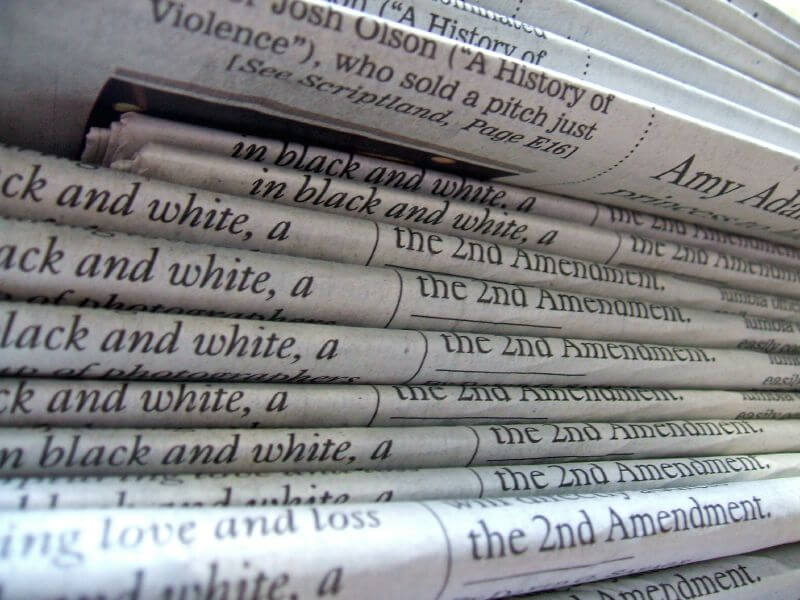
The printed word is to be treasured.
Two decades ago, I would have written newspapers are to be treasured. But the morning newspaper of old — manufactured in a factory in the middle of the night, shoved onto a truck and trusted to a child for delivery — is largely over. It follows the demise of its predecessor, the afternoon newspaper. These fell to competition from television in the 1960s and 1970s.
The word nowadays is largely carried digitally, even though it might have the imprimatur of a print publication. All the really big names in print now have more virtual readers than traditional ones. These readers may never have the tactile enjoyment, the feel of “the paper” they read, but they read. Increasingly, I am one of those.
I plow through The Washington Post, The New York Times and The Wall Street Journal. I dip into The Guardian, The Daily Telegraph and the Financial Times.
I also read — and this is an interesting development — a number of magazines which are de facto dailies. These include The Economist, The New Yorker and The Spectator.
The Economist is the only publication to which I have a digital and a paper subscription.
Much as I have loved newspapers down through the years, I am resigned to the fact there will be fewer going forward, and a generation of young people will find them more a curiosity than anything else.
But the importance of the written word hasn’t diminished. I make the point about the written word — and I distinguish it purposely from the broadcast word — because it has staying power.
I have spent my entire career working on newspapers and making television programs. It is words that are written on paper or online that last, that are referenced down through time.
Overnight television has an impact, but it fades quickly; the advertising industry has scads of data on this. The printed word — using that term to embrace words on paper and online — has staying power.
People often remind me of something I wrote decades ago. Few remember something I said on television years ago. Or months ago. But people remember your face.
My regard for the printed word brings me to The Washington Post, where the news staff is aligned against the owner, Jeff Bezos.
There are two issues here.
The staff feels that Bezos has sold them out to President Donald Trump and the forces of MAGA.
Bezos bought the paper without any interest in being a newspaperman, in enjoying the pleasures and pain of news ownership. He didn’t understand that you don’t own a newspaper like you own a yacht.
A newspaper is a live, active, rambunctious and roiling thing. You have to enjoy the fray to own one. Hearst did, Pulitzer did, Murdoch did. You don’t retail words the way Amazon sells pizza crusts.
Not only must the newspaper proprietor deal with the news and its inherent controversies, but he or she also must deal with journalists, a breed apart, disinclined to any discipline besides deadlines. By nature and practice, they are opponents of authority.
The Post has been mostly untouched by Bezos, except for his decision to spike an editorial endorsing Vice President Kamala Harris. The staff took it hard.
Bezos was undeterred and took what had become the billionaire’s pilgrimage to Mar-a-Lago to become, to staff fears, Trump’s liegeman, or at least to reassure Trump. Then Bezos got a seat at the inaugural.
Readers of The Post also took it hard and unsubscribed en masse. Thirty percent of those were among the critical digital subscriber ranks, indicating how political its readership is and just how difficult it is for the paper to please all the constituencies it must serve.
I was an assistant editor at The Post in the glory days of editor Ben Bradlee and the ownership of the pressure-resistant Graham family, under matriarch Katherine Graham. When I was at the paper, I was president of the Washington-Baltimore Newspaper Guild. The Guild negotiated what turned out to be the largest wage increase for journalists in any Guild contract. As I remember, it was 67 percent over three years.
Even so, the membership complained. The Post editors and writers are good at complaining with a high sense of self-regard. Len Downie, who was to rise to the executive editorship of the paper, declared, “King has sold us out.”
It was a contract that benefitted both the management of The Post and journalism in general.
It was a loud reminder of how poorly journalists are compensated and how this affects the flow of talent into the trade.
The driving force behind the contract from the union side was its professional head, the remarkably gifted Brian Flores and the equally gifted Guild chairman at The Post, John Reistrup.
Under Bezos, The Post first looked as though it would become a great force in the digital world, while the printed paper survived unspectacularly. Bezos clearly saw the digital potential.
But things unraveled and The Post started losing money. It lost $100 million last year.
It is still a good and maybe a great paper. But it needs to get its sense of mission back. That sense of mission can’t be at war with its owner.
The Post clearly would benefit from a new owner, but who has pockets deep enough and skin thick enough? It is a question Bezos and the querulous staff both need to ask themselves as the fate of the paper is uncertain.
 Follow
Leave a Reply