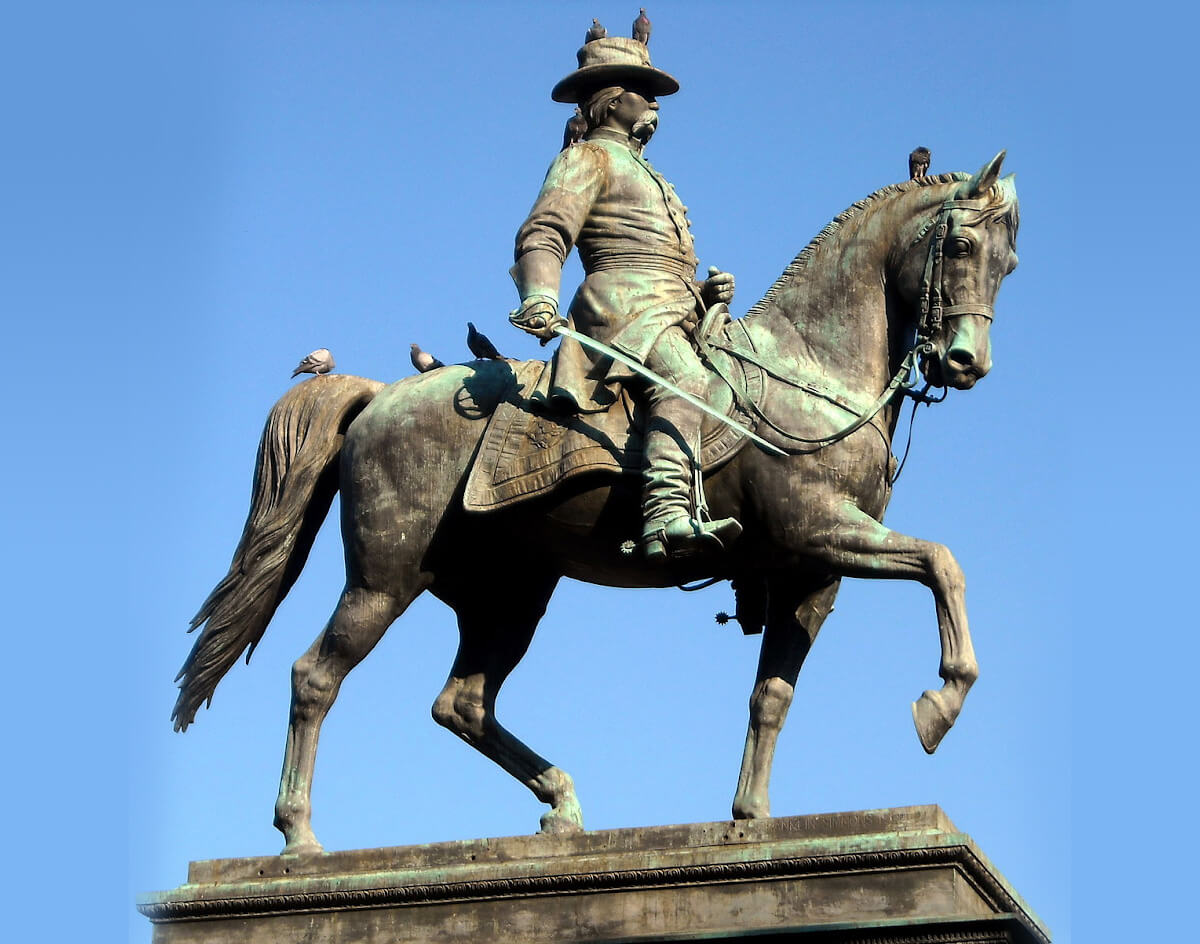
(Channeling Gen. John A. “Black Jack” Logan)
WASHINGTON — It’s Memorial Day. I see you’re walking from Logan Circle to Constitution Avenue to watch the parade honoring all the nation’s veterans.
I’ll be there, too. In spirit.
Do you see the bronze statue in the circle? That’s me: Gen. John A. Logan, sitting erect on my horse, my sword drawn and the ends of my thick mustache flying in the wind. I was nicknamed “Black Jack” for my swarthy complexion, boot-black hair, eyes and that mustache.
At the outset of the Civil War, I won re-election to the U.S. House of Representatives as a Jacksonian Democrat from Illinois’s 9th Congressional District, a region that had partisan and divided loyalties. I tried to take a neutral stance, but I ended up fighting to preserve the union. I rose from colonel to major general, distinguishing myself in eight major campaigns. Many historians consider me to be best of the Union Army’s “political” generals.
Gen. Ulysses S. Grant offered me a brigadier generalship in the postwar U.S. Army, but I returned to politics, winning three more U.S. House elections as a Republican from Illinois, and an advocate of African-American civil rights and public education.
Later I won three U.S. Senate elections, which spurred me to run for higher offices. I was a vice-presidential candidate on the Republican ticket that lost the general election in 1884, and I failed twice to become my party’s presidential nominee.
Enough about my political career. If you can dally, I’d like to tell you about the origin of this national holiday, which involves me and my wife, Mary, an indefatigable Washington hostess and a prodigious writer and public speaker.
In March 1868, when I was a congressman and commander in chief of the Grand Army of the Republic, an organization of Union veterans, my wife and I were invited to tour the battlefields of Virginia. Unfortunately, I couldn’t accompany her on what she called a “pilgrimage” in her May 30, 1903, article in The Los Angeles Times, headlined “Memorial Day: A Noted Woman’s Story of Its Origin and Growth.”
She wrote that on her visit to the oldest church in Petersburg, Va., whose bricks had been brought from England, “as we passed through the rows of graves, I noticed that many of them had been strewn with beautiful blossoms and decorated with small flags of the dead Confederacy.”
When I met her at the train station, she told me about this “sentimental idea” and I said, by her account, “What a splendid thought! We will have it done all over the country, and the Grand Army shall do it! I will issue an order at once for a national Memorial Day for the decoration of the graves of all of these noble fellows who died for their country.”
While I’d known about the Decoration Day observances in the South (and mentioned them in a speech in 1866), my wife’s enrapture with the idea likely got me moving on an annual national day to honor the fallen.
On May 5, 1868, at Grand Army headquarters in Washington, I issued General Order No. 11, designating that May 30 “for the purpose of strewing with flowers or otherwise decorating the graves of comrades who died in defense of their country during the late rebellion. … It is the purpose of the Commander-in-Chief to inaugurate this observance with the hope it will be kept up from year to year …”
Now, on your way to the parade. But I hope you’ll take the time, as I said in my order, to visit the graves of our heroic dead and “garland the passionless mounds above them with the choicest flowers of springtime.”