By Llewellyn King
Ever thought you’d be pleased to wait at a stoplight? Well, the day is coming when the stoplight may also be a refueling point for your electric car. It won’t be the key point, but it might give your car a little boost until you get home, or to your parking garage or the supermarket.
Electric cars are much in the news these days, as the big automakers like Mercedes and General Motors try to catch up with the space, and notoriety, that Elon Musk and his Tesla Motors occupy.
But the bugaboo for electric cars, whether they are the super-refined Tesla or the more utilitarian Nissan Leaf, is charging. Batteries are getting better all the time, but they still need frequent charging. You wouldn’t want to try to go any distance without planning ahead for where you can plug in, whether it’s a high-speed, high-voltage charging station or a wire coming out of a kitchen window, which would need about eight hours to get you ready to speed off with that legendary electric car acceleration.
Electric cars have been the dream of automakers since the first cars, some of which were electric, but the limits of lead-acid batteries doomed them to very narrow uses. When I lived in Britain, milk delivery vehicles, called milk floats, were electric; and Harrods, the great London department store, used electric delivery vans for decades. In this case the slow-moving, use-specific and very distinctive vehicles possibly were as much for advertising as anything else. Customers wanted to have them pull up at their homes, suggesting that they could afford the substantial prices that are still part of the mystique of Harrods.
Over the decades, many new battery types have been tried, including some very far-out ideas like the aluminum-air battery. But the best, so far, is the lithium ion battery, a version of which you have in your cell phone or your computer, and which powers both pure electric cars and the electric component of hybrids like the Toyota Prius.
But there’s still the pesky issue of charging. A Nissan Leaf has a range of about 100 miles, and a Tesla Model S Performance car’s range is 265 miles. The test comes on a cold, wet night when you’re throwing everything at the electric system in addition to propulsion. Get it wrong and your only way home is by tow truck.
But the technology is on the way. The limits, as in so many things, are not on the technology, but the institutions that will bring it to market. Anyone want to make a business of car charging?
The technology, where the power is delivered by magnetic field without a direct connection to the wires, is called induction charging. You probably use it if you have an electric toothbrush, or a phone that charges in a cradle. Scaled up, it can be used to charge cars without a hard wire: a car, or other vehicle, drives over a plate in a parking lot or at a stoplight in the road and, miraculously, charging begins.
The Department of Energy’s National Renewable Energy Laboratory in Golden, Colo., is working on induction charging; and in South Korea, the technology already is in use for buses. The South Korean buses charge, among other places on their routes, at bus stops. While the bus is loading passengers, it is also fueling. Very cool.
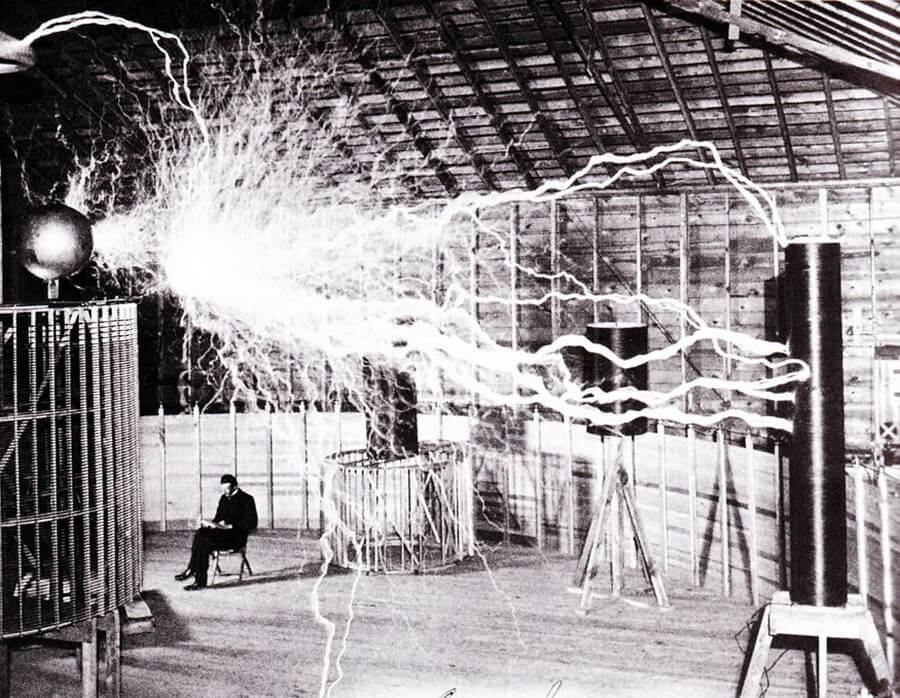
Nikola Tesla, after whom the car is named, was the Serbian-American genius who briefly worked with Thomas Edison before selling several patent rights, including those to his alternating-current machinery, to George Westinghouse. Tesla claimed he’d found a way of distributing electricity without wires. But how he’d planned to do this remains one of science’s biggest mysteries because he left no plans when he died in 1943.
It’s fitting that Tesla, in some small way, may be vindicated as electric vehicles named for him could be among the early beneficiaries of wireless charging. — For InsideSources.com