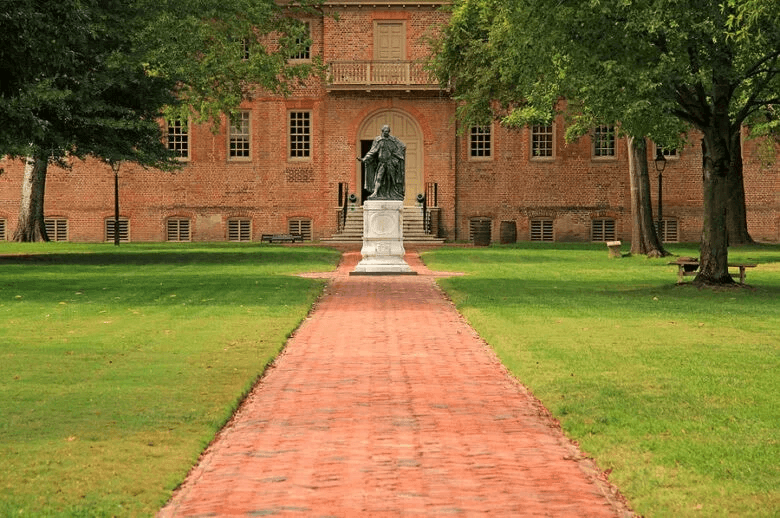
The venerable College of William & Mary, located in Williamsburg, Virginia, might want to beef up its admissions office staff because a tidal wave of students may soon hit the campus.
Founded in 1693, it is the second-oldest college, after Harvard University (1636). It is the setting — indeed, the star — of an astounding adventure novel, “The Temple Keep,” written by one of its alumni, Michael Holtzman.
The novel is climbing the Amazon charts and is scheduled to become a six-part, streamed television series. That is huge exposure for a college that doesn’t get the attention that other fabled schools expect and get — and which its alumni feel it deserves.
To me, a good novel involves a dilemma for the reader: You can’t wait until you get to the end to learn what happened, but that isn’t really what you want. You want to be able to read more, to savor the imaginary lives and situations a lot longer.
When I am reading a novel, I move in. Its protagonists are my friends, and its locales are my habitat until the last page has been read.
I don’t want to move out even though I want to know what happens.
That is how I felt as I was swept along by Holtzman’s story with its extraordinary characters, real and imagined.
“The Temple Keep” left me keen to revisit Colonial Williamsburg and see it and the College of William & Mary with fresh eyes. In a sense, the reenacted lives in Colonial Williamsburg blind visitors to the area’s real history and, of course, the college’s extraordinary story.
Holtzman has written a novel that is first and foremost an adventure, but he manages to sweep in the illustrious early students of the college, including Thomas Jefferson, James Monroe and John Tyler. George Washington didn’t attend the college but got his surveyor’s license there.
The royal charter was granted by England’s William III, and the college was named for him and his wife, Mary. Its foundational building, which anchors the novel, was designed by the king’s architect, Christopher Wren.
Wren’s masterpiece is, of course, St. Paul’s Cathedral in London. It is by far and away, in my view, the most interesting church in Britain, eclipsing Westminster Abbey, Canterbury Cathedral and York Minster. Wren’s soaring imagination is captured in stone.
The novel’s premise is that Jefferson added a secret room beneath the college, a sacred chamber of mystic purpose. And in that chamber, he left something that would affect the future of all humanity.
Holtzman’s protagonist is a student named Noah Greaves, who falls for another student — or he believes she is just a student — Amanda Pope. The romance is just background; Jefferson, Francis Bacon, Shakespeare and Wren are much more important. The quest for Jefferson’s sanctum holds the reader’s attention and keeps the pages turning.
You might think for a moment that Holtzman has borrowed from Dan Brown’s “The Da Vinci Code” or even from Tom Clancy’s “The Hunt for Red October,” but you would be wrong.
This is an original work, and it is original in many ways, suggesting Holtzman’s commitment to the college, Shakespeare, Wren and Jefferson. He also draws extraordinary word pictures of several faculty members Noah encounters, including a mathematician, a literary scholar and a computer whiz.
In what I believe to be craftsmanship, Holtzman brings in a secondary story: whether Bacon wrote Shakespeare’s plays and sonnets. Along the way, he also brings in a lot of literary sleuthing, math, some computer science and a role for the CIA.
The CIA’s big training ground, Camp Peary, which abuts the college, figures in Noah’s search for the secret chamber. He also suggests that the CIA actively recruits from the college.
When the college was floundering financially in 1906, it became a state university. In 1918, it began admitting women, revolutionary at the time.
One of the charms of Holtzman’s novel is the ease with which he uses his own scholarship to tell the tale without allowing the diversity of his information — historical, literary, scientific and academic — to slow down the story.
I read a lot of novels, and this one really grabbed me. I hope it boosts the profile of the College of William & Mary and its extraordinary role in our history.
It may not be Ivy League, but the moss of history abounds about the campus and permeates the novel.