White House Chronicle

News Analysis With a Sense of Humor

  • Home
  • King’s Commentaries
  • Random Features
  • Photos
  • Public Speaker
  • WHC Episodes
  • About WHC
  • Carrying Stations
  • ME/CFS Alert
  • Contact Us

Via AI, an Ancient Roman Historian’s Account of Trump II

19th-century etching of Suetonius, author of "The Twelve Caesars"

June 13, 2026 by Linda Gasparello Leave a Comment

Via AI, an Ancient Roman Historian’s Account of Trump II

If the Roman Emperor Caligula were alive today, you can bet that he would cheer the UFC fight on the South Lawn of the White House, which President Trump is hosting to mark his 80th birthday, and the nation’s 250th anniversary.

Caligula, who reigned from 37-41 AD, hosted lavish spectacles and games for his birthday and other occasions at Roman venues. According to the Roman historian Suetonius, author of “The Twelve Caesars,” these celebrations were notorious for their extravagance and cruelty, including instances where he forced senators to run alongside his chariot for miles or ordered spectators thrown into the arena.

There are many parallels between the twisted Caesar’s reign and the Trump administrations.

For some fast fun, I asked Gemini, Google’s AI assistant, to write an account of Trump’s second administration in the style of Suetonius, whose juicy history of Julius Caesar and the first eleven emperors of the Roman Empire is one of the only sources of Caligula’s horrid reign.

Here is the slightly hallucinatory result:

The Life of Donald the Second Ancestry and Early Omens

He was born of the lineage of the Trumps, a clan enriched by the building of great monuments and towers of glass. His father, Fred, had amassed vast wealth in the provinces of New York, which the son multiplied through daring spectacles and the renaming of structures after his own image.

Before his second elevation to the principate, many omens appeared. It is said that a leaden bullet grazed his very ear during an oration in the fields of Pennsylvania, yet he arose bloody and defiant, shouting to the crowds to fight. This escape was viewed by his followers as a sign of divine favor from Mars himself.

The Second Ascent to the Throne

Having once held the supreme power and lost it to the elder statesman Joseph of Delaware, Donald did not retire to quiet contemplation. Instead, he waged a relentless four-year campaign from his seaside villa at Mar-a-Lago, which resembled an imperial court.

In the Year of the Ballot, he routed the faction of the Democrats led by the priestess Kamala, securing not only the electoral college but the popular vote of the entire Republic.

His return to the capital was celebrated with grand spectacles, and the Senate was quickly filled with his most loyal tribunes.

The Purge of the Bureaucrats and the New Court

Upon re-entering the White House, his first decree was the systematic dismantling of the “Deep State,” which he likened to a hidden cabal of corrupt patricians.

  • He stripped thousands of public servants of their protections, replacing them with fiercely loyal clients.
  • He appointed Elon, a wealthy maker of celestial chariots, and Vivek, a young merchant, to oversee a new commission to hollow out the treasury’s waste.
  • He banished traditional magistrates and elevated loyal praetorians to head the legions and the courts.

Habits, Vices, and Public Spectacles

In his personal conduct, Donald retained the eccentricities of his first reign, though hardened by age and past grievances.

He eschewed standard imperial dispatches, choosing instead to govern by electronic edicts broadcast at all hours of the night to millions of citizens.

  • Diet: He disdained the refined banquets of the elite, preferring the charred flesh of cattle and the sparkling syrups of the West.
  • Amusements: He spent his days on manicured lawns, striking small white spheres with iron clubs, surrounded by courtiers seeking his favor.
  • Temperament: He rewarded absolute loyalty with high honors, but those who crossed him were subjected to public mockery, branded with insulting epithets, and cast out into political exile.

Foreign Tributes and Border Walls

Toward foreign nations, Donald acted with the unpredictability of a capricious deity.

He demanded heavy tribute from the allied kingdoms of Europe, threatening to withdraw the protection of the Republic’s legions if they did not pay.

He placed vast tariffs upon the silks and wares of the Seres (the Chinese), initiating a fierce war of merchants.

At the southern frontier, he renewed the construction of his massive wall with frantic energy, boasting that he had successfully stemmed the migration of the barbarian tribes.

The End of the Reign

As his second term drew to its close, the Republic remained deeply fractured, split into warring factions that could no longer agree on the truth of things.

Some viewed him as a savior who restored the golden age of the Republic, while others whispered in fear of an absolute monarchy.

Having fulfilled the constitutional limit of his rule, he prepared to pass the mantle to his chosen Caesar, James David of Ohio, ensuring his shadow would loom over the state for generations to come.
Filed Under: Gasparello's Articles Tagged With: President Donald Trump, Roman Emperor Caligula, Roman Historian Suetonius, UFC fight at White House

Before There Was Trump, There Was Cleon

January 25, 2017 by White House Chronicle 1 Comment

By Kevin Morrell

Following Donald Trump’s inauguration as president the world is anticipating a new, and potentially radically different era for the United States. The inauguration also prompts questions about this new style of politics.

Trump’s surge to leading the most powerful nation in the world was fueled by a rhetoric we associate with a new term: post-truth. The Oxford dictionary named post-truth its word of the year in 2016, and defined it as “circumstances in which objective facts are less influential in shaping public opinion than appeals to emotion and personal belief.”

Brexit, and Trump’s success were new lows for many of us, particularly in higher education, precisely because facts came a distant second to populist appeals.

But, as a number of people have identified, post-truth didn’t begin with Trump.

One reference point for the two campaigns 2016 will be remembered for has been the propagandism of the 1930s, and two wickedly cynical pieces of advice: repeat lies often enough until they are accepted as true, or remember if you are going to lie, tell a big lie.

But almost a century earlier, in the 1850s, there was a far dirtier U.S. election campaign where an anti-immigration party, the Know-Nothings, actively thrived on pretending to be ignorant of their own party’s activities.

Further back still, before U.S. independence, the satirist John Arbuthnot wrote: “Falsehood flies, and the truth comes limping after it, so that when Men come to be undeceived, it is too late … like a physician who has found out an infallible medicine after the patient is dead.” The title of his 1712 essay? “The Art of Political Lying.”

And way, way before Arbuthnot, in 350 BC, Aristotle’s “Constitution of Athens” describes the demagogue Cleon in a way Trump critics might recognize: “The cause of the corruption of the democracy by his wild undertakings.”

A closer look at Cleon invites several parallels with how critics see Trump. Cleon inherited his wealth from his father in the form of a tannery, a leather factory; certainly, the Athenian equivalent of blue-collar.

He rose to power in 430 BC, during a desperate time for Athens — it was at war with Sparta and was devastated by plague. Plutarch describes him as someone who “catered to the pleasure of the Athenians” with a combination of “mad vanity,” “versatile buffoonery” and “disgusting boldness.”

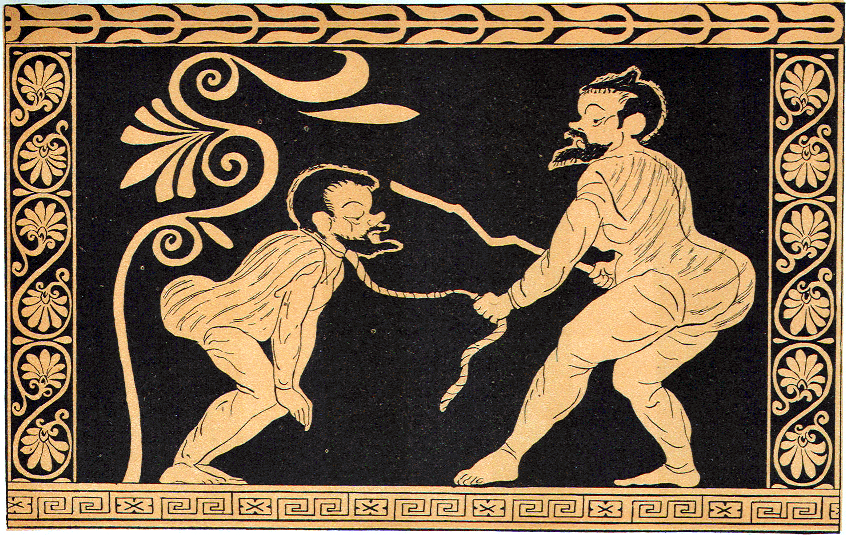
Cleon had a distinctive and shocking communication style, one Athenians had never seen before. While speaking, he would hitch his cloak up and slap his thighs, running and yelling at the crowds.

Aristotle says he was “the first to use unseemly shouting and coarse abuse.” Aside from this radically new communication style, Cleon’s populism was based on attacking two enemies.

First, though wealthy himself, he was an anti-establishment figure, pursuing a “relentless persecution of the upper classes.”

Second, he was a flag-waving xenophobe, antagonistic towards Athens’ rival and (partly thanks to Cleon) bitter enemy Sparta, as well as to the city of Mytilene, who wanted independence from Athens.

The Athenian general and historian Thucydides even records a speech where Cleon expresses admiration for Mytilene’s “unassailable” walls.

Parallels don’t end there. A later Athenian writer, Lucian, suggests Cleon profited from exploiting his office as some warn Trump is set to do and that he was “venal to excess” (as Trump detractors suggest).

He was boastful, once bragging that he could win a war against some Spartans by himself. He was thin-skinned and censorious, as well as a litigious bully.

Cleon tried, unsuccessfully, to have the satirist Aristophanes prosecuted for writing “The Babylonians,” which he considered a treasonable play — in the process turning Aristophanes into a lifelong enemy.

He accused Athenian generals of incompetence and, in establishment-bashing mode tried, unsuccessfully, to prosecute one of them, Laches.

Cleon was held responsible for the eventual exile of another, Thucydides, who as well as being a general is sometimes described as the founder of history.

Indeed, Thucydides’ contribution was to found a tradition of historians as being concerned with facts and the truth.

Throughout this period Cleon was the biggest obstacle to normal relations with Sparta and within a year of his death a peace treaty was agreed.

History was certainly not kind to Cleon, and perhaps Trump will not be showered in praise either.

In Cleon’s case this was no surprise perhaps given that he exiled the most eminent Athenian historian and tried to silence the most eminent Athenian satirist.

Nowadays Cleon is most well-known through Aristophanes’ play, “The Knights” (far ruder than “Saturday Night Live”).

This has an unusually small cast because it is essentially a relentless assault on the character Paphlagon, who is obviously based on Cleon: “the leather-seller” with a “gaping arse,” “a perfect glutton for beans” who loudly “farts and snores,” an “arrant rogue” and “mud-stirrer” with a “pig’s education” and the “stink of leather” — “this villain, this villain, this villain! I cannot say the word too often, for he is a villain a thousand times a day.”

Cleon may well have had a front-row seat for “The Knights,” where he would have seen Aristophanes playing Paphlagon/Cleon, presumably because no one else dared to.

Characters in these plays were masked, but no prop-maker dared make a mask resembling Cleon.

We might imagine Cleon later reviewing “The Knights” as: “A totally one-sided, biased show — overrated! The theater must always be a safe and special place. Apologize!”

What matters is that Aristophanes’ contemporaries awarded “The Knights” first prize at the Lenaia festival (something like Athens’ Cannes Festival).

Cleon’s brand of post-truth politics flourished because when life is extremely hard, facts are not as novel or distracting as sensationalism.

Some Athenians were won over by the novel spectacle of yelling, coarse abuse and thigh-slapping — and distracted by diversionary ranting against Sparta.

Critics of Brexit and Trump might say voters were won over by bus-sized gimmicks or tweet-sized slogans — where both camps painted “enemy” over an anonymous other.

Last year was a bad year in which millions were desperate for change, but perhaps what we saw was an age-old spectacle. Populism and appeals to emotion always work on some people. When times are bad enough they work on enough people.

One consolation for Trump’s opponents and Remainers is that the Athenians kept Cleon partly in check using existing governance mechanisms: the courts.

They can also take comfort that contemporary culture remembers Cleon through the eyes of his bitter enemy Aristophanes. Cleon’s era was horrific yet it also became a golden age for satire and saw the birth of the discipline of history.

The worst fears for the Trump presidency are bleak, but civilization survived Cleon. Shortly after his death, we saw another kind of Athenian golden age — with Socrates, Plato and Aristotle laying down the basis for Western philosophy and civilization.

They taught the importance of skepticism and scrutiny, and of virtue. They placed the ultimate premium on the search for knowledge and truth.

In the “Rhetoric” Aristotle gave us all the tools we need to see through a Cleon. Indeed, he wanted rhetoric to be widely understood so politicians’ arguments were evaluated on their merits rather than the wrapper (or bus) they arrived in.

Kevin Morrell is professor of strategy at the Warwick Business School, part of the University of Warwick in the United Kingdom. He researches rhetoric in politics.


Filed Under: Random Features Tagged With: 2016 election, Aristophhanes, Aristotle, Athens, Brexit, Cleon, Constitution of Athens, Lucian, Mytilene, post-truth, President Donald Trump, Remainers, Rhetoric, Sparta, The Knights, Thycydides

White House Chronicle on Social

  • Facebook
  • Twitter
  • Vimeo
  • YouTube
The Question That Must Be Answered: How Dangerous Is AI?

The Question That Must Be Answered: How Dangerous Is AI?

Llewellyn King

Races have winners and losers — at least so I have always thought. At some point, the competition ends and a winner is identified, whether it is first-past-the-post as in a horse race, or first in the marketplace as in a commercial race. Think about VHS and Betamax. Similarly, we knew who won the space […]

9/11 — The Tragedy That Didn’t Have To Happen

9/11 — The Tragedy That Didn’t Have To Happen

Llewellyn King

There is a terrible truth about 9/11: It didn’t have to happen. Something as simple as a hardware store lock could have deterred the perpetrators. The arguments against hardening cockpits were numerous, and now seem unconvincing to the point of being risible. They included: It would cost too much; the public had to see the […]

Medicare for All Is the Wrong Fix for the Healthcare Crisis

Medicare for All Is the Wrong Fix for the Healthcare Crisis

Llewellyn King

As Charles Dickens might have said, “It is the best of times in medicine, it is the worst of times in healthcare.” It is a time of great medical discovery with artificial intelligence, it is a time of the poorest outcomes for the sick. One of America’s most distinguished pediatric cardiologists says the nation is in […]

My Maiden Flight Without a Necktie

My Maiden Flight Without a Necktie

Llewellyn King

Friday, Aug. 14, was a seminal day for me. For the first time in my long life, I boarded a flight without a necktie. In seven decades of flying, I have never done that. Truth is, I felt underdressed on the flight from Providence, R.I., to Jacksonville, Fla., as if I were wearing my pajamas […]

Copyright © 2026 · White House Chronicle Theme on Genesis Framework · WordPress · Log in