White House Chronicle

News Analysis With a Sense of Humor

  • Home
  • King’s Commentaries
  • Random Features
  • Photos
  • Public Speaker
  • WHC Episodes
  • About WHC
  • Carrying Stations
  • ME/CFS Alert
  • Contact Us

The Collision Between Money and News — We Lose

May 29, 2026 by Llewellyn King Leave a Comment

Trillions, as in trillions of dollars, are being bandied about in the way millions were, then billions. But take a look at 1 trillion expressed numerically: 1,000,000,000,000. Awesome, isn’t it? Twelve zeros.

The national debt stands at $39 trillion, and the interest on that will top $1 trillion this year. Very soon, the first trillionaire will thunder past the post, presumably Elon Musk.

I have nothing against Musk. And I have nothing against successful people being rewarded for their talent.

Musk has done enormous things. An immigrant, he made his first fortune with PayPal. Since then, he has given the United States the solar revolution, the electric car, and a viable heavy-lift rocket that has made space exploration cheaper than when NASA alone was at the controls. His Boring Co. still holds promise.

It is assumed, as so often, that because a person is good at one thing, that same person must be good at everything else. Whoa! Musk’s limits as a manager and a visionary were exposed when he barged about streamlining the government for President Trump.

It was a case of a bridge too far for Musk. A disaster for America that eroded privacy, critically wounded many departments and saved no money.

Whereas much of what Musk has achieved has been beneficial, his purchase of Twitter, rebranded as X, was evidence of the harm that accompanies gigantic wealth. He wanted to control not just the medium, but also the news.

Musk — although it isn’t good that he has taken steps to control the message with X — isn’t the problem facing the media and the public’s right to know. When so much money is floating around, press freedom is in trouble.

The immediate threat comes not from Musk, but from two other men of gargantuan wealth: Larry Ellison, co-founder of the tech firm Oracle Corp., whose personal net worth is estimated at $245 billion, and his son, David.

Together, they are set to control the media to an extent not imagined and never seen. The media titans of yesteryear — Pulitzer, Hearst, Luce, Thompson, Sulzberger, Graham and Murdoch — are knee-high to the fearsome power that the Ellisons have, and which will more than double if (and it is more when than if) the merger of their Paramount Skydance Corp. with Warner Bros. Discovery is approved by regulators.

At present, the Ellisons control the CBS Television Network, CBS Sports, MTV, Nickelodeon, Comedy Central, Paramount Network and BET. They control CBS News, and Paramount+, which has 79 million streaming subscribers.

If the merger goes through, they will control CNN, HBO Max and Warner Bros. Studios — a treasure trove of entertainment.

In short, they will control a huge swath of American broadcast news, information dissemination, and movie and television culture.

Their declared purpose is to incorporate more technology and more AI across their astounding current and probably future empire. That is bad for journalism and worse for movies. The invasion of the bots.

I know how media control works. I have seen it firsthand: It isn’t what is said, but what is implied or what employees feel the owners of the outlet want. A casual remark can become policy; a hint of preference can become a hard rule.

If an Ellison family member were — of course, this is hypothetical — to say they hated rhubarb, you could bet the Food Network wouldn’t do a show episode on rhubarb pie making. If it were known that one of the owners of Paramount was a booster of nuclear power, movies such as “The China Syndrome” and “Silkwood” would never have been made.

In journalism, the story that isn’t covered is as important as the one that is covered. If a disease caused by a common product — asbestos is a good example — isn’t covered because the staff has heard that the media owners love that product or is invested in it, then you can bet it won’t be covered.

Consolidated corporate ownership is antithetical to free speech, creativity and open government. No news is bad news.

News isn’t suited to the corporate world; it isn’t a fit with those whose interest is adding zeros to bottom lines. It is the pursuit by an irregular army of often eccentric individuals, who turn over stones to find out what is beneath.

Likewise, individual ownership furthers the news objective, which for me was summed up by something Dan Raviv said when he was a correspondent for CBS Radio (recently shuttered by the Ellisons): “My job is simple. I try to find out what is going on and tell people.” 

Write that in the corporate prospectus.

News organizations need to be owned by news people, like Ted Turner, Bill Paley and, yes, Rupert Murdoch.

Filed Under: King's Commentaries Tagged With: AI, America, CNN, debt, money, Musk, NASA, Oracle, PayPal, technology, trump

Postcard from A Coruña: A Summit in a Spanish City in Ascendency

August 21, 2024 by Linda Gasparello Leave a Comment

I am one of those who believes what Seneca, the ancient Roman writer and statesman, said, “Travel and change of place impart new vigor to the mind.”

I don’t know if the stoic Seneca said that before or after his exile to the island of Corsica by the emperor Claudius.

Anyway, earlier this summer, my husband and I had the opportunity to visit a city in the country where Seneca was born: Spain. Both the city and the purpose of our trip imparted a new vigor to our minds.

We were invited to participate in the Ecosystems 2030 (ES2030) summit, held in A Coruña, a port city on a promontory in the Galicia region of northwest Spain, from June 26-29. The summit is the creation of a man with a vigorous mind: Omar Hatamleh, the head of AI at the National Aeronautics and Space Administration and the executive chairman of ES2030.

The annual summits in Spain — where Hatamleh lived and studied — gather speakers and participants from a wide swathe of professions, connecting the unconnected and spurring ideas. His stated aim for summiteers is for them to ditch linear thinking and “to successfully embrace disruption, transform your organization, and thrive over the next decade.” Hatamleh has used the same formula — cross-industry innovation — for meetings he has organized at NASA.

The agenda for this year’s summit, the fourth of 10, was “Women in Leadership.” And the women who addressed the summit were wonder women from private and public entities including Pilar Manchon, Google; Aylin Uysal, Oracle; Rika Nakazawa, NTT; JoAnn Stonier, Mastercard; Maria Fernandez, Sony Music Entertainment; Deepti Pahwa, an innovation and leadership coach to C-suites and entrepreneurs; Nancy Namrouqa, Jordanian minister of state for legal affairs; and Jennifer Stumm, a concert violist and founder and director of Illumina, a Sao Paulo-based music collective, festival and social group “working for greater equity and goodwill in classical music by young musicians around the world without access to private instruction or mentorship.”

In formal addresses and in conversations at lunches, dinners and in hotel lounges, these women shared their thoughts about new ventures and innovation in the AI age, the future of AI governance, e-commerce, privacy and social media, and even board member leadership. Their talk was of how they are shaping new frontiers not how they shattered barriers in the private and public sectors —refreshing and inspiring.

The summit was a movable feast, convening mostly at the avant-garde Palexco Conference Center, which is located at the city’s port and has a roof that resembles the wings of a giant seabird, the mayor’s office in the neoclassical-style City Hall, built in the early 20th century, and the two-Michelin-starred Pepe Vieira Restaurante & Hotel.

The restaurant and hotel, part of the Relais & Chateaux group, is located “in the upper area of Raxo, the smallest municipality of the municipality of Poio, in Pontevedra,” according to directions on its website.

It was an experience getting to the restaurant, which is about an hour-and-a-half drive from A Coruña through a sea of Galician vineyards and villages where the backyard of every house had wine grape vines. No grape escape.

The website says, “For a better experience in finding ‘the last kitchen in the world,’ follow our instructions, since Google has already gotten lost several times along the way.” That is truth in advising.

Pepe Vieira is located on a terraced hill overlooking the Pontevedra estuary. It is surrounded by woods, au naturel landscaping and “biodynamic” vegetable gardens, enjoyed on the patio or inside the dining room which has huge, picture windows.

Chef Vieira prepares dishes, combining “ancestral local produce, rediscovered through research with historians, scientists and anthropologists” with ingredients from afar. He prepared a variety of small dishes for us, including hake with Albariño lees, tapioca pearls and sorrel oil. His decision to locate the restaurant far from city pollution and his combination of gastronomy and sustainable gardening earned him a Michelin Green Star.

A Coruña is far from the anti-tourism protests in Madrid and Barcelona. While it is one of the chief ports of northern Spain, the country’s second-largest fishing center and has a shipyard for building fishing vessels, it also has a significant real-estate market for vacation homes — and welcomes tourists.

Cruise ships stop there and disgorge passengers who visit the Old Town and the New Town; the city’s churches, from medieval to modern; and notable landmarks, including the Roman Tower of Hercules, an imposing, square-shaped lighthouse dating from the reign of Trajan (98-117 AD). A characteristic feature of the houses is their window balconies, glazed for the Atlantic gales, giving A Coruña the name “Crystal City.”

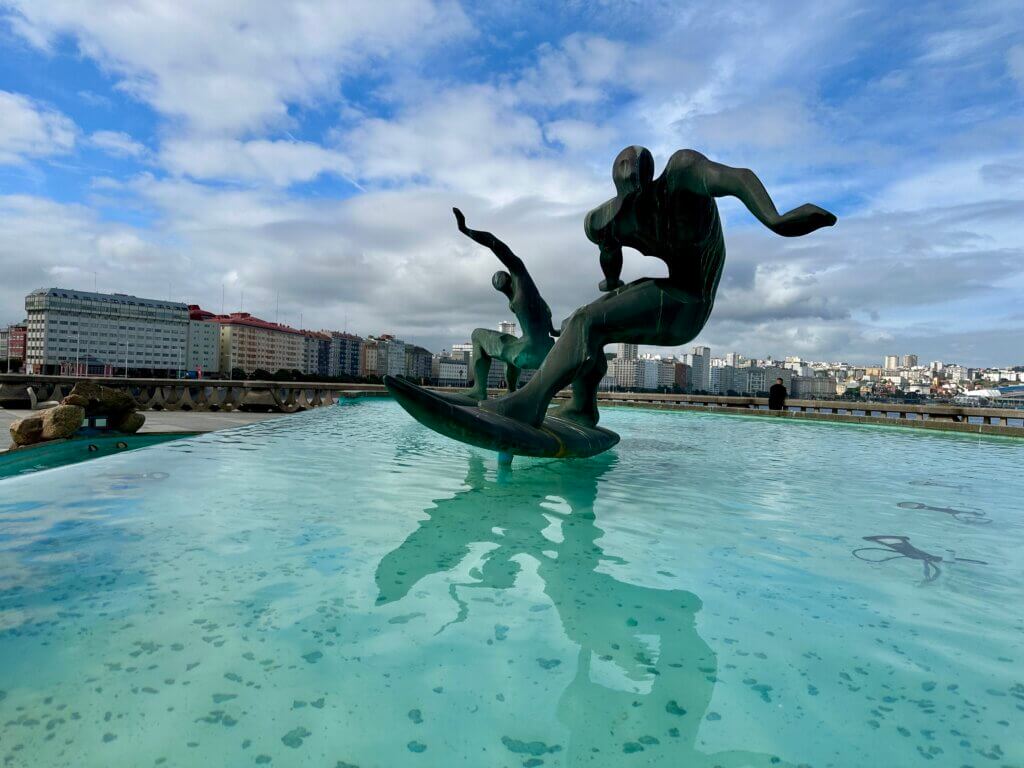
Spaniards from the south come to this Galician city in the summer for the cool wind and the surf. As with many cities on Spain’s Atlantic coast, A Coruña is a surfer spot — with a bronze statue of two surfer dudes riding the waves in a fountain on a seafront avenue.

Photo Credit: Linda Gasparello

A Coruña has been discovered by the foodies, who have long flocked to San Sebastián, also on the Atlantic coast, close to the border with France. On the last night of Ecosystems 2030, the summiteers dined on some of the tastiest octopus in the city at Pulperia de Melide. The Galician dish of octopus sprinkled with paprika is a favorite of mine.

Seneca insisted on eating moderately, not indulging in luxuries or delicacies. He wrote,“Our aim is to live in accordance with nature, is it not?”

I don’t know if Seneca traveled to A Coruña, called Brigantium under the Romans. But I can imagine him being a happy stoic there.

Filed Under: Gasparello's Articles Tagged With: A Coruña, AI, Artificial intelligence, Ecosystems 2030, Galicia, Google, Illumina, Mastercard, NASA, NTT, Omar Hatamleh, Oracle, Palexco Conference Center, Pepe Vieira Restaurante & Hotel, Sony Music Entertainment, Spain

White House Chronicle on Social

  • Facebook
  • Twitter
  • Vimeo
  • YouTube
A British Immigrant’s Defense of Immigration

A British Immigrant’s Defense of Immigration

Llewellyn King

Migration, people moving to new lands, is as old as human history, and as fraught. Today it is a global problem complete with layered hypocrisy, cruelty and, always, hope among those on the move. War and extreme poverty collude in driving people to seek a livable future. There is no simple solution, no slogan that […]

The Birth of a New Reactor: Thorium Past and Present

The Birth of a New Reactor: Thorium Past and Present

Llewellyn King

If you are designing a car from scratch, there are certain essentials to begin with. You need to start with the wheels on the corners, for example. But when it comes to building a nuclear reactor, things are different. There are hundreds and maybe thousands of ways of doing it. The constant is that you […]

Air Conditioning Costs Threaten Summer of Sun Belt Catastrophe

Air Conditioning Costs Threaten Summer of Sun Belt Catastrophe

Llewellyn King

The summer of our discontent is at hand. When I asked a professional weather forecaster what we might expect this season, he said, “Hades.” That was as disturbing as everything else in this disturbing year. America has a summer culture. You could say the whole of the Northern Hemisphere has one, but there is a […]

The New Media: A Pea of News in a Mattress of Words

The New Media: A Pea of News in a Mattress of Words

Llewellyn King

Journalism is choking on the low-hanging fruit. Every day hundreds of newsletters and podcasts flood inboxes. These are almost entirely concerned with political goings-on in Washington. But this isn’t to say that journalism is alive and well. In fact, this is a symptom of journalism’s straitened times. Mostly, there is just a pea of news […]

Copyright © 2026 · White House Chronicle Theme on Genesis Framework · WordPress · Log in