White House Chronicle

News Analysis With a Sense of Humor

  • Home
  • King’s Commentaries
  • Random Features
  • Photos
  • Public Speaker
  • WHC Episodes
  • About WHC
  • Carrying Stations
  • ME/CFS Alert
  • Contact Us

Summer Is Too Important for Politics to Steal

April 3, 2026 by Llewellyn King Leave a Comment

If you can get your mind off the wars in the Middle East and Ukraine, if you can stop checking your 401(K), which seems to have taken off for the dark side of the moon, if you can turn off the cable news channels and do a quick personal inventory, noting that your arms, legs and enough of your mind are still functioning, then you are ready for the balm of summer.

I had always thought that summer culture was epitomized by the French fleeing Paris during August. But the summer migration that renews, whether it is to Myrtle Beach, South Carolina, or to Botswana, is just as important to Americans.

People need to get away. Staycation is an oxymoron, like airline food.

Americans live for summer and nothing will keep them from the beaches, lakes, mountains and resorts of their bounteous native land. But an increasing number go abroad.

Beware. We might not be as welcome in that great bistro in Montmartre where we often supped, or on the delightful beach in Crete where we once sunned. There are just too many tourists trying to do the same things all over Europe, and more are planning to go.

Americans are part of a new phenomenon, known as overtourism. We were the first mass tourists in the world, but we have since been joined by people of other nationalities, many of whom think they must see Venice, visit the Acropolis, and walk Britain’s Lake District. Not in high summer you won’t, and if you do, you will pay high fees and face various gentle disincentives.

The problem is that more and more people can afford to travel, and they do.

In his 1961 musical “Sail Away,” Noel Coward wrote, “Why do the wrong people travel?” If Coward were alive today, he might write, “Why do so many people travel?”

Curious Germans and inquiring Americans have long since been joined by regiments of Japanese picture-taking tourists. Now the Chinese, too, feel they must gaze upon the Mona Lisa, and the Indians want to see the Highland cattle of Scotland, affectionately referred to as “hairy coos.”

The solution: Go early or go late, if Europe is your destination. There is much to enjoy in what the professionals of the travel industry call the “shoulder season,” which is from about now until late June — and from September to October. Some places like Dubrovnik and Venice are unable to accommodate mass tourism in the summer, and have prevented cruise ships from docking.

About cruising: My wife, Linda Gasparello, and I used to build our vacations around horseback riding, taking our boots and hats with us wherever we went in the world. Then, reluctantly, we took our first cruise. We had misgivings about cruise ships, thinking of them as floating holiday camps. In fact, cruising is a way of taking the hotel with you.

Our first cruise, not long after the collapse of the Soviet Union, was from Greece through the Bosporus and into the Black Sea, and it was magnificent. We went to places we would never have seen if left to ourselves, like Yalta, Odesa, and Constanta, and we had great tours in all of them. We were enchanted from the moment we stepped on board in Athens to our disembarkation in Venice. Also, I was able to visit Istanbul for the first time.

Another memorable cruise was around Cape Horn from Argentina to Chile with plenty of stops in some of the most delightful and unusual towns such as Punta Arenas, Ushuaia and Puerto Montt. To be cruising the treacherous body of water at the bottom of the world, where so many mariners perished, in a luxury liner, is to marvel at technology and your own good luck.

Our most delightful cruise, perhaps, was last year when we took Cunard’s stately Queen Mary 2 across the Atlantic from New York to Southampton. This cruise reached levels that were near ecstasy for us.

The crossing entertainment featured conductor Anthony Inglis with members of the UK’s National Symphony Orchestra. Inglis assembled a passenger choir — complete with auditions and rehearsals — which gave two rousing concerts.

In the interests of harmony, I stayed in the audience, but my wife made it into the chorus and was elated that her long-unused gifts as a soprano were still there.

You have to love a man who travels with an orchestra. That, as they say, is class. And to think that we were once snobbish about cruising.

We learned that Inglis will conduct the NSO on the Sept. 5 to 12 QM2 crossing from New York to Southampton. This was music to our ears.
Filed Under: King's Commentaries Tagged With: Americans, beach, Chile, cruise, Noel Coward, Paris, resorts, Staycation, summer, tourism, Ukraine

The Collision Course in the South China Sea

November 7, 2015 by Llewellyn King Leave a Comment

By Llewellyn King

When I was learning to fly, one of the lessons was that if you see an object on the horizon that is seemingly stationary but getting larger, watch out. It is probably an aircraft closing with you.

Trouble with China in the South China Sea is on the horizon of U.S. strategic concerns and getting larger. A major confrontation may be at hand.

China claims sovereignty over the Spratly and Paracel islands in the South China Sea. Its claims have been disputed by Brunei, Malaysia, the Philippines,Taiwan and Vietnam.

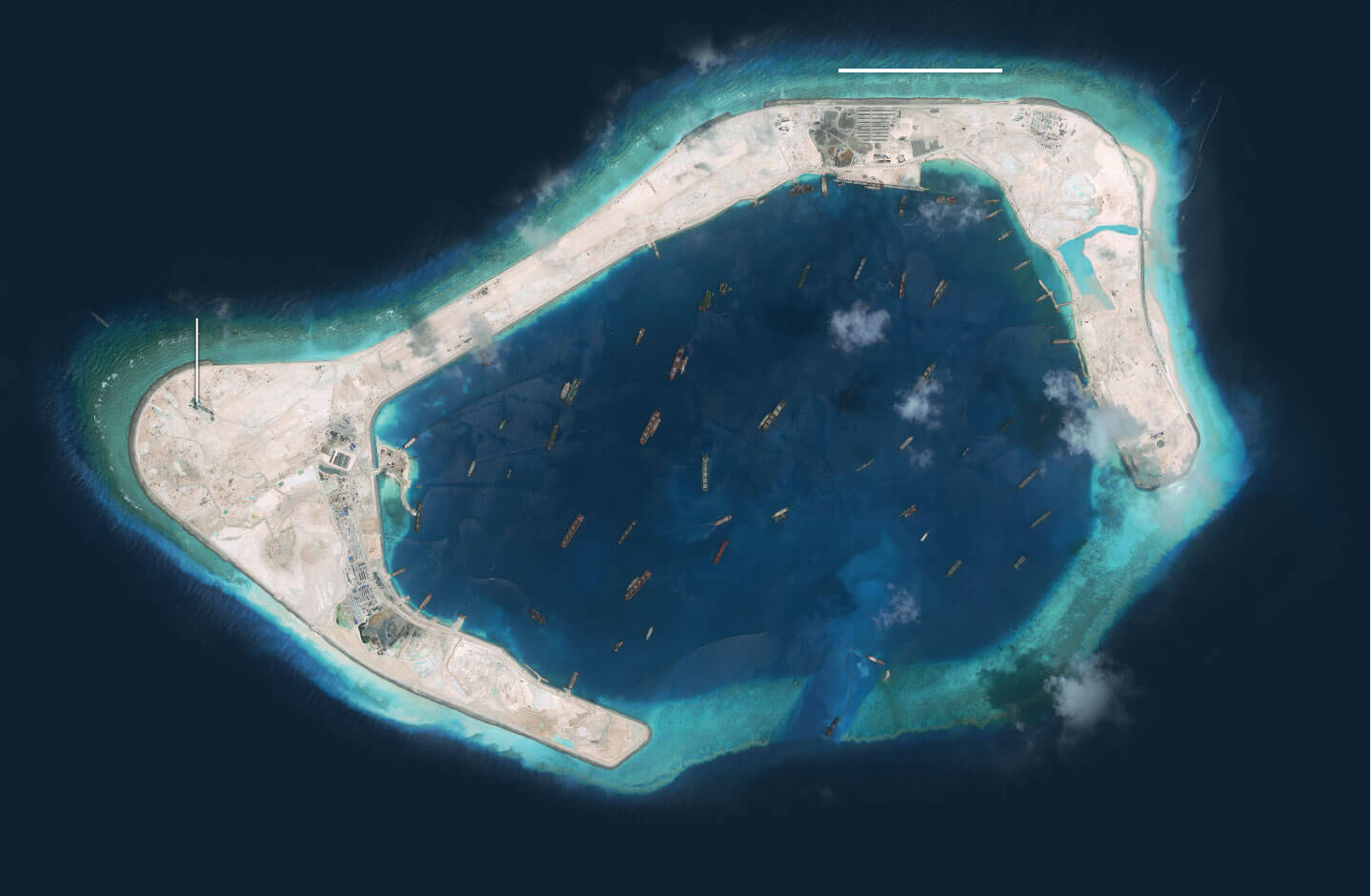
Ignoring these neighbors’ territorial claims, China has built artificial islands on otherwise submerged reefs in the Spratly archipelago. They have built runways, capable of landing military jets, on Fiery Cross and Subi reefs, and are building one on Mischief Reef.

Vietnam and the Philippines have also built up reefs, but on a smaller scale, and mostly to help their fishing fleets.

Offshore islands, real or summoned from the deep, are trouble. Argentina and Chile nearly went to war over the Beagle Channel Islands, off the inhospitable tip of South America, until Pope John Paul II brokered a peace deal in 1984.

Britain and Argentina most certainly did go to war in 1982 over the Falkland Islands, which Argentina claimed then and still claims.

Nations use territorial disputes not only to divert attention from domestic problems, but also to heal the real or imagined wounds of history.

China feels, reasonably, that it was kicked around in history. Britain occupied parts of it, most notably Hong Kong, and then acted as a drug lord in the 19th-century Opium Wars. In the 20th century, China was invaded by Japan.

Now, as the world’s second-largest economy and most populous nation, China is feeling assertive.

But all of Asia, and by extension the rest of the world, is invested in this dispute: one third of the world’s shipping passes through the South China Sea, and its rich fishing grounds are a vital food source for the region.

The Chinese bolster their claims with a 1947 map showing what is known as the “nine-dash line,” or the cow’s tongue because of its shape, in the South China Sea. This line extends around the sea and encloses 90 percent of the area; by historical standards this is a whopper of a claim for territory, and one which threatens U.S. allies in the region as well as our shipping.

The Chinese claims appear to be in total violation of international law,  particularly the United Nations Convention on the Law of the Sea, which the United States has not ratified, and which China ratified in 1996.

The dispute with claims and counterclaims is laid out in a new, dispassionate report by the Boston Global Forum, a Harvard professor-heavy think tank.

The United States responded to the China’s claim of territorial integrity for its artificial islands after a long delay, testing the right to navigate by sending the USS Lassen, a guided missile destroyer, through the 12-nautical-mile zone off Subi Reef on Oct. 27. China has reacted angrily with aerial exercises.

The USS Lassen’s transit of the reef appears to have divided the White House. At one point, Defense Secretary Ashton Carter would not acknowledge in public that it had actually happened, or that U.S. aircraft might test the Chinese claim to territorial air rights.

These actions are known as freedom of navigation operations, or FONOPS. It is a term we will hear more of if the United States and China cannot divert from their brinkmanship in the South China Sea.

The United States does not favor any nation’s claim to islands, or even rocks, in that sea. It does, though, have a vital interest in checking Chinese expansion and the interests of its Asian allies who expect a robust U.S. response to China’s island grab — and claim to a whole ocean. — For InsideSources.com

Filed Under: King's Commentaries Tagged With: Argentina, Beagle Channel Islands, Boston Global Forum, Britain, Brunei, Chile, China, Falkland Islands, Fiery Reef, Hong Kong, Japan, Malaysia, Mischief Reef, Opium Wars, Paracel Islands, Pentagon, Secretary of Defense Ashton Carter, South China Sea, Spratly Islands, Subi Reef, Taiwan, the Philippines, U.S. Navy, USS Lassen, Vietnam, White House

White House Chronicle on Social

  • Facebook
  • Twitter
  • Vimeo
  • YouTube
In the Turmoil, Challenges for Graduates in the Class of ’26

In the Turmoil, Challenges for Graduates in the Class of ’26

Llewellyn King

Dear Graduates of 2026, Welcome to the world you will be taking jobs in and where you will begin building careers, and at times shaping history. It isn’t the world of your parents, and it isn’t the world your college has taught you about, because it is changing too fast. It begins anew daily. As […]

Watch Out When the Political Class Forgets Cause and Effect

Watch Out When the Political Class Forgets Cause and Effect

Llewellyn King

Anyone who has spent time in criminal court knows this: One of the characteristics of lawbreakers is a poorly developed sense of cause and effect. At the low end, the folly of the defendants is always on display. The young man who takes a gun with him on a night of drinking. He has increased […]

The Electricity Future for New England: Uncertainty and High Prices

The Electricity Future for New England: Uncertainty and High Prices

Llewellyn King

These days, in terms of resources, New England is poorly positioned to make electricity. As Gregg Cornett, president of Rhode Island Energy, told me in an interview, it doesn’t sit on abundant coal reserves and natural gas — the critical fuel in today’s electricity generating mix — or hide beneath the surface, waiting for the […]

A Revolutionary Calls Out the Utility Industry

A Revolutionary Calls Out the Utility Industry

Llewellyn King

The demand for electricity continues to rise, and there is a wide recognition that there is going to be pressure on the grid as never before, and that it is time to think about the grid in new ways.  We need to think about how it operates, how it might operate, and the technologies — including artificial intelligence as […]

Copyright © 2026 · White House Chronicle Theme on Genesis Framework · WordPress · Log in