Long before my first trip to Chicago by plane, I traveled there by poetry and stories.
Carl Sandburg’s “Chicago” took me to the city as a teenager. The poem’s opening verse added to the foundational image of the city which my father, a Boston-based meat broker, built with his stories about the Chicago meatpacking industry:
Hog Butcher for the World,
Tool Maker, Stacker of Wheat,
Player with Railroads and the Nation’s Freight Handler;
Stormy, husky, brawling,
City of the Big Shoulders:
In 1914, when the poem was published, Sandburg was working in Chicago for Day Book, a newspaper which fashioned itself as a defender of the common people. In the poem he attacks the city’s immorality, which he wrote about in his newspaper articles:
They tell me you are wicked and I believe them, for I have seen your painted women under the gas lamps luring the farm boys.
And they tell me you are crooked and I answer: Yes, it is true I have seen the gunman kill and go free to kill again.
And they tell me you are brutal and my reply is: On the faces of women and children I have seen the marks of wanton hunger.
Despite its terrible side, Sandburg defends Chicago’s pride and industriousness:
And having answered so I turn once more to those who sneer at this my city, and I give them back the sneer and say to them:
Come and show me another city with lifted head singing so proud to be alive and coarse and strong and cunning.
Flinging magnetic curses amid the toil of piling job on job, here is a tall bold slugger set vivid against the little soft cities;
Fierce as a dog with tongue lapping for action, cunning as a savage pitted against the wilderness,
Bareheaded,
Shoveling,
Wrecking,
Planning,
Building, breaking, rebuilding,
Like Sandburg, my father loved the vitality of Chicago, especially its laborers. He had some of the best times of his life in the city as a bartender, during a summer break from Cornell’s School of Hotel Administration, in one of the landmark hotels.
Some of the worse times in his life involved Chicago — like the time a truck carrying a load of meat byproducts that he sold to a dog food company overturned on an icy highway south of the city, spilling its contents.
In the dead of night, the Illinois state police notified my father about the accident. The next morning, he flew to Chicago and helped with the highway cleanup.
Under the smoke, dust all over his mouth, laughing with white teeth,
Laughing even as an ignorant fighter laughs who has never lost a battle,
Bragging and laughing that under his wrist is the pulse, and under his ribs the heart of the people.
Laughing!
My father laughed about shoveling frozen animal lungs, spleens, livers and kidneys on that highway as rushing vehicles sprayed him with bloodied snow and ice. But his laughter about that awful work came years later.
A Magnificent Mile of Murals
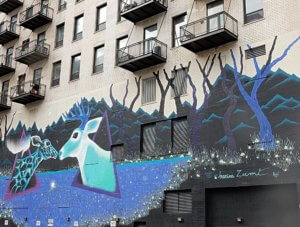
Artist Marina Zuni’s enchanting mural of kissing deer on the campus of Chicago’s Columbia College.
On a recent trip to Chicago for a television shoot, my husband and I stayed at a hotel on South Michigan Avenue, amid the Columbia College campus. It was a lucky choice because I’m a muralista – a devoted follower of murals – and the campus buildings are resplendent with them.
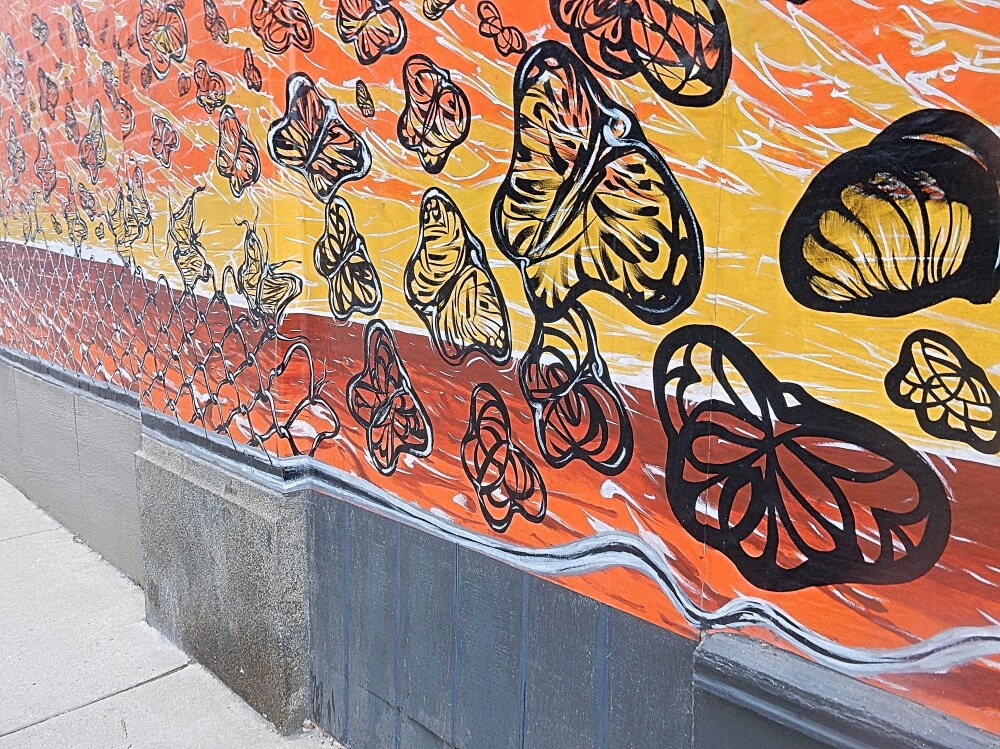
Along the side of the building across from our hotel, there was a surrealist mural of a black chain-link fence turning into a swarm of bright orange-and-yellow butterflies. There were four fabulous murals on the walls of the building surrounding an outdoor parking lot on South Wabash Street: one, by artist Marina Zuni, depicts a buck and a doe kissing while submerged in an ice-blue lake in an enchanted forest. Another mural pays tribute to the comic strips that were born in Chicago, including “Brenda Star,” “Dick Tracy,” “Gasoline Alley,” “Moon Mullins” and “Little Orphan Annie.”
Columbia College, which specializes in the arts and media, had an interesting birth. It was founded in 1890 as the Columbia School of Oratory by Mary A. Blood and Ida Morey Riley, both graduates of the Monroe Conservatory of Oratory, now Emerson College in Boston.
Anticipating a strong need for public speaking at the 1893 World’s Columbian Exposition, which celebrated the 400th anniversary of Christopher Columbus’s arrival in the Americas, the women were inspired to open their school in the exposition city, Chicago, and adopt the exposition’s name, according to a history of the college.
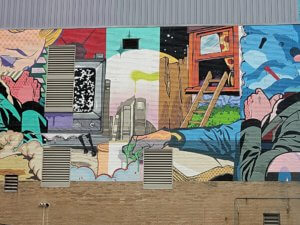
This Columbia College mural reflects Chicago’s important place in comic strip history.
Blood and Riley, who became the college’s first co-presidents, established a coeducational school that “should stand for high ideals, for the teaching of expression by methods truly educational, for the gospel of good cheer, and for the building of sterling good character.”
In 1904, when it was incorporated in Illinois, the college’s name was changed to the Columbia College of Expression. As radio broadcasting grew in the 1920s and 1930s, the college was advertised under different names, including the Columbia College of Speech and Drama, the Radio Institute of Columbia School of Speech and Drama, and the Columbia College of Speech, Drama, and Radio. It settled on Columbia College in 1944.
Photos: Linda Gasparello