

News Analysis With a Sense of Humor


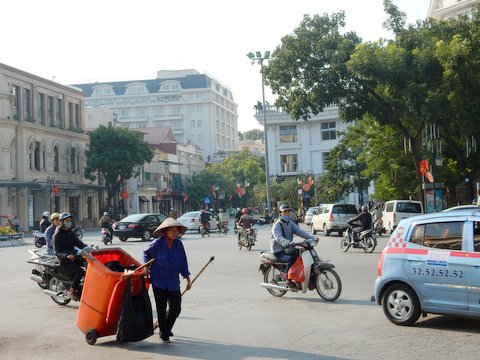
“There's gold in them thar hills,” goes the old saying. There’s also human blood and nerve damage in that gold. And there's dying animals and destroyed rivers.
The greatest gold rush in all of human history is on. It's not a pretty, a romantic or a benign business. Indeed, it's a catastrophe for the environment and for human and animal health.
The high price of gold – it has tripled since 2000 – is such that every gold-bearing plot of land and river is being ravaged in more than 70 countries. As many as 50 million of the world’s poorest people now depend on this kind of plunder for a living.
It's the mining equivalent of subsistence farming, but it's lethal in the cruelest ways. Mercury is used to identify the gold (2 grams of mercury for 1 gram of gold) to which it adheres. With each use, some of the mercury is washed away and vapor escapes into the air. In another variant of this practice, cyanide is used to leach gold out of ore in vats or ponds. Either way, two deadly substances are released without control into the environment.
The problem isn't with the deep mines of Australia, Canada, South Africa and the United States – the hard-rock mines. It's with two other categories of mining that use mercury or cyanide: alluvial and artisan.
Alluvial is working a river with pans and sluice tables, which are primitive devices that trap gold granules in a blanket or grease. Artisan – a term used by the United Nations and environmental groups — uses bigger machines and expensive “shaker tables,” which process earth by the ton rather than the bucket. These can be found in surface gold deposits in rivers and farther away. This is a mechanized version of finding gold that is not deep in the ground.
While artisan mining may conjure images of dedicated craftsmen coaxing gold out of rock with love and skill, don’t be deceived. The activity is savage and brutal; the plundered rock and soil is left to wash away, causing death and destruction over many years.
The Natural Resources Defense Council in Washington, and its cohorts at the U.N. Development Program and the World Bank, consider cyanide to be the lesser of the two threats. Maybe. But I've seen great piles of mining spoil which the cyanide has rendered lifeless. Nothing lives in it or grows on it.
Certainly, mercury is the largest of the real-and-present danger of subsistence mining. In Indonesia, men stand in rivers with their hands in buckets of water, muck and mercury, according to one Associated Press report. The BBC also has reported promiscuous use of mercury in Indonesia and Peru.
From China to Romania, in much of Latin America and throughout Africa, there is extensive mining on the surface — and that means mercury use. Miners in these countries are well aware of the dangers — miners often are. But the economics of their lives dictate that they mine until it kills them, or the food chain collapses and their families are poisoned, or the operation has to move to a pristine area to be repeated.
The economic life that sustains also destroys.
The United States and the European Union have restricted the export of mercury. But that's only increased the price, while there appears to be plenty in international trade – enough for the nomadic miners of those 70 or so countries.
I have to declare a personal interest in alluvial gold mining at its simplest: panning and sluicing. My father, whenever his many little business endeavors failed, headed for the beautiful Angwa River in Zimbabwe, both before and after World War II, to look for gold. He mined it with picks, shovels, pans and sluices. The activity was so minor it left no lasting mark. In those days gold fetched $35 an ounce, hardly enough to sustain him and his family, but better than nothing. Now it's about $1,600 an ounce.
My father loved that river. He often spoke about its beauty and tranquility. I've been reviewing photographs of it today: a ravaged moonscape of pits and waste piles. Crime is unchecked, murder is common.
Shakespeare said it: “All that glisters is not gold.” Indeed not. – For the Hearst-New York Times Syndicate

The great event of the nuclear calendar for 2011 was the earthquake and tsunami that hammered three reactors at the Fukushima Daiichi plant in Japan.
If you are a nuclear power believer, these sturdy old machines proved their mettle. They withstood all that nature could throw at them; although terrible damage resulted from the loss of external power and the swamping of the emergency diesel generators. The result was core melting and trouble in the used fuel storage pools.
If you are doubtful about nuclear power, or you are simply a political opportunist, this event was the final nail in the coffin, the proof that the end had arrived. For you, it provided more evidence that nuclear power is inherently unsafe and that its use, as American scientist Alvin Weinberg once said, is a Faustian bargain. (It was a remark that Weinberg wished he had not made and which his staff and supporters tried to justify by explaining that in the German legend, Faust finally gets his soul back, having foolishly pledged it to the devil.)
Such nonsense aside, the extraordinary thing about Fukushima is that although almost 25,000 Japanese died as the result of the earthquake and tsunami, no one died directly from the nuclear accident or from the release of radioactivity. The buildings and containment structures survived as they were designed to 40 years ago. This, despite a wall of water 45 feet high with incalculable force.
Each year, thousands of people are killed in coal mine accidents around the world. In 2010, 2,433 people were killed in China’s mines, the world’s deadliest.
Yet it was nuclear that had the world holding its breath. As with all accidents or even incidents, nuclear is held to a standard of safety orders of magnitude stricter than is applied to any other industrial activity, including other big energy undertakings, like oil refining, chemical production and transportation, and aviation.
The suspicion that falls upon nuclear technology is not only unfair – it is uneven.
The peace has been kept for five decades by the U.S. nuclear navy. In home waters and ports, nuclear ships and submarines sail without criticism.
Even the two organizations which appear to make their livings from relentless attacks on nuclear, the Union of Concerned Scientists and the Nuclear Information and Resource Service, have not dared to attack the nuclear navy. They do not protest, say, the USS Enterprise, when the great aircraft carrier sails blithely into domestic ports with eight reactors at work.
No one raises issues of waste, terrorist attacks or the consequences of military action. Those who make a living out of opposing nuclear power do not have the temerity to go after nuclear propulsion in warships. The public would not tolerate the disarmament that that would entail.
So the opponents go after nuclear’s soft underbelly: civilian power. It is hard to imagine that it is more dangerous to operate a nuclear facility built to be safe on land than one built for war-fighting on the high seas and in ports and harbors.
There are times in history when triumph is recorded as failure. The British and the Prussians finished off Napoleon in the Belgian town of Waterloo. But in the English Language, “Waterloo” — a British victory – is a synonym for catastrophic defeat. Americans believe the Tet Offensive was the turning point in the Vietnam War, even though the combined forces of the Viet Cong and North Vietnamese Army were roundly defeated by U.S. and South Vietnamese forces.
Fukushima, a once-in-history accident, was a victory of design and construction for its time. Even the radiation releases are now found to be lower than expected, even those in the exclusion zone are surprisingly low. Despite eager attempts to find a surge in new cancers around the plant, none has shown up.
The lessons are to incorporate more passive features, better power supply and to protect the emergency generators. Newer designs already incorporate some of these features — and all will going forward. The industry has reacted with unusual alacrity in the past to new lessons, something uncommon across the broad range of industrial endeavor from aircraft to automobiles. As with aviation, nuclear safety is always a work in progress, a striving.
To my mind, after 40 years of chronicling nuclear power, the industry makes a mistake in rushing to advertise the safety of nuclear power plants. That way the seeds of doubt are sown.
Aircraft makers learned that lesson back in the 1930s. They learned that the trick was to shut up and do better.
If nuclear plants are unsafe, they should be closed down. Now. Today.
If not, their virtues should be trumpeted. Now. Today. Where are the trumpets? – For the Hearst-New York Times Syndicate
It wasn’t the Grinch who stole Christmas; it was Northern Europe.
As a child born and raised in Central Africa, I was very aware of this confiscation. It outraged my mother, who was also born and raised in Africa.
We lived in British colony of Southern Rhodesia; and we were dominated by British immigrants who insisted on “dreaming of a white Christmas.” Well, tough luck.
As my mother liked to point out, not one more flake of snow fell in Central Africa than fell in the Holy Land, where Jesus Christ was born.
But we were — indigenous Africans and settlers alike — in the thrall of snow imperialism.
Being so close to the equator, snowfall was a meteorological impossibility. So those under the European cultural thumb decorated everything in sight with cotton wool. We could only dream of a cotton-wool Christmas.
Unlike my mother, my father felt no pressure from the European and North American inauthentic portrayal of Christmas as a white, cold affair. He didn't mind that the retailers edged their windows in cotton wool or that the Anglican Church went along with the Northern Hemisphere’s implication that Joseph and Mary struggled through the snow to get to the manger in Bethlehem.
The one thing my parents agreed upon was that Christmas began on December 24 and lasted for the traditional 12 days.
Not only was no snow substitute allowed in our house, but also no commercially produced ornaments; flowers and greenery were fine. As a result the whole family would go to a marshy area, known as a vlei, on Christmas Eve and cut great quantities of ferns which would be strung along the picture rails.
Decorations could be added to the green frieze, but only if we made them out of painted paper. Mostly, we stuck fresh flowers in it. It was a green Christmas.
When it came to food, my mother relented completely and we made English Christmas pudding (boiled for hours in muslin), fruit cake and pies made with mincemeat (an all-fruit mixture).
We weren't a drinking family, but a bottle of sweet sherry appeared at Christmas. My mother — who otherwise drank only tea and sometimes coffee (no water, milk, alcohol or sodas) — would take, ostentatiously, a very small glass of sherry. Having downed this half-ounce or so of fortified wine, she'd announce that she wasn't responsible for her actions, that she could feel her legs getting heavy and that she was drunk.
My brother and I watched Christmas after Christmas to see if there was any sign that there had been a physiological or psychological change in Mamma, but none was recorded.
We then ate a very English meal and listened to very English Christmas carols, like “The Holly and the Ivy” and “God Rest Ye Merry Gentlemen.” My mother, who hadn’t signed her separate peace treaty with Germany, wasn’t too keen on “Silent Night.”
It wasn't until I had turned 20 and was working in London at United Press International that I saw real snow. Sorry, Mamma, it beats cotton wool and it makes for a splendid Christmas, even if things were a bit different in Royal David’s City two millennia ago.
Now for some wassail. – For the Hearst-New York Times Syndicate

Brace for a storm of platitudes, recycled myths, and just old-fashioned
political lies.
It will all start with President Obama when he addresses a joint session
of Congress on Thursday about the jobs deficit. Whatever he says will be
followed by scorn and abuse from the Republicans. All the hoary old claims
about the absence of leadership, wasteful spending, punitive regulation
and the need to cut taxes will be regurgitated.
The president will have a TelePrompTer full of enchantment tales. He also
will talk of cutting some taxes; maybe because he thinks this will endear
him to the undecided voters, or mollify some Republicans, or because he
consistently tries to make his way in a viciously partisan political world
by endeavoring to sound like the voice of detached reason. It will make no
friends and infuriate the Democratic core. It will be another betrayal to
them.
All of the tax ideas, presidential and Republican, will be wrapped in cant
about small business. Oh, do politicians love small business. Apple pie is
good, mom is noble but small business, and small business alone, can cause
the entire Congress of the United States to genuflect.
They love the travel agent with six employees with the same passion that
they adore General Electric. The machine tool repair and maintenance
contractor with 40 employees – he is the very embodiment of American
exceptionalism. The woman with a wholesale jewelry business that she
operates with her husband and grown daughter — they are the stuff of
American legend.
Nonsense.
If Congress knew anything about the small business world, it would
stop forcing the wrong medicine on the patient. Incorrect therapies won’t
help, no matter how vigorous the applications.
To the political establishment, small business is suffering because of
taxation and regulation. Fiddle with these twin bugaboos, the political
narrative goes, and small business will bloom like the bluebells in
spring.
Have any of these people ever talked to small business operators? Small
business has many problems, but taxation is seldom one of them. Do they
really think the garment manufacturers on New York’s 7th Avenue are on the
phone, schmoozing about the rate of corporate taxation? More likely they
are talking about why the banks won’t lend, even against collateral, to
heretofore good customers; why imports from all over Asia are laying waste
to their customer base; and why the traffic in the cross-town streets is
horrendous.
Like all small businessmen, they don’t agonize over the frustration of
having to meet OSHA and EPA standards — these are irritants. Instead,
they agonize over whether there will be enough money to meet payroll.
Taxes, if any, come once a year, but the payroll keeps the small
entrepreneur anxious all year. It is the ogre that visits every two weeks.
To many, government is the problem; but not in the way legislators think.
The problem is the growing shortage of federal and state funds. This
affects many small businesses like builders, excavators, asphalt-layers
and the service industries that owe their survival to small contracts:
social service providers, translators, software writers, and consultants
in just about everything.
If you cut budgets, you cut small business.
Then there is the “chaining” of America. Local diners, hardware stores,
pharmacies and other retailing are crushed, annihilated when the chains
move in. The chains are not inherently evil, but they are manifestly
merciless. Walmart is but one of the chains putting small business to the
sword.
If those who administer government want to know something about small
business, they should spend a weekend at a strip-mall bakery or any other
firm with less than 50 employees. The experience would radically adjust
the rhetoric. It’s too late for Thursday, but don’t believe what you hear.
–For the Hearst-New York Times Syndicate
Brace for a storm of platitudes, recycled myths, and just old-fashioned political lies.
It will all start with President Obama when he addresses a joint session of Congress on Thursday about the jobs deficit. Whatever he says will be followed by scorn and abuse from the Republicans. All the hoary old claims about the absence of leadership, wasteful spending, punitive regulation and the need to cut taxes will be regurgitated.
The president will have a TelePrompTer full of enchantment tales. He also will talk of cutting some taxes; maybe because he thinks this will endear him to the undecided voters, or mollify some Republicans, or because he consistently tries to make his way in a viciously partisan political world by endeavoring to sound like the voice of detached reason. It will make nofriends and infuriate the Democratic core. It will be another betrayal to them.
All of the tax ideas, presidential and Republican, will be wrapped in cant about small business. Oh, do politicians love small business. Apple pie is good, mom is noble but small business, and small business alone, can cause the entire Congress of the United States to genuflect.
They love the travel agent with six employees with the same passion that they adore General Electric. The machine tool repair and maintenance contractor with 40 employees – he is the very embodiment of American exceptionalism. The woman with a wholesale jewelry business that she operates with her husband and grown daughter — they are the stuff of American legend.
Nonsense.
If Congress knew anything about the small business world, it would stop forcing the wrong medicine on the patient. Incorrect therapies won’t help, no matter how vigorous the applications.
To the political establishment, small business is suffering because of taxation and regulation. Fiddle with these twin bugaboos, the political narrative goes, and small business will bloom like the bluebells in spring.
Have any of these people ever talked to small business operators? Small business has many problems, but taxation is seldom one of them. Do they really think the garment manufacturers on New York’s 7th Avenue are on the phone, schmoozing about the rate of corporate taxation? More likely they are talking about why the banks won’t lend, even against collateral, toheretofore good customers; why imports from all over Asia are laying waste to their customer base; and why the traffic in the cross-town streets is horrendous.
Like all small businessmen, they don’t agonize over the frustration of having to meet OSHA and EPA standards — these are irritants. Instead, they agonize over whether there will be enough money to meet payroll. Taxes, if any, come once a year, but the payroll keeps the smallentrepreneur anxious all year. It is the ogre that visits every two weeks.
To many, government is the problem; but not in the way legislators think. The problem is the growing shortage of federal and state funds. This affects many small businesses like builders, excavators, asphalt-layers and the service industries that owe their survival to small contracts:social service providers, translators, software writers, and consultants in just about everything.
If you cut budgets, you cut small business.
Then there is the “chaining” of America. Local diners, hardware stores, pharmacies and other retailing are crushed, annihilated when the chains move in. The chains are not inherently evil, but they are manifestly merciless. Walmart is but one of the chains putting small business to thesword.
If those who administer government want to know something about small business, they should spend a weekend at a strip-mall bakery or any other firm with less than 50 employees. The experience would radically adjust the rhetoric. It’s too late for Thursday, but don’t believe what you hear.
–For the Hearst-New York Times Syndicate
They are not a gale, not even a stiff breeze — more like a zephyr really — but there are winds of change stirring Washington. There are hints that when Republicans return from their travels and their time with constituents they will be ready for some righting of their ship, which has been listing heavily to starboard.
Over in Democratic circles there are hopes that President Obama, presumably buoyed by the fall of Tripoli, will tighten his grip on the helm and begin to assert himself in ways that his party has felt that he has been missing.
The Associated Press released the results of a new poll on Thursday that showed approval of Congress has dropped to 12 percent, down from 21 percent in June, before the ugly debate over raising the debt ceiling. The Associated Press-GfK poll taken earlier this month also showed that the Tea Party has lost public support, Republican House Speaker John Boehner is increasingly unpopular and that people are warming to the idea of not just cutting spending but also raising taxes, just as both parties prepare for another struggle with deficit reduction.
Stuff happens — and when stuff happens, the political dynamic is changed.
An earthquake and hurricane, for example, has convinced people along the East Coast the cutting the funding for the U.S. Geological Survey, as has been proposed, may not be so prudent. Likewise, the National Oceanic and Atmospheric Administration might need full funding.
Enter states in economic shock. From Maine to California, they are bracing for the impact of federal grants drying up.
At least two Republican governors, who were out in front with austerity programs, are looking less sagacious.
New Jersey Gov. Chris Christie, a Republican Party favorite, sacrificed a long-planned new tunnel into Manhattan on the altar of economic rectitude, just before it was becoming apparent that the only way government can really create jobs is through big infrastructure projects.
Farther south, in a burst of ideological zeal, Florida Gov. Rick Scott waved off federal stimulus funds for high-speed rail and other things. So the funds traveled up the coast to be plowed into road projects in Massachusetts, much to the joy of Democratic Sen. John Kerry who crows about his state's infrastructure progress. The wily presidential hopeful Texas Gov. Rick Perry denounced the stimulus package and then pocketed $14 billion for his state.
The lesson for those who thought that statesmanship lay in placating the well-intentioned but economically challenged Tea Party movement is that surgery with a machete is doomed to terrible results when a laser scalpel is needed.
Malcolm Muggeridge, the great British essayist and popular philosopher, wrote a prescient essay on the failures of reform. Of 12 major reforms, from the Russian Revolution to the ending of Tammany Hall political domination in New York, people who were supposed to benefit were left worse off.
The latter is an issue that Obama may want to ponder as his health care reforms are implemented. Without a public option to benchmark prices, he may have covered more Americans but, in so doing, allowed for prices to further escalate.
It is by the Republicans that the larger pressure for course correction is being felt. "No new taxes," increasingly sounds about as sophisticated as what spectators to the guillotining of French aristocrats chanted, "Off with their heads!"
The public wants government to do many and mysterious things, like invent the Internet, go to Mars, cure cancer, build better highways, and keep us safe at home and abroad. Whether we enunciate it or not, we want the government to look after us in areas of health, world stature, scientific discovery, defense, and food supply and safety. Business does not do those things, and even the most rugged of individualists cannot do them for themselves.
Ergo, we have to pay for those things and the credit card is maxed out.
Tax is back on the table, if not in fashion. Tax and judicious cuts in spending.
Members of Congress also read the poll numbers. At around 13 percent, their approval ratings do not make them feel good. Nobody likes to be told they are an incompetent bum, especially incompetent bums.
So for the first time there is some feeling that the super committee, which is set to tackle the deficit problem, may actually do something before Congress allows mandated cuts — the machete to start hacking.
Just a little more wind, and a grand bargain will be scented on it. Wet a finger and hold it up in September. — For the Hearst-New York Times Syndicate
The manner of a man’s arriving is not without consequence. Tom Enders, the
German-born and American-educated head of Airbus, the European aircraft
giant, likes to do it by parachute, if it is an open-air event. People
don’t always remember what he says, but they sure remember how he got
there.
Of Texas Gov. Rick Perry, it could be said that he parachuted into the
race for the Republican presidential nomination. The manner of his entry
will be remembered, as it was meant to be.
Perry orchestrated a drum roll of media speculation, leading up to his
announcement. He assessed, contemplated, debated, discussed, examined,
explored and weighed entry. The media followed: might he, should he, would
he?
The drum roll, fed by leaks, grew louder as the declared candidates
traveled to Iowa for a debate and straw poll. Then Perry, with an
announcement in South Carolina, jumped and precision-landed on the parade
in Iowa.
Poor Michele Bachmann, left like a performing dolphin that has had its
fish snatched away. She had won the straw poll, deserved a few hours of
party adulation and had her joy cut by this man, who dropped in from the
West, all swagger and handshakes.
Perry hit the ground campaigning, when she was hoping to savor a victory
moment or two. Those famed southern manners don’t extend into Texas
politics. Ask fellow Texan, Kay Bailey Hutchison. He crushed her in a
Republican primary in Texas.
In Perry’s political lexicon Texas, and things Texan, are at once policy,
ideology and creed. But Perry’s Texas is not all of Texas, with its
alluring geographical and social diversity. It is the Texas of the
caricature — of barbecue, boots, swagger and can-do. It is not the Texas
of artists in Austin, of the symphony in Houston, ballet in Dallas or jazz
in San Antonio.
It is an inauthentic Texas, minted not on the ranches and the oil rigs,
nor the ugly, sprawling, low-income housing that surrounds the bustling
cities – a testament to an increasing chasm between rich and poor. It is
not the place where schools are failing, the prisons are overflowing, and
the execution rate is the highest in the advanced world.
Perry’s projection of Texas, which he sees as a template for the rest of
the United States, is as inauthentic as tumbleweed — an invasive species
from Russia. Perry’s Texas was created in novels, honed in Hollywood and is
part of the myth that Texas and Texans are imbued with qualities denied to
lesser breeds beyond the Lone Star State.
The problem with believing in myth, and elevating it to the the standing
of principle, is that myth is flexible and can be adjusted to reality.
Ergo the early revelation that Perry is happy to disavow difficult things,
like global warming. He says that there is a list of scientists, growing
almost daily, that say global warming is not the result of human activity.
This is cunning. It disavows responsibility without having to deny the
evidence. While the heads of most advanced governments worry about the
impact of greenhouse gases, a President Perry will not have to.
Perry has also laid down his marker as a man of faith, or at least a man
of public piety. He might want to note that the two most publicly
religious presidents of recent times, Jimmy Carter and George W. Bush,
left office in low esteem and are not faring well in the first books of
history. He may want to ponder why the Founding Fathers were so anxious to
separate church and state.
Perry’s political barbecue sauce, such as berating the Federal Reserve,
may be the precursor to a string of tired, old political nonsenses, like
returning to the gold standard; quitting the United Nations; and
abrogating treaties, in the belief that every commitment abroad is an
infringement of sovereignty.
Perry has made a dramatic entry. Now we wait in trepidation; even George
W. Bush’s people are alarmed. Are we to be shown the real Texas, at the
same time proud and flawed, or the synthetic one, doctored for political
effect? — For the Hearst-New York Times Syndicate