When I lived in Manhattan, I pursued an unusual pastime. I started it to avoid eye contact with Unification Church members who peddled flowers and their faith on many street corners in the 197os. If a Moonie (as a church member was known derisively) were to approach me, I’d cast my eyes down to the sidewalk, where I’d see things that would set my mind wandering.
In the winter months, I’d see lone gloves and mittens. On the curb in front of La Cote Basque on East 55th Street, the luxe French restaurant where Truman Capote dined with the doyennes of New York’s social scene and dished on them in his unfinished novel, “Answered Prayers,” I saw a black leather glove with a gold metal “F” sewn on the cuff. I coveted such a Fendi pair, eyeing them at the glove counter at Bergdorf Goodman, but not buying them – they cost about a third of my Greenwich Village studio apartment rent in the late 1970s. On the sidewalk on Fifth Avenue, in front of an FAO Schwartz window, I saw a child’s mitten, expertly knit in a red-and-white Norwegian pattern that I never had the patience to follow. I wondered whether the child dropped the mitten after removing it to point excitedly to a toy in the window.
In the summer months, I’d see pairs of sunglasses and single sneakers on the sidewalks, things that had fallen out of stuffed weekenders. It wasn’t unusual for me to see pantyhose. Working women in Manhattan, in my time there, could wear a short-sleeved wrap dress – the one designed by Diane von Furstenberg was the working woman’s boilersuit — in the summer, but they’d better have put on pantyhose, or packed a pair in their pocketbooks or tote bags. The pantyhose would fall out of them and roll like tumbleweed along the avenues.
One summer morning on Perry Street, near where I lived, I saw a long, black zipper. It looked like a black snake had slithered out of a drain grate on the street and was warming itself on the asphalt, its white belly gleaming in the sun.
Now when I walk on a city sidewalk, I still look down, not to pursue my pastime but to preserve myself from tripping and falling on them. I sometimes see interesting litter, but mostly I see single-use and reusable face masks.
This fall, as I walked on the waterfront promenade along the Rondout Creek in Kingston, New York, I saw a single-use mask swirling in the wind with the fallen leaves. I grabbed the mask and deposited it in a trash can, worried that it would fall into the creek, ensnarling the waterfowl and the fish.
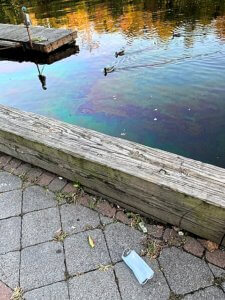
Mask of Doom: A face mask imperiling ducks on the Rondout Creek in Kingston, N.Y. Photo: Linda Gasparello
In the Covid-19 crisis, masks have been lifesavers. But masks, especially single-use, polypropylene surgical masks, have been killing marine wildlife and devastating ecosystems.
Billions of masks have been entering our oceans and washing onto our beaches when they are littered, when waste management systems are inadequate or nonexistent, or when these systems become overwhelmed due to increased volumes of waste.
A new report from OceansAsia, a Hong Kong-based marine conservation organization, estimates that 1.56 billion masks will have entered the oceans in 2020. This will result in an additional 4,680 to 6,240 metric tonnes of marine plastic pollution, says the report, entitled “Masks on the Beach: The impact of COVID-19 on Marine Plastic Pollution.”
Single-use masks are made from a variety of meltdown plastics and are difficult to recycle, due to both composition and risk of contamination and infection, the report points out. These masks will take as long as 450 years to break down, slowly turning into microplastics ingested by wildlife.
“Marine plastic pollution is devastating our oceans. Plastic pollution kills an estimated 100,000 marine mammals and turtles, over a million seabirds, and even greater numbers of fish, invertebrates, and other animals each year. It also negatively impacts fisheries and the tourism industry and costs the global economy an estimated $13 billion per year,” according to Gary Stokes, operations director of OceansAsia.
The report recommends that people wear reusable masks, and to dispose of all masks properly.
I hope everyone will wear them for the sake of their own and others’ health, and that I won’t see them lying on sidewalks on my strolls, or on beaches, where they are a sorry sight.