By Linda Gasparello
Forty years ago, I attended Easter Sunday mass at the Church of St. Barbara in Old Cairo, also known as Coptic Cairo, on the east bank of the Nile. I was a graduate student at the American University in Cairo, and this was my first Coptic mass. At it, regrettably, I had a front-row seat to the routine disrespect Coptic Christians suffered in Egypt under President Anwar el-Sadat.
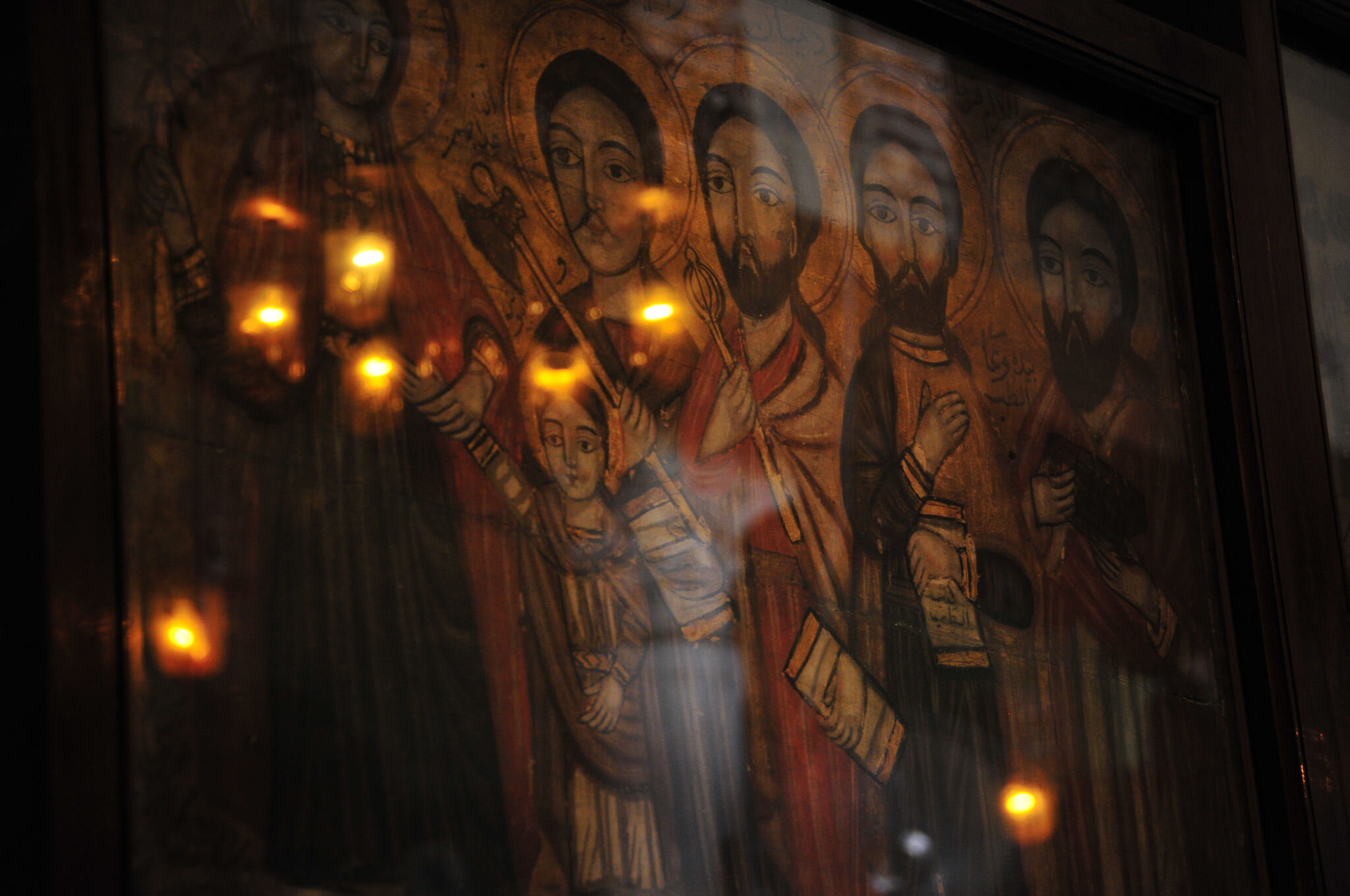
The Church of St. Barbara is a fine example of Coptic architecture with its white plaster walls, marble double-colonnaded nave and timbered roof, carved cedar pews, and rare, gleaming icons. It is one of the most popular in the district, and it quickly filled to capacity.
No sooner had the mass begun, when I heard the sound of firecrackers outside the church. The noise pierced the solemnity of the mass, but the congregation took no notice and prayed on.
During the communion, a man in a suit, accompanied by two other men, marched down the center aisle of the church. The man in the suit was a government official, I was later told. In a symbolic gesture meant to mollify the Copts, who comprised about 10 percent of Egypt’s population, government officials made appearances at churches during Christmas and Easter.
The three men pushed into a pew, sat down and started chatting with each other. The congregation brushed away this disruption of the holiest part of the mass as easily as street flies. A woman sitting behind me muttered, “Ma’alesh.” In Egyptian dialect, she said, “It doesn’t matter.”
The Copts were used to disrespect and, far worse, persecution, which they had suffered since St. Mark founded the Coptic Orthodox Church in Alexandria around 43 A.D. In fact, the Church of St. Barbara stands on the site of a church dedicated to St. Cyrus and St. John in 684 A.D. that was destroyed during an Arab assault. The story goes that when some Christians from Damanhur, a city about 100 miles northwest of Cairo, including Cyrus and John, confessed to their faith, they were shot with arrows, burned in a furnace, tied to a horse’s tail, dragged through the streets and survived – to be beheaded. One of the church’s chapels contains the remains of St. Cyrus and St. John; another contains relics of St. Barbara, a beauty from the Greek city of Nicomedia, whose pagan father had her tortured before he beheaded her in 306 A.D.
The Copts were being excluded from the “new society” plan that Sadat had highlighted on his trip to Washington, D.C., just a week before Easter. The Egyptian president held his first meeting with President Jimmy Carter on April 3. In his toast at a state dinner on April 4, Sadat said, “Mr. President and dear friends, as you know we are embarking on an ambitious program to rebuild our society along lines which ensure more justice and equal opportunity. We are revitalizing our system with a view to enable it to cope with the immense problems we encounter, old and new. We are determined to build this new society on ideals of faith in human dignity, which we inherited from the ancient Egyptian civilization. This heritage has kept us united together and optimistic in the face of the most difficult of challenges.”
Actually, Sadat’s state was falling apart. It ceded to the religious institutions the provision of education, financial assistance and health services to the public. Sadat, who was a devout Muslim, allowed Islamist groups to flourish in society and on campuses, countering the leftist and Nasserist domination of them. Religion – an emboldened Islamism — was replacing the “Egypt for the Egyptians” nationalism of Nasser as the country’s foundation. There was a rising level of disregard for the Copts, who became increasingly fearful for their future. In 1977, there were clashes between Muslims and Copts in Upper Egypt.
I should have left the Church of St. Barbara with a sense of joy — the mass was beautiful. Instead, I left with one of foreboding: I thought the rise of the Islamists and their disrespect of Copts, condoned by the government, would lead to mass deaths.
And so it did – to Sadat’s death and to hundreds of deaths of Muslims and Copts, including at least 45 in two church bombings by ISIS on Palm Sunday.
Photo: August 11, 2012 Church of St. Barbara, Cairo, Nadia Ismail. Used under the Creative Commons 2.0 Generic License