Jimmy Dean, the country musician, actor and entrepreneur, famously said: “I can’t change the direction of the wind, but I can adjust my sails to always reach my destination.”
A new wind turbine from a California startup, Wind Harvest, takes Dean’s maxim to heart and applies it to wind power generation. It goes after untapped, abundant wind.
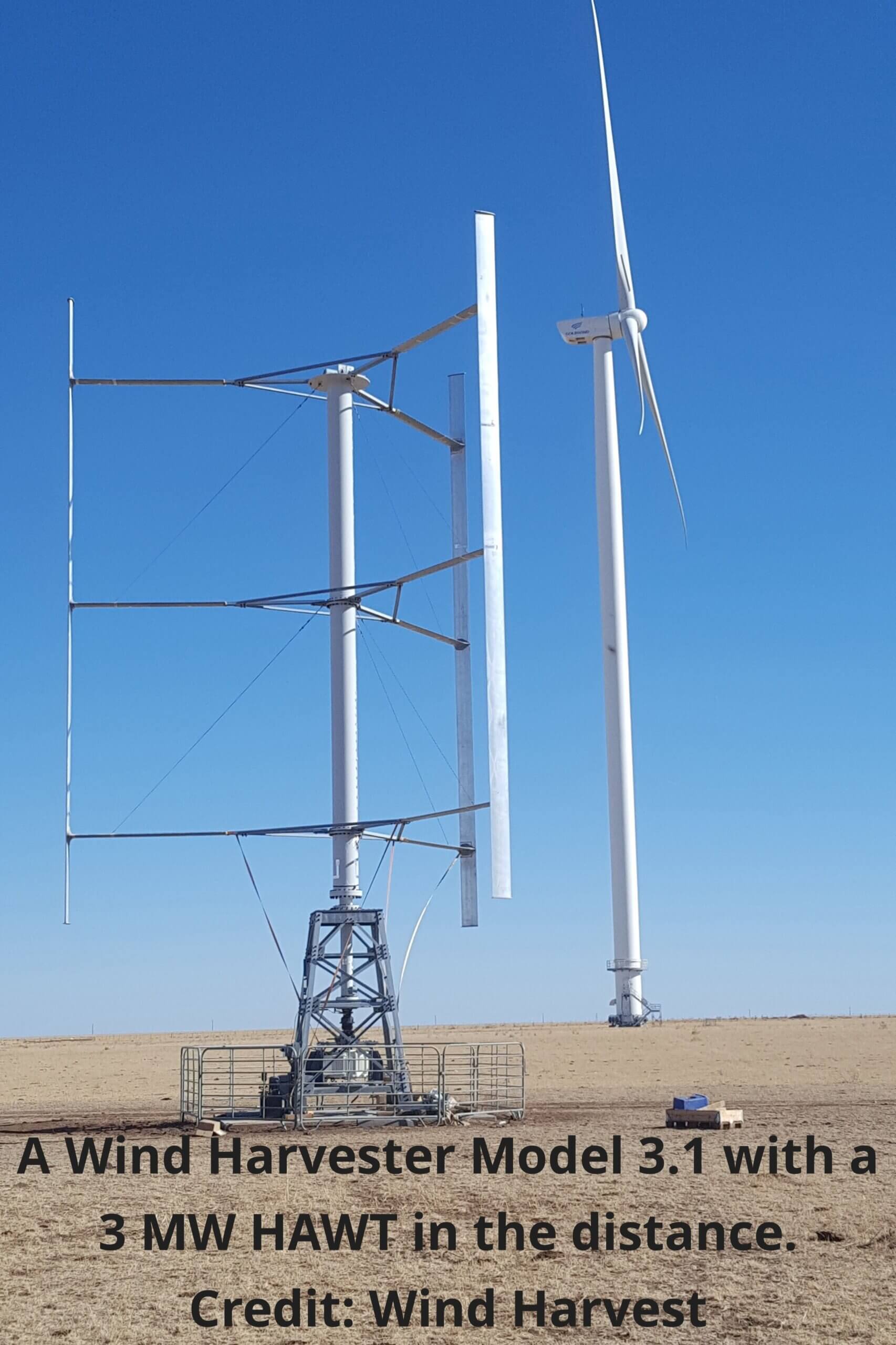
Wind Harvest is bringing to market a possibly revolutionary but well-tested vertical axis wind turbine (VAWT) that operates on ungathered wind resources near the ground, thriving in turbulence and shifting wind directions.
The founders and investors – many of them recruited through a crowd-funding mechanism — believe that wind near the ground is a great underused resource that can go a long way to helping utilities in the United States and around the world with rising electricity demand.
The Wind Harvest turbines neither seek to replace nor compete with the horizontal axis wind turbines (HAWT), which are the dominant propeller-type turbines seen everywhere. These operate at heights from 200 feet to 500 feet above ground.
Instead, these vertical turbines are at the most 90 feet above the ground and, ideally, can operate beneath large turbines, complementing the tall, horizontal turbines and potentially doubling the output from a wind farm.
The wind disturbance from conventional tall, horizontal turbines is additional wind fuel for vertical turbines sited below.
Studies and modeling from CalTech and other universities predict that the vortices of wind shed by the verticals will draw faster-moving wind from higher altitude into the rotors of the horizontals.
For optimum performance, their machines should be located in pairs just about 3 feet apart and that causes the airflow between the two turbines to accelerate, enhancing electricity production.
Kevin Wolf, CEO and co-founder of Wind Harvest, told me that they used code from the Department of Energy’s Sandia National Laboratory to engineer and evaluate their designs. They believe they have eliminated known weaknesses in vertical turbines and have a durable and easy-to-make design, which they call Wind Harvester 4.0.
This confidence is reflected in the first commercial installation of the Wind Harvest turbines on St. Croix, one of the U.S. Virgin Islands in the Caribbean. Some 100 turbines are being proposed for construction on a peninsula made from dredge spoils. This 5-megawatt project would produce 15,000 megawatt hours of power annually.
All the off-take from this pilot project will go to a local oil refinery for its operations, reducing its propane generation.
Wolf said the Wind Harvester will be modified to withstand Category 5 hurricanes; can be built entirely in the United States of steel and aluminum; and are engineered to last 70-plus years with some refurbishing along the way. Future turbines will avoid dependence on rare earths by using ferrite magnets in the generators.
Recently, there have been various breakthroughs in small wind turbines designed for urban use. But Wind Harvest is squarely aimed at the utility market, at scale. The company has been working solidly to complete the commercialization process and spread VAWTs around the world.
“You don’t have to install them on wind farms, but their highest use should be doubling or more the power yield from those farms with a great wind resource under their tall turbines,” Wolf said.
Horizontal wind turbines, so named because the drive shaft is aligned horizontally to the ground, compared to vertical turbines where the drive shaft and generator are vertically aligned and much closer to the ground, facilitating installation, maintenance and access.
Wolf believes his engineering team has eliminated the normal concerns associated with VAWTs, like resonance and the problem of the forces of 15 million revolutions per year on the blade-arm connections. The company has been granted two hinge patents and four others. Three more are pending.
Wind turbines have a long history. The famous eggbeater-shaped VAWT was patented by a French engineer, Georges Jean Marie Darrieus, in 1926, but had significant limitations on efficiency and cost-effectiveness. It has always been more of a dream machine than an operational one.
Wind turbines became serious as a concept in the United States as a result of the energy crisis that broke in the fall of 1973. At that time, Sandia began studying windmills and leaned toward vertical designs. But when the National Renewable Energy Laboratory assumed responsibility for renewables, turbine design and engineering moved there; horizontal was the design of choice at the lab.
In pursuing the horizontal turbine, DOE fit in with a world trend that made offshore wind generation possible but not a technology that could utilize the turbulent wind near the ground.
Now, Wind Harvest believes, the time has come to take advantage of that untouched resource.
Wolf said this can be done without committing to new wind farms. These additions, he said, would have a long-projected life and some other advantages: Birds and bats seem to be more adept at avoiding the three-dimensional, vertical turbines closer to the surface. Agricultural uses can continue between rows of closely spaced VAWTs that can align fields, he added.
Some vertical turbines will use simple, highly durable lattice towers, especially in hurricane-prone areas. But Wolf believes the future will be in wooden, monopole towers that reduce the amount of embodied carbon in their projects.
One way or another, the battle for more electricity to accommodate rising demand is joined close to the ground.
This article was originally published on Forbes.com