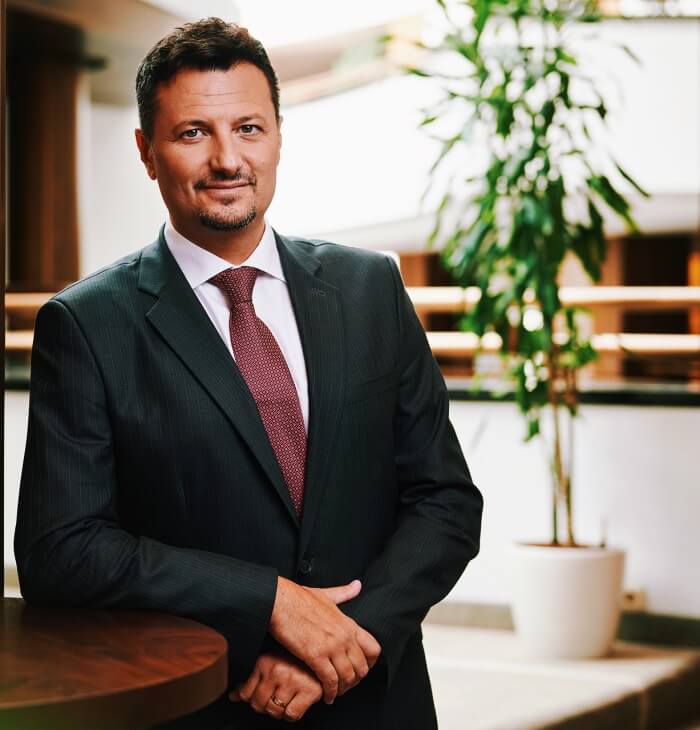
When Benjamin Lakatos speaks, energy people listen in Europe and increasingly farther afield.
Recently Lakatos, chairman and Group CEO of MET Group, has been speaking out strongly in favor of a European energy bank to correct some of the chaos which often convulses European energy markets and leads to general instability.
As laid out by Lakatos, in an interview with Mlex, an energy news service which is part of LexisNexis, the energy bank could be modeled on a central bank.
Since the Russian invasion of Ukraine in 2022, there has been a lot of chaos with prices and supplies yo-yoing, often reflecting geopolitical uncertainty and state actions.
Some of the normal market protections, like long-term contracts, haven’t been effective, largely because vendors and buyers have found the market so unstable that they have been reluctant to enter into binding, long-term commitments.
MET Group, which is based in Zug, Switzerland, points out that the idea of a European energy bank is far from universal acceptance, but there have been adjacent ideas. One idea is that the energy bank could grow out of the European Central Bank, be an offspring enterprise.
The idea of a European energy bank has also been advancing in think tanks and in policy workshops.
“The ‘energy bank’ would have tools analogous to central banks: liquidity injections, ‘circuit breakers’ in trading, easing margin calls, guarantees, and counter party support,” Lakatos told Mlex.
Lakatos, just 49 years old, is the dynamic leader of MET Group, an integrated European energy conglomerate, which has grown from a gas trading company in 2007 to its current status as a heavyweight active in 21 countries, 33 national energy markets and 44 trading hubs.
Originally, MET Group was a subsidiary of MOL, a Hungarian energy company. It became an independent company in a management buyout in 2018.
The headquarters were moved to Zug because Lakatos, who headed the buyout and is MET Group’s largest stockholder, felt it was a better base for raising capital, from a tax point of view and quite possibly, but he didn’t say so, from a political one.
MET Group is a purchaser of U.S. liquified natural gas for distribution in Europe. From its base in natural gas, MET Group is heavily involved in renewables, wind and solar, and storage. It has endorsed the concept of energy transition from fossil fuels to renewables and has become a leader in solar, wind and storage.
The company embraces forward-thinking and is 90 percent employee-owned with the remaining 10 percent held by Singapore’s Keppel Infrastructure.
In January 2026, Lakatos will move from Group CEO to his new role as executive chairman with emphasis on future strategies.
Lakatos seems to have no illusions about the size of the undertaking in persuading European institutions to sign onto the creation of an energy bank or the potential lethargy of government and established entities.
Lakatos’s concept of an energy bank is remarkably far- reaching and has no exact precedent anywhere. However, there are echoes of when Henry Kissinger created the International Energy Agency in 1974.
At that time, it was believed the IEA would act, in part, as an oil bank and that it would take an active role in opposing OPEC and monopolists controlling oil, after the Arab oil embargo in the fall of 1973. As time wore on, the mission of the IEA changed and it became more of a noticeboard agency than an executive one.
The story of the buffeting volatility of the European energy markets is told in MET Group’s own revenues.
Last year, it reported consolidated revenue of $17.9 billion. But in 2022, the year of the great shortages, its revenues were a staggering $40.5 billion. Its 2023 revenues were also high at $24.5 billion.
Interestingly, the call for an energy bank comes at a time when thought leaders are seeking to enhance the idea of European identity.
At a fall meeting of the Jean Monnet Association in France, at which I was present, there was a detailed examination of how those living in the 27-member European Union could feel a greater sense of common European identity. More clearly defined, Europe-wide institutions would help, the association’s members thought.