It is coming as surely as cars changed the way we live, as airplanes revolutionized transportation and as the cellphone has conquered all.
It is the smart city of the future.
While it will look much like today’s cities, it will in fact be a digital construct; a place where sensors, interactivity and hyper-electronic speeds replace what will come to be seen as today’s leisurely pace of city operation and communication.
Imagine a place where police cruisers know the location of gunshots before anyone has called 911. Or, as Morgan O’Brien, chief executive officer of Anterix, a creator of private telephone networks for utilities, says, “By using broadband private networks, utilities can know a transmission wire has snapped before it hits the ground.”
Electric utilities, sometimes seen as wedded to the old ways of generation and distribution, have already laid the groundwork for cities’ electronic refurbishment. The first wave of the future, the smart meter, is in more than 60 percent of homes, and deployment continues apace.
The home smart meter does much more than simply record electricity use and ready a bill. It generates data on the local demand and flow patterns in the neighborhood. The smart meter has become vital in helping people save money when electricity prices are low (such as the middle of the night in many jurisdictions), but also helping to integrate the diverse new sources of generation from solar farms, solar panels on rooftops and wind turbines. Keeping tabs on this intermittent generation requires very smart electronics.
“Interconnectivity is the future,” says Clinton Vince, chairman of the U.S. Energy practice and co-chairman of the global energy sector at Dentons, the world’s largest law firm. Basically, he points out, electric utilities must be very nimble to deal with the new microgrids and with individual generators using rooftop solar. The same applies to wind turbines, where the flow of electricity can be cut off instantly with a wind drop and other sources have to pick up seamlessly.
Chris Peoples, founding and managing partner of the Baltimore-based innovation strategy firm PP&A, says all this hyperactivity in the smart city will be recorded and preserved by blockchain, the ledger system of the 21st century.
To come are electric vehicles and autonomous ridesharing — so important that the big tech companies Cisco, Google, Uber and Amazon have invested in smart cities technologies, and have high hopes for growth there.
The smart city will want an even more reliable electric supply than we have today. Rapid response has been the modus operandi of electric companies down through the decades. Outages are handled with speed and big outages, such as after hurricanes, are dealt with by mobilizing restoration crews from unaffected areas.
But that may not be enough with greater reliance on electricity for things like autonomous vehicles and electric-powered delivery drones. These will have self-sufficiency through their batteries, but they also will need to have control systems that can operate in a blackout.
Anterix, for example, will provide secure broadband communications to utilities, enabling them to communicate when all other systems have failed.
There are two existential threats to the electric grid and, therefore, to the electricity-hungry smart city. One is cyberattack by enemies known and unknown. The other is a magnetic pulse, generated by an act of God in the form of solar flares, or an act of evil in the form of a nuclear weapon detonated overhead. Either way, the grid must be hardened, as far as science allows, against such eventualities.
I would submit that this amounts to a brave new world. But I would implore the designers to remember people also want simple things of their cities, like walkability and mobility.
If you get walkability you get livability and, yes, lovability. Think Paris, San Antonio and San Francisco. Get smart, smart city designers.
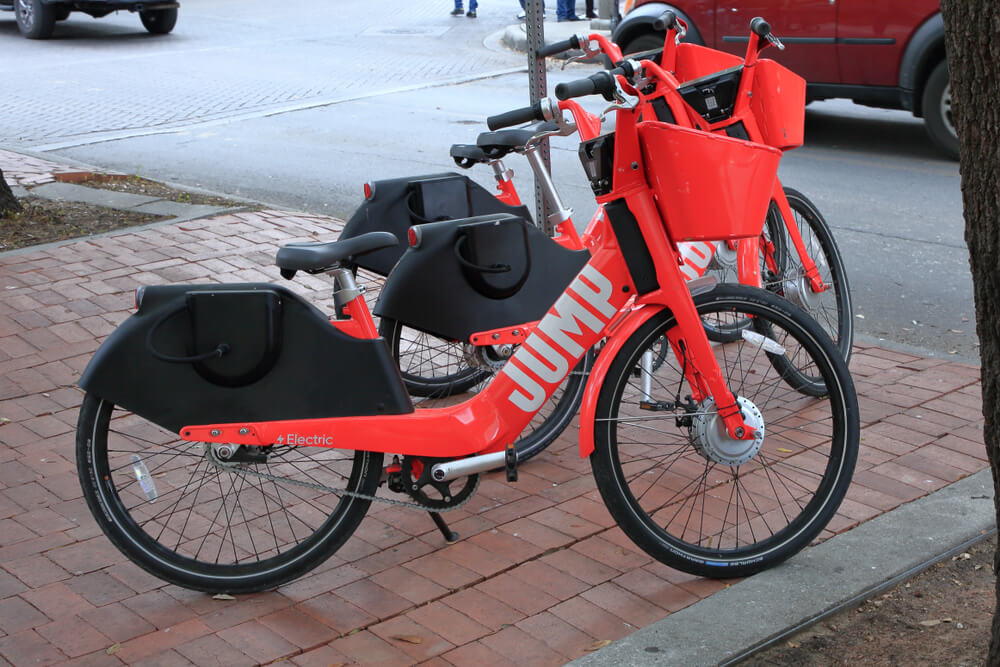
Photo: A JUMP on-demand electric bike in downtown San Antonio. JUMP Bikes is a dockless electric bicycle sharing system acquired by Uber – San Antonio, Texas, USA
 Follow
Leave a Reply