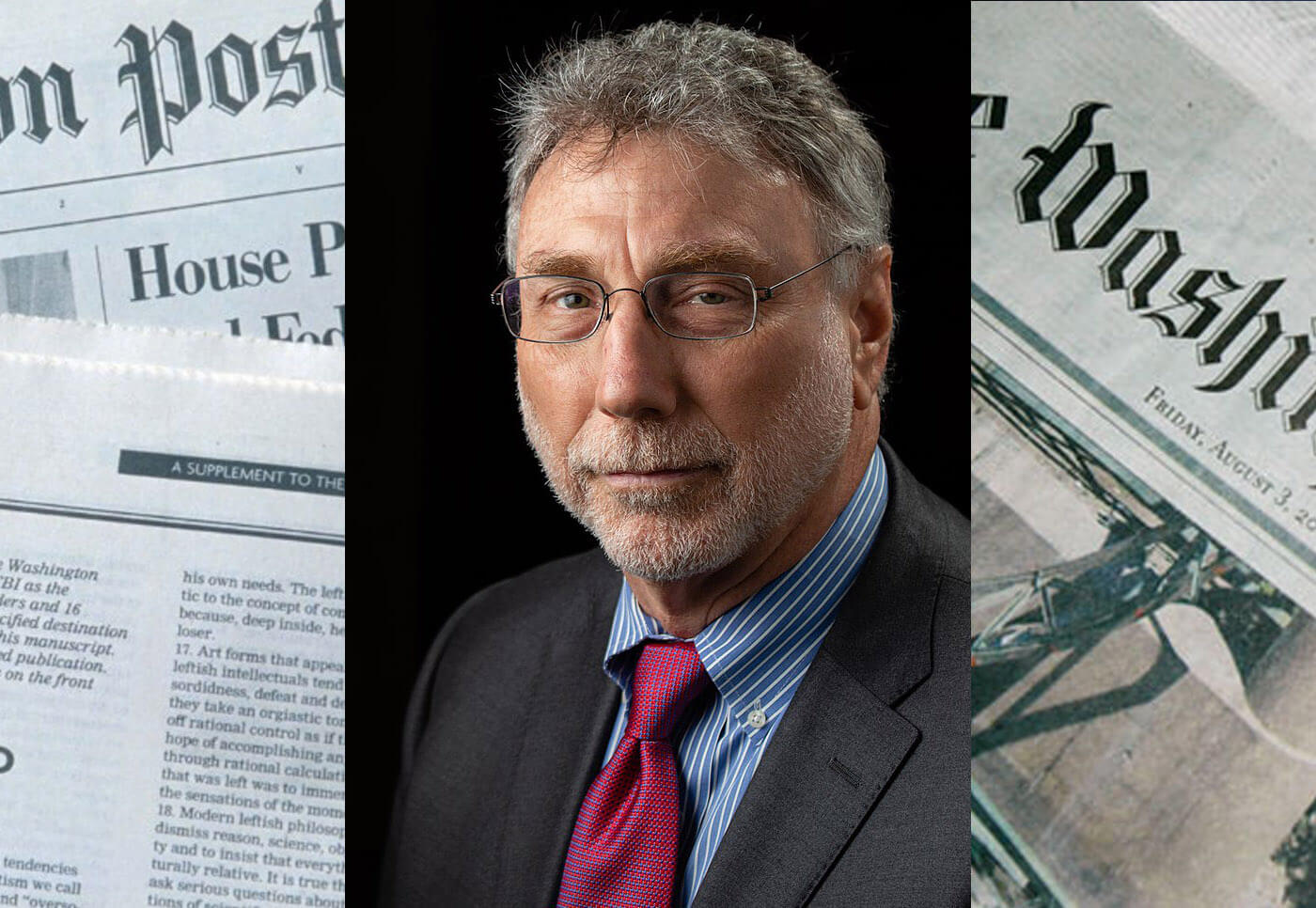
I am something of a connoisseur of editors. I have worked for them, alongside them, and have hated and admired them.
So I was ecstatic when Adam Clayton Powell III, my cohost on the TV show “White House Chronicle,” told me he contacted Martin “Marty” Baron, who has a place in the pantheon of great editors, and he agreed to come on the show.
We recorded a two-part series with Baron, which was a tour de force appearance. He talked about the excitement of being the editor of The Miami Herald when Elian Gonzalez was the big story; the years-long unveiling of sexual abuse in the Catholic Church in The Boston Globe when he was its editor; and his becoming executive editor of The Washington Post and its transition from being a family property to being owned by Jeff Bezos, then the world’s richest man.
As he did in his book, “Collision of Power: Trump, Bezos, and The Washington Post,” he discussed how Trump early on had the new Post team to dinner at the White House and endeavored to co-opt them into the Trump camp. Trump had, as Baron explained, picked on the wrong team.
Baron’s biggest achievement, I believe, was the investigation that exposed the Catholic Church. I was traveling frequently to Ireland at that time — a country, sadly, that had seen more than its share of clerical excess. The Globe’s revelations had an immediate impact there and around the world: Think of the thousands of boys and girls who won’t be abused as a result.
Every editor edits differently and leaves a different mark. I worked for a weekly newspaper editor in Zimbabwe, Costa Theo, who set much of the hot type and edited on the Linotype machine. He urged me to use what he called “informants” many years before Watergate ushered in the practice of talking about “sources” without naming them and relying on the integrity of the reporter to guarantee the existence of the sources.
Herbert Gunn, father of the poet Thom Gunn, edited various newspapers in London’s Fleet Street — when I knew him, it was The Sunday Dispatch. He sat in a commanding way on what was called the “backbench” at the end of the newsroom and edited what he thought needed his touch in green ink with a Parker 51. If you saw green ink, you jumped.
Gunn was a superb editor and, like Ben Bradlee at the Post, gave a theatrical performance as well. All I ever saw in green ink were cryptic notes like “15 minutes.” That meant, “I will see you in the pub in 15 minutes.” It was an assignment not an invitation.
Some editors are technicians and change the look of the papers they edit. John Denson at The New York Herald Tribune is credited with introducing horizontal layouts using Bodoni typefaces as the principal type of the newspaper. This became the standard for many U.S. newspapers, including The Washington Post.
A newspaper genius, David Laventhol, put the women’s page in the Post to flight. As the Style section’s first editor, he did it with typological aplomb and with the use of photos in a Life magazine way: big and bold.
Laventhol, who ended up as publisher of The Los Angeles Times and Newsday, came to the Post from The New York Herald Tribune, where he had risen to managing editor. He and I worked together briefly in 1963 and I remember him having a days-long battle with Marguerite Higgins, the famous foreign correspondent, over the use of the word “exotic.”
Of course, Laventhol was only able to create the revolutionary Style section because executive editor Bradlee gave him free rein.
Bradlee edited with leadership, while affecting a kind international jewel thief persona, as might be played by David Niven or Steve McQueen. His genius always was the big picture. He didn’t write headlines or change captions, but he did decide the big stories of the day.
One of those stories was about a break-in at an office and apartment complex called The Watergate. I had arranged a dinner date with a reporter at the rival Evening Star. She called me and said, “I am afraid I will be late. There has been some sort of break-in at The Watergate. But it can’t be important because the Post is sending Carl.”
At that time, Carl Bernstein wasn’t a star, just a young city-desk reporter. I don’t think my date that night stayed in journalism.
Baron, like Bradlee, had a nose for the big one — and he brought it home.
 Follow
Leave a Reply