White House Chronicle

News Analysis With a Sense of Humor

  • Home
  • King’s Commentaries
  • Random Features
  • Photos
  • Public Speaker
  • WHC Episodes
  • About WHC
  • Carrying Stations
  • ME/CFS Alert
  • Contact Us

After the Hurricane, There Are Real Heroes up the Pole

October 15, 2016 by Llewellyn King Leave a Comment

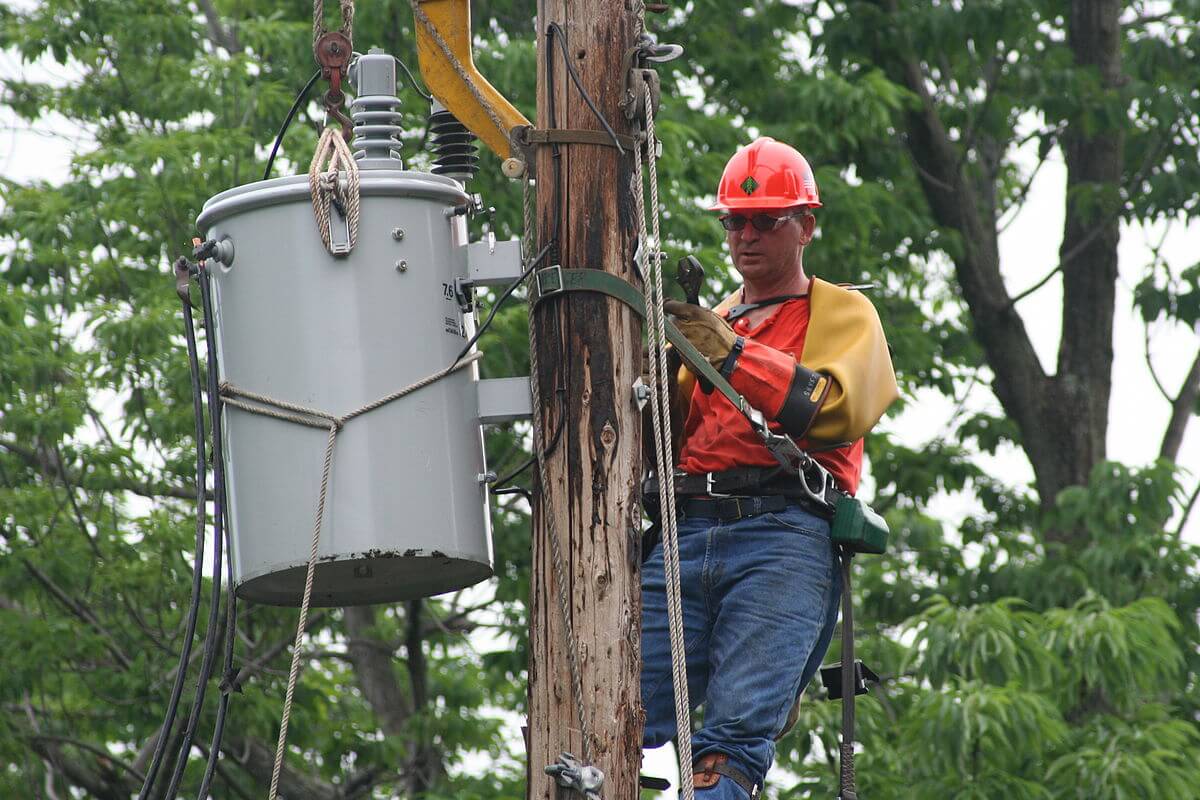
From across the nation an army of men, and a few women, is on the move. They are deployed with tools and gauges, maps and their own know-how in a critical battle. They are shock troops fighting the flooding in North and South Carolina.

They are electricity linemen.

When disaster strikes, the nation’s electric utilities spring into action, sending equipment — which can range from temporary lighting to the familiar bucket trucks — hundreds and thousands of miles to the battle.

When these first responders reach the site of disaster, they go to work down manholes and up poles, struggle with knotted wires and fallen trees.

The work is hard and the conditions are dangerous, but there is a camaraderie that binds linemen from different localities in a common purpose and danger. Those who more usually might rely on a bucket truck, in fine conditions, take out their climbing gear and up the pole they go.

The constant danger is electricity itself: the threat of electrocution. Up the pole, there are many other dangers. The pole may be weakened and critters seeking safety may be up there, from raccoons to venomous snakes.

When the lights go off, life as most of us know stops. It does not grind to a slow halt, it stops. Elevators, air conditioners, heating systems, ovens, refrigerators, televisions and computers are stranded. Even the pumps for removing water from a flooded basement need electricity.

Everyone knows that in an emergency, it is vital to restore the juice. The linemen, often several sleeping in a single motel room or in their trucks, are the heroes who work as many as 19 hours straight to do that.

It is rewarding, exacting and well-paid work. A spokesman for the American Public Power Association explains that pay varies, depending on the part of the country, but $100,000 a year is common and earnings shoot up with overtime, as in emergencies. The association represents more than 2,000 publicly owned utilities, serving about 14 percent of the nation’s electricity consumers.

So it is astounding that for a number of years both the publicly owned and the large, investor-owned utilities, which the Edison Electric Institute represents and account for 80 percent of the power supply, have been having a devil of a time finding workers prepared for a very secure life that has its moments of high drama — as is the case right now with the crews restoring power to areas devastated by Hurricane Matthew.

The problem is that even the most enthusiastic young person cannot just go up a pole without a lot of training: four years of training.

In the world of labor, electric utilities are not the only ones gasping for help. There is an artisan labor shortage and it is worsening. One truck operator reckons there are vacancies for at least 50,000 truck drivers. Similar shortages exist for electricians, pipe-fitters, sheet metal workers, stone masons, welders and many other skilled artisans.

If all the manufacturing jobs that politicians say they would like to bring back to the United States were to arrive next year, there would be no workers to build the factories, nor a trained workforce to make the goods. The unemployment crisis — so emphasized in this election year — is with the unskilled.

Part of the artisan problem may be that too many young men and women are being herded into colleges without any knowledge of alternatives for which they might have more aptitude and interest. More college is always seen as a virtue. But who needs four years of college to become an Uber driver?

When the APPA tried recruiting in high schools with a video, they found teachers trashed the video. Schools are rated on how many graduates go on to college, not on to training in trades offering job security and satisfaction.

There is a future up the pole.

For InsideSources

Filed Under: King's Commentaries Tagged With: labor, linemen, trade jobs

How Computers Are Trashing the Old Ways of Work

November 5, 2013 by White House Chronicle Leave a Comment

I saw the future outside my apartment building this week — and it was a brown van. To be exact, it was a United Parcel Service van and the operator was struggling with a huge load of parcels on a hand truck.
 
You can’t tell too much from a parcel, but the shape gives the contents away to some extent: a small, rolled carpet; a large, flat-screen television; about a dozen boxes that could contain a variety of goods — goodies for fun and essentials to keep things going. Talk about Frankie Laines’1949 hit “Mule Train.”
 
Every day the UPS delivery man is at our building, sometimes with more, sometimes with less. Sometimes he brings clothes for my wife, and recently he brought a book for me. What the trusty fellow in the brown van doesn’t unload, his compatriots from FedEx and the United States Postal Service do.
 
A sea of goods flow into this building each day; goods that have never seen a retail store, never been offered for sale in a mall or high street shop, but goods that people want anyway. Welcome to online shopping and the future disruption it'll bring.
 
What's missing with this shopping is the shop, whether it's a big box store in the mall or a ma-and-pa operation on the high street.
 
It's part of one of the great historical revolution brought about by the Internet. All the data show that online shopping grows every day.
 
Eventually, in the way that the malls undermined the neighborhood shop and the chains killed off those wonderful downtown department stores, a different one for each city (Garfinkel's in Washington, D.C., Jordan Marsh in Boston and I. Magnin in San Francisco), the Internet may bury the malls.
 
Make no mistake, the Internet is a hellishly efficient and cruel exterminator of jobs, as well as a ruthless agent of social change.
 
As so often, the political class is still convinced that job growth can be achieved by economic and regulatory policy shifts. It's easier to blame presidents Barack Obama and George W. Bush, depending on your ideological persuasion, even though the evidence of massive change is everywhere, than to face a new reality.
 
It's nigh impossible to speak to anyone on the phone at a bank, an insurance company or a utility without going through 20 minutes of computer-assisted torture in the form of voice prompts — “Press star 2 to get your balance.”
 
Academia has been surprisingly slow to study and quantify the job-threatening nature of the new order. MIT, Oxford and Harvard have spoken up, and now you can expect more pessimism from on high as academics get the wind up about their own employment.
 
In the ivory towers, those citadels of refined arrogance, there is deep disquiet. The cause: MOOCS, or massive open online courses. These are attracting students by the hundreds of thousands; some for credit, some just for the joy of watching the most articulate professors in action. They are creating a star system that favors the telegenic over everything else and could, in time, change the nature of higher education so profoundly that many lesser university will close up shop. One study, by researchers at Oxford, has estimated 47 percent of our jobs may disappear.
 
History tells us that new ways of doing things lead to new areas of endeavor; agrarian people became urban manufacturers, manual labor gave way to service-sector work. The computerization of work is an equal-opportunity un-employer. Is new work possible?
Factories in China and Germany are as subject to computer predation as those in the United States. We may yet see a global economic collapse driven by too much productivity; computer productivity.
 
This column was written on a computer and distributed by computer. The contents were generated by a human being, but that may change. Stay online. — For the Hearst-New York Times Syndicate


Filed Under: King's Commentaries Tagged With: academia, computers, FedEx, jobs, labor, MOOCS, productivity, shopping, United Parcel Service

White House Chronicle on Social

  • Facebook
  • Twitter
  • Vimeo
  • YouTube
How U.S. Natural Gas Came Back from the Dead

How U.S. Natural Gas Came Back from the Dead

Llewellyn King

The Trump administration is proud of America’s dominance in natural gas. The nation is the world’s largest producer and a net exporter. We produce a quarter of the world supply of the fuel, which has become fundamental to electricity production. Forty-three percent of our electricity is generated from natural gas. According to the Energy Information […]

Foreign Aid That Works — the Malawi Story

Foreign Aid That Works — the Malawi Story

Llewellyn King

In 2005, Gordon Brown, British chancellor of the exchequer, later prime  minister, was in Washington, seeking to raise $50 billion annually in  additional international aid for Africa. I hosted a press event for Brown at the National Press Club, and I  asked him how all this money would get to the people who needed it? […]

Is Rubio Starting a Nuclear Arms Race in the Middle East?

Is Rubio Starting a Nuclear Arms Race in the Middle East?

Llewellyn King

The Trump administration has announced and appears to be crowing over an agreement with Saudi Arabia to help the kingdom not only to build nuclear power plants but also to enrich the uranium fuel. There is no reason for the Saudis to enrich uranium. There are plenty of willing suppliers of enriched uranium and more […]

Soft Power, the Secret Sauce of the British Empire

Soft Power, the Secret Sauce of the British Empire

Llewellyn King

When President Trump, on the first day of his second term, closed the U.S. Agency for International Development and began dismantling the Voice of America, he also severely curtailed what had been America’s soft power dominance in the world. With those actions, we abandoned something of inestimable value: the ability to project Americanism, our ideals. […]

Copyright © 2026 · White House Chronicle Theme on Genesis Framework · WordPress · Log in