White House Chronicle

News Analysis With a Sense of Humor

  • Home
  • King’s Commentaries
  • Random Features
  • Photos
  • Public Speaker
  • WHC Episodes
  • About WHC
  • Carrying Stations
  • ME/CFS Alert
  • Contact Us

How John McLaughlin Blew Up Television Talk Shows

August 19, 2016 by Llewellyn King Leave a Comment

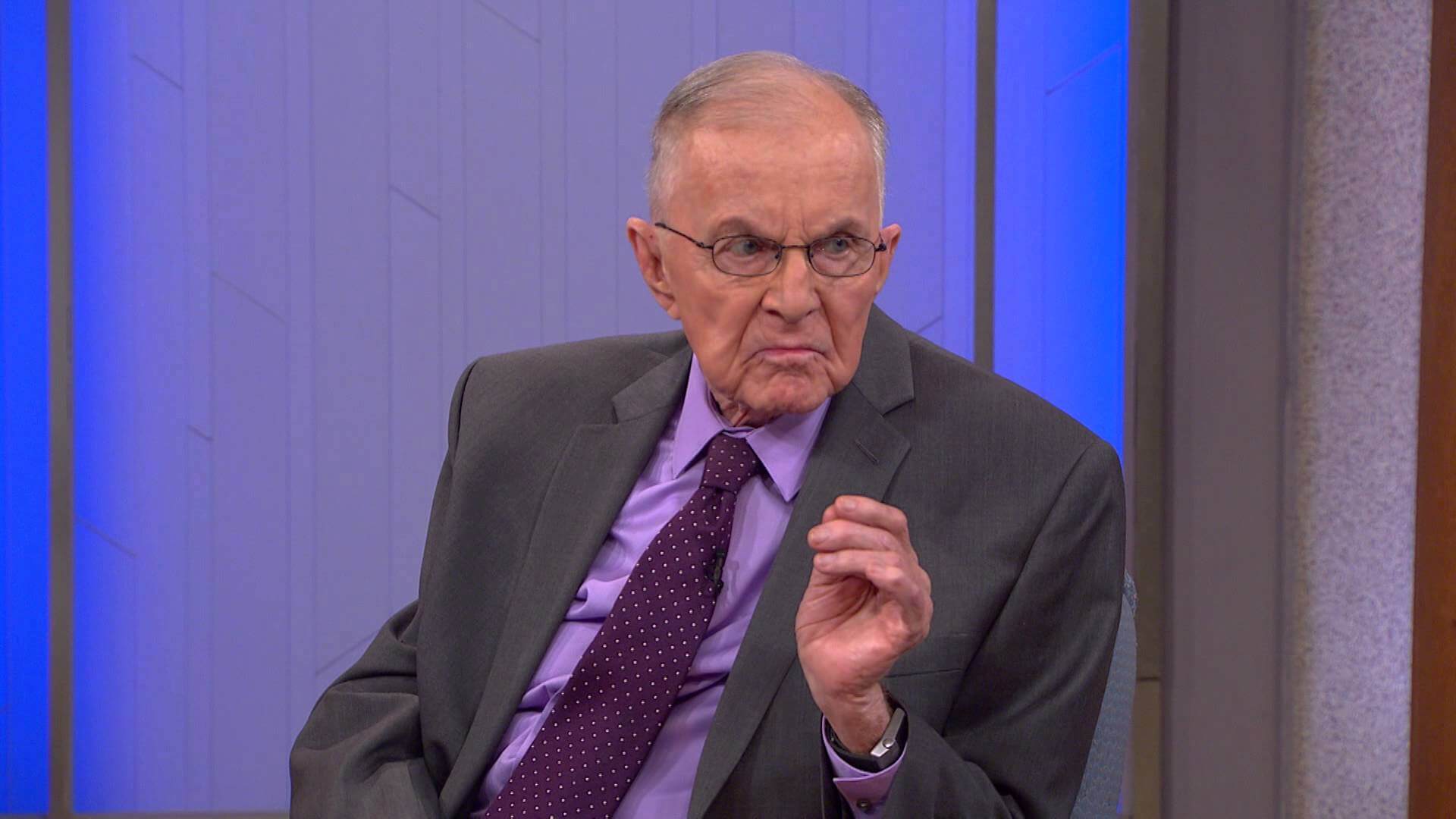
Thirty-four years ago, a former Jesuit priest threw an incendiary device into the world of televised political talk shows. He was John McLaughlin, host of “The McLaughlin Group,” who has died at the age of 89.

Until McLaughlin exploded of the scene, it was all rather sedate. The dominant programs were PBS’s “Washington Week in Review” and “Agronsky & Company,” hosted by veteran broadcaster Martin Agronsky.

In these programs, the host was magisterial and the guests were journalists who answered questions either about what they were covering or what they thought; and their answers were expected to conform to a level of decorum. “Agronsky & Company” — largely because of Agronsky’s own strong personality — had a little more flash than “Washington Week in Review,” but there was a level of earnestness about both programs.

Along came McLaughlin, who was not so much a seeker-of-wisdom- and-truth as a man in pursuit of fun and something watchable. With “The McLaughlin Group,” a window was opened and fresh air gushed in. The conventions were trounced. Shouting and loud dispute on television arrived, all skillfully goaded by McLaughlin.

The program became essential viewing not only for political junkies, but also for much of the nation. At one time, it was carried on nearly 400 PBS stations, although it originated on commercial television in Washington. It was sponsored by the Edison Electric Institute.

It was also commercially successful, so it was able to pay its contributors and to have a large staff — a very large staff for a half-hour show. McLaughlin was not easy to work for, staffers who later worked with me said. Washington television circles are replete with stories of him sending staffers on personal errands and, in one case, ordering a woman to make toast for him.

All I can say is that in our very occasional meetings, he was very encouraging about my own television and radio talk show, “White House Chronicle.”

McLaughlin left nothing to chance: the effect had to be right. So shows were packaged, reworked, and second and third takes were common. There was perfectionism in the riot.

He was the ringmaster, demanding terse answers, switching subjects and making declarative statements. After a “lighting round” of questions, he would opine, “The answer is.”

McLaughlin had the best opinion journalists of the time on his program, including Jack Germond, Robert Novak, Morton Kondracke, Pat Buchanan, Eleanor Clift and Michael Barone. There were falling outs with some of his stars: Novak is reported to have stormed off the set, and Germond also quit with harsh words.

But there were loyalists and people who loved McLaughlin. They include Clift and Buchanan, whose friendship with McLaughlin dated back to the Nixon White House.

In the past decade, the program fell victim to the “new journalism” it had created. As the cable networks grew, they adopted the aggressive approach to political discussion that McLaughlin had introduced, but often without the finesse or the self-deprecation, which was part of McLaughlin as a broadcaster and as a man.

He loved Dana Carvey’s skewering of the program on “Saturday Night Live.” He would openly joke about a very prudish article of advice to girls about sex that he had written when he was in the priesthood.

McLaughlin, an extraordinary man with an extraordinary legacy, was an ordained Jesuit who left the priesthood and married twice. He ran unsuccessfully as a Republican for the Senate from Rhode Island, became a speechwriter for President Nixon, and editor and columnist for National Review and then, without a background in television, reinvented political talk shows.

If you are tired of journalists shooting off their mouths and shouting at each other 24/7, blame John McLaughlin. He would have loved you for it.

— For InsideSources

Filed Under: King's Commentaries Tagged With: John McLaughlin, The McLaughlin Group

Television Political Talk, It’s a Growth Industry

May 25, 2008 by White House Chronicle Leave a Comment

This is the year of the political talk show. Never have so many had so much to say about so little. No wonder CNN snapped up Tony Snow, when he left his job as White House press secretary. David Gregory, the uncontested successor to ABC’s Sam Donaldson as press corps lightening rod, is missing from NBC’s booth at the White House. He is doing a talk show for MSNBC–just one more talk show host in long lineup that includes Bill O’Reilly, Hannity & Colmes, Keith Olbermann, Dan Abrahms, Wolf Blitzer, Glenn Beck, Lou Dobbs and Campbell Brown. Even C-SPAN does politics.

But if you do not get cable, do not worry. You can still get your fix of talking hosts on over-the-air broadcasting. Beginning on Friday night, there is “Washington Week with Gwen Ifill.” It is the national anthem before the main event. The first-string players take the field on Sunday morning. On my dial the lineup is “Fox News Sunday with Chris Wallace,” “This Week with George Stephanopoulos,” “The Chris Matthews Show,” “Meet the Press with Tim Russert” and “Face the Nation with Bob Schieffer.”

Two programs, “Meet the Press” and “Face the Nation,” have been around since the days of radio. But all political broadcasting today owes much to a half-hour show that thundered to life 25 years ago. I speak of “The McLaughlin Group” and its extraordinary host, John McLaughlin.

McLaughlin invigorated the television talk show. He made the host a participant and encouraged contention, even shouting, among the guests.

It is hard now to remember how static the talk shows were. The host was a magisterial figure, who pretended he had no interest in the discussion. I was a panelist on “Meet The Press,” when Bill Monroe moderated it. There was a single guest who was interviewed by a panel of reporters. You could get in two questions, and that was it. It was a structure more satisfactory in concept than in practice. Once, when I was on the panel, Sen. Henry “Scoop” Jackson was a guest. I knew Jackson well and while we were in makeup, he said, “I want you to take me to the mat, and ask me the hard questions.” Of course he knew, and I was to learn, that the format did not include hard questions.

McLaughlin’s show is now in some decline, overshadowed by the resources and sheer volume of the competition. It has moved to another channel in Washington; and its rating are falling, according to The Weekly Standard. The show is a little tired, and McLaughlin’s conservatism a little idiosyncratic.

I have to confess that McLaughlin has been important to my career. I started a television talk show called “White House Chronicle,” which airs on some PBS and many public access channels, mostly because I got tired of waiting on the short list to be a guest on “The McLaughlin Group.”

At a White House Correspondents’ Association annual dinner, McLaughlin came over and told me how much he enjoyed my show. I told him how much he was responsible for it. This seemed to make him very happy.

Meanwhile, back on the dial, it is all politics, all the time. Or, more accurately, it is more people saying more about the tiniest perturbation in the week’s presidential campaign news. The question is whether the public interest in politics will continue after this extraordinary election year–and with it, the 24-7 political talk.


Filed Under: King's Commentaries Tagged With: ABC, Bill O'Reilly, Bill Press, C-SPAN, Campbell Brown, CNN, Dan Abrahms, David Gregory, Face the Nation with Bob Schieffer, Fox News Sunday with Chris Wallace, Glenn Beck, Hannity & Colmes, Henry "Scoop" Jackson, John McLaughlin, Keith Olbermann, Lou Dobbs, Meet the Press with Tim Russert, MSNBC, NBC, political talk show, Sam Donaldson, The McLaughlin Group, This Week with George Stephanopoulos, Washington Week with Gwen Ifill, Wolf Blitzer

White House Chronicle on Social

  • Facebook
  • Twitter
  • Vimeo
  • YouTube
The ‘New Weather’ Reality Will Change the Nation, Defy Politics

The ‘New Weather’ Reality Will Change the Nation, Defy Politics

Llewellyn King

I have never done political consulting. So it was novel to me when a candidate in the midterms asked me what he should be worried about in 2027. I repeated what Harold Macmillan, British prime minister from 1957 to 1963, is believed to have said, “Events, dear boy, events.” Actually, I had a little list […]

How U.S. Natural Gas Came Back from the Dead

How U.S. Natural Gas Came Back from the Dead

Llewellyn King

The Trump administration is proud of America’s dominance in natural gas. The nation is the world’s largest producer and a net exporter. We produce a quarter of the world supply of the fuel, which has become fundamental to electricity production. Forty-three percent of our electricity is generated from natural gas. According to the Energy Information […]

Foreign Aid That Works — the Malawi Story

Foreign Aid That Works — the Malawi Story

Llewellyn King

In 2005, Gordon Brown, British chancellor of the exchequer, later prime  minister, was in Washington, seeking to raise $50 billion annually in  additional international aid for Africa. I hosted a press event for Brown at the National Press Club, and I  asked him how all this money would get to the people who needed it? […]

Is Rubio Starting a Nuclear Arms Race in the Middle East?

Is Rubio Starting a Nuclear Arms Race in the Middle East?

Llewellyn King

The Trump administration has announced and appears to be crowing over an agreement with Saudi Arabia to help the kingdom not only to build nuclear power plants but also to enrich the uranium fuel. There is no reason for the Saudis to enrich uranium. There are plenty of willing suppliers of enriched uranium and more […]

Copyright © 2026 · White House Chronicle Theme on Genesis Framework · WordPress · Log in