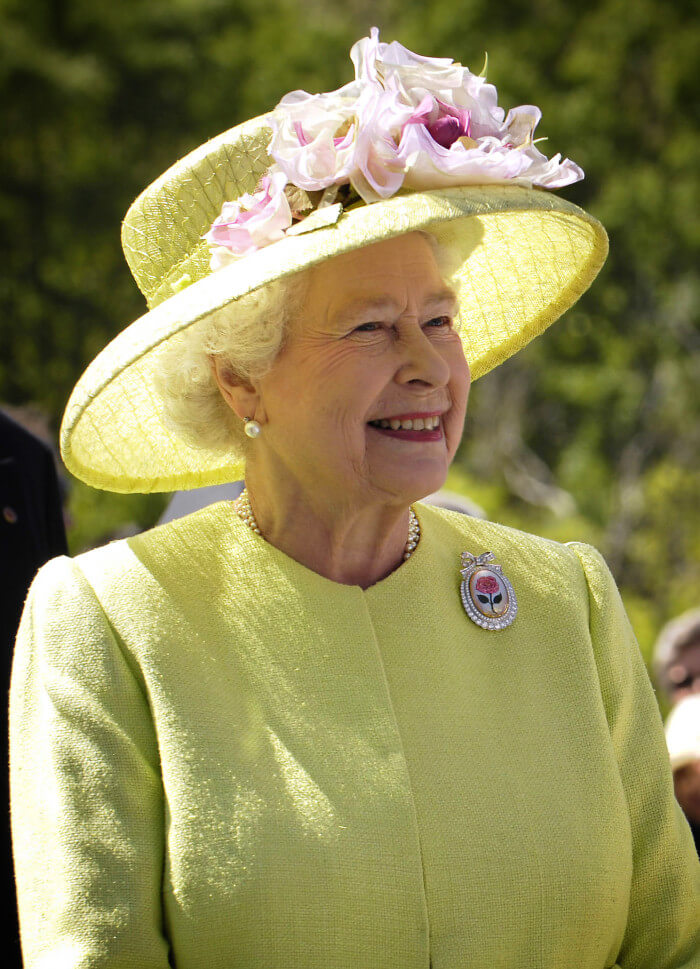
She is the best-known woman in the world, and she has been since 1952 when Elizabeth Alexandra Mary Windsor, at age 25, became Queen Elizabeth II. Although she has a huge list of titles, she is to most people simply the queen. And she has been the only British monarch in most people’s lives: She has always seemingly been there.
Once Queen Elizabeth was young and quite pretty; now she is old and quite beloved. She works very hard, whether it is presiding over meetings with prime ministers – she has dealt with 12 of them, starting with Winston Churchill — or applying herself to an endless schedule of charity events. She has visited 116 countries. I have always wondered at her incredible tolerance, no endurance, at watching cultural events in faraway lands: How many children’s choirs, folk dancers or synchronized gymnasts can a human being watch? In the case of the queen, the number seems to have been infinite.
When she came to the throne, she set off a surge of hope in Britain and the Commonwealth. Popular mythology, as I remember, held that a new Queen Elizabeth would bring a revival of fortune for Britain — the second Elizabethan period would be as great as the first Queen Elizabeth’s reign, from 1558 to 1603.
After World War II, Britain was adjusting to a new order in most things, including the social changes introduced by the Labor government immediately after the war, such as national health insurance, and the recognition that Britain was no longer be the preeminent world power, ruling a quarter of the world. The empire was shrinking, and Britain felt exhausted and lessened.
But the new, young queen signaled hope, and the royal family shot to a position of public adulation. I remember covering the wedding of the queen’s sister, Princess Margaret, to the photographer Anthony Armstrong-Jones in 1960, when Britain went was in a kind of royal hysteria. That began to fade as the decade wore on, and that marriage began to creak and eventually dissolve.
As royal scandals multiplied and Britain became a trendsetter in fashion and the arts, Princess Diana, during and after her marriage to Prince Charles, stole much of the queen’s thunder.
The queen said her worst year was 1992, which she famously called an “annus horribilis” in a Nov. 24 speech at Guildhall to mark the 40th anniversary of her accession. Newspapers wondered whether the monarchy was finished and whether it would either give way to a republican Britain or to one where the constitutional monarch was of little importance, as in the Netherlands, Belgium and Spain.
But Queen Elizabeth persevered and, she just turned 89, is more loved than ever. She is slightly old-fashioned, even as Buckingham Palace is anxious to remind us she e-mails and tweets.
She is a fabulous piece of English bric-a-brac in her omnipresent hat and gloves. Though perfectly dressed in her way, she is not a fashion idol. She was a fine horsewoman. She attends cultural events, but seems only to have a passion for horses and dogs. Critics have faulted her for how limited she is in some ways. It may be that at this point, she is as much an anachronism as the monarchy, and there is strength in that.
No longer do comedians make fun of her piping voice and her ability to ride out gaffes, like the time in Canada when she read the wrong speech, having forgotten which city she was visiting. The British might have come to love her for her famously dysfunctional family — even Charles, her quirky son and heir to the throne. Scandals have touched all of her family, excepting herself and her husband Prince Philip, although one of the queen’s ladies-in-waiting told me that he was busy in that circle when he was young.
When she does die, Britain will enter into the most extraordinary period of mourning, followed a year or so later by a coronation. The change will be enormously expensive, from the queen’s burial to the coronation of the king. Tens of thousands of items stamped with ER (Elizabeth Regina) or the queen’s face, including mail boxes, stamps and the 20-pound note, will have to be changed.
Happily and gloriously, after 62 years as queen, Elizabeth is, physically as well as emotionally, part of British life. She is also, in a way, the world’s queen. — For the Hearst-New York Times Syndicate