Oh, dear! President Trump has hinted that journalists should lose their credentials. He probably means the passes which allow journalists to enter the White House complex at the Northwest Gate and to walk to the briefing room a few hundred yards away.
Over the decades, successive administrations — in my accounting, starting with Jimmy Carter — have reduced the amount of freedom journalists enjoy inside the White House fence. It has been whittled away to the token that it is today. Jousting with the press secretary, Sarah Sanders, is not freedom to gather the news.
A reporter used to be able to walk around the complex without an escort and meet with White House staff in the Old Executive Office Building (now the Eisenhower Executive Office Building) without an escort.
More important, when you had an appointment in the West Wing, the nerve center of any administration, once you were through the door, you were at liberty to sit in the corridor before or after your appointment and often someone would invite you in for an unscheduled chat. At least, that was my experience and it was invaluable. You and they learned things. It was a two-way flow.
Incidentally, you did not need one of the prized “hard passes” to do that. Even now, in a time of restriction, a journalist does not need a hard pass to cover a briefing. You can get cleared through the gate by that part of the White House communications operation known as the Lower Press Office. You need pretty good identification like a congressional press pass, which are issued by standing committees of journalists covering Congress; sometimes just a passport or driver’s license.
Trump’s tweet about credentials suggests he believes all reporters need these to do their jobs. Fact is credentials are useful but not essential. Indeed, I question the emphasis on credentials in Washington because they hint at the licensing of journalists, devoutly to be avoided and contested — a constitutional violation under the First Amendment.
Credentials are a game subject to abuse: the very abuse Trump hints at.
It has even been suggested, by the George W. Bush and other administrations, that the press should be kicked out of the White House and given a briefing room in a nearby government building. One of the major values of being inside the White House fence is to garner interviews in the driveway with important visitors — to be able to file on the spot with authenticity and to be a constant, if thorny, reminder to the White House, any White House, that the eyes and ears of the world are feet away.
The damage that Trump has done to the media and by extension to this liberal democracy, is the ceaseless denigration. In 2017, 46 journalists were killed around the world – 26 so far this year — for just doing their jobs. Death in the line of duty is not “fake.”
What is the reporting job? It was best encapsulated by my friend Dan Raviv when he was with CBS News Radio. He said, “I try to find out what is going on and tell people.”
Quite so.
Trump makes that simple idea of finding out what is going on and telling people more difficult and sometimes dangerous. Trump’s daily assault on the media has encouraged all of those with something to hide: those who are cheating, lying, torturing, killing and suppressing the freedom of others. He is damaging the body politic here and in other countries.
Journalism maybe a feeble light but it is a light. For many it is last hope for justice, the ultimate appellate court and the hope that they will be heard.
Trump’s relentless undermining comes at the worst of times for the journalism we have known. Newspapers are gasping, television is losing advertisers and viewers. If all this were not sobering enough, many are demanding that the great new forces for disseminating journalistic output, Google and Facebook, should practice censorship. Shame.
Finding out what’s going on and telling people is hard enough without Trump’s dangerous disparagement — and politically correct censorship.
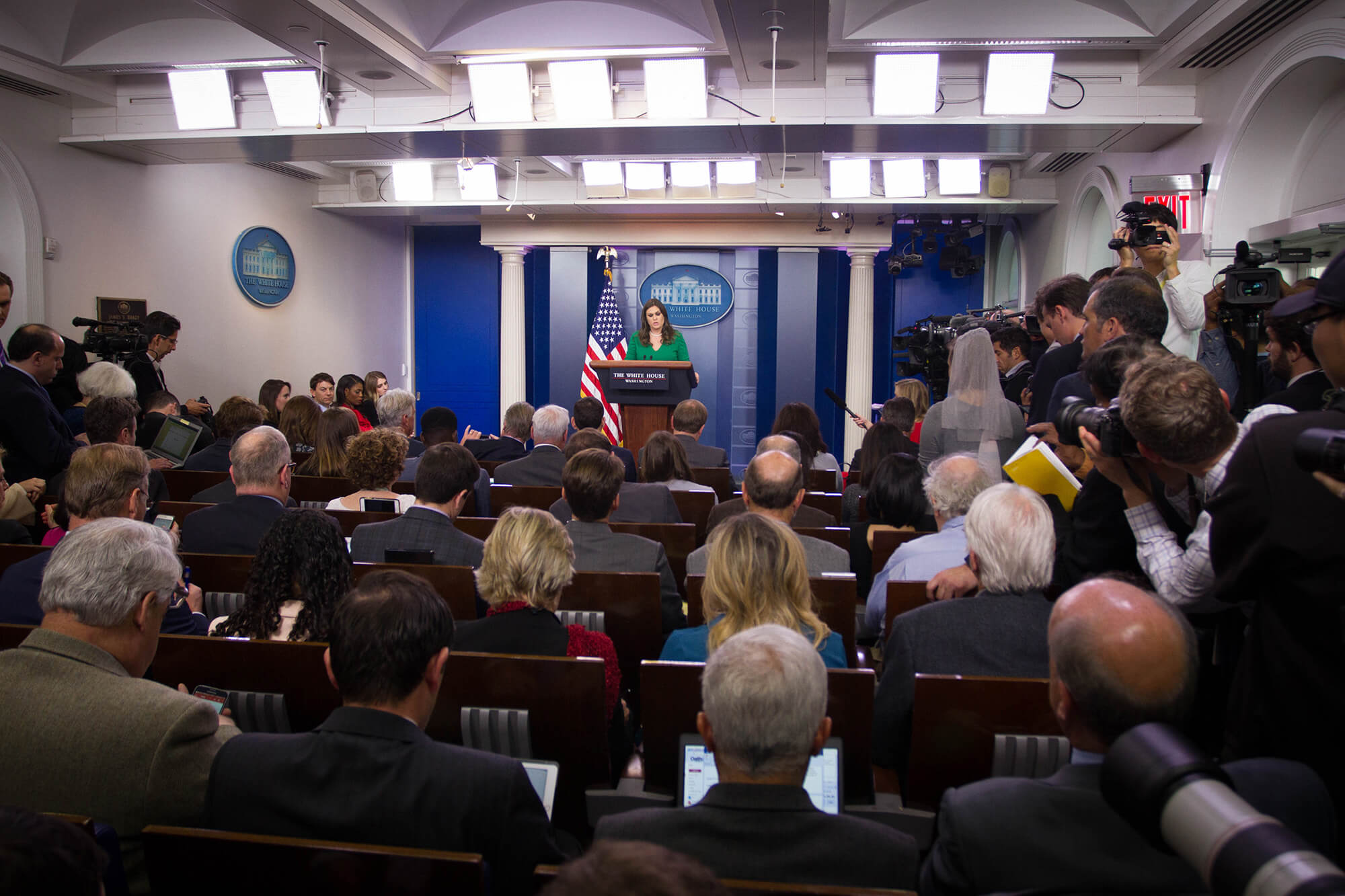
Photo: White House press secretary Sarah Huckabee Sanders takes questions from reporters at the White House, Friday, October 27, 2017. Editorial credit: Michael Candelori / Shutterstock.com