NUR-SULTAN, Kazakhstan — Want a world-class legal system known for its integrity? Then go to London and get one, judges and all. That’s what Kazakhstan has done.
When businesses are looking to invest abroad, the availability and dependability of legal redress is a critical consideration. Should things go wrong, companies and hedge funds want to know that they can resolve matters in court, and that their cases will be heard in an impartial and timely fashion.
Kazakhstan, the vast country that straddles the boundary between Asia and Europe, decided it would put its commercial legal system above reproach. In 2015, it imported a whole legal system from England, along with English common law, to deal with commercial issues. It also imported some English judges to sit on the bench.
Presiding over this remarkable court system is Lord Woolf, one of England’s most revered justices and, before that, one of its most eminent barristers.
Kairat Kelimbetov, governor of the Astana International Finance Centre (AIFC), described this to me as a move to establish the “rule of law.” He said it was decisive in improving the investment climate. It’s also symptomatic of a desire here to “do what it takes” to move Kazakhstan to the first row of nations — in this case, to import a legal system complete with eminent jurists.
This sets Kazakhstan, a country still growing out of its years as a Soviet republic, apart from other emerging countries that seek the indigenous over the imported. In Africa, the desire to indigenize has often cost countries heavily.
This philosophy of going out and bringing in what you prize to Kazakhstan, like so much else in the country, reflects the vision of Nursultan Nazarbayev, who upon the Soviet Union’s dissolution in 1991, was elected president of the new country of Kazakhstan, which he led until his resignation this March.
Nazarbayev built this secular, economically thrusting and technologically ambitious country with an authoritative hand, but with a view to adopting and adapting. He was helped by plentiful oil revenues — Kazakhstan produces 1.9 million barrels a day.
The Kazakh managerial class reflects a diversity of elite education from Oxford to Cambridge, Harvard to Stanford, to Moscow, Singapore and Beijing universities. President Kassym-Jomart Tokayev, the constitutional successor to Nazarbayev, has heavy ties to China, and AIFC’s Kelimbetov was educated at Moscow State University and Georgetown University. The effects of that educational spread have informed policymaking and the country’s can-do culture.
Kazakhs go to the polls on June 9, in a presidential election widely expected to endorse the policies of Nazarbayev and to elect Tokayev, a former prime minister and close political ally of Nazarbayev.
In an interview, Tokayev told me that he’d have an increased emphasis on the environment, especially the Caspian Sea, the world’s largest inland waterway, which has been detrimentally affected by oil drilling, and he’d create an environment ministry.
Although Tokayev is expected to get a huge majority at the polls, he’s facing opposition from six rivals, ranging from a communist to a woman who wants to speak for small business. In fact, gender equality is, to an observer, remarkably well-achieved in Kazakhstan, at least in the capital.
Kazakhstan is challenged by its sheer size and its location. It’s larger than Western Europe, but its population is just 18 million. It’s the world’s 9th-largest country by land mass, and it’s land-locked. It has five contiguous and, at times, contentious neighbors: China, Russia, Kyrgyzstan, Uzbekistan and Turkmenistan. Governing Kazakhstan requires diplomatic agility.
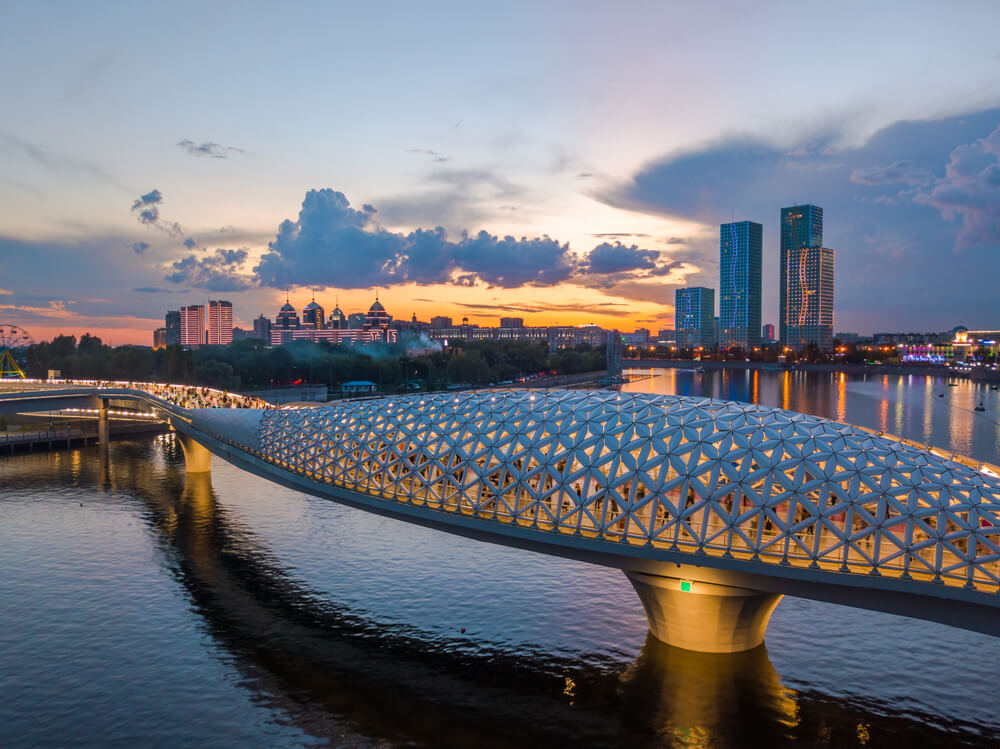
Although oil has financed the growth and the building of this architecturally creative new capital, Tokayev told me he’s going to push energy diversification. Already, the electric sector has embraced solar and wind — a great resource in the country — and is increasing its exports to neighbors.
In short, Tokayev wants future development to embrace the unique size and resources of the country. So, he hopes to make it a transportation hub, an agricultural powerhouse and a technology leader. He also wants Kazakhstan, which, he told me, already accounts for 60 percent of the Central Asian GDP, to be an international financial center.
The country’s premier institution of higher learning, Nazarbayev University, emphasizes STEM, its president, Shigeo Katsu, told me. At the university, too, there’s diverse expertise: the faculty includes 50 nationalities and instruction is in English.
 Follow
Leave a Reply